
Why Funeral Markups Exist, Explained for San Diego Families

Funeral markups exist because providers must recover fixed overhead from a small number of cases; merchandise like caskets carries far higher margins than services do; and grief and time pressure make families less likely to compare prices. Those three forces, cost recovery, merchandise economics, and buyer psychology, sit inside a legal framework built specifically to limit how far markups can go without disclosure.
The FTC’s Funeral Rule requires every funeral home to hand you a General Price List (GPL) itemizing 16 separate goods and services, and it lets you buy a casket or urn from anywhere you want. That right exists because Congress and regulators recognized decades ago that bundled, undisclosed pricing let providers hide steep markups inside a single “package” price. Here’s what typically drives the numbers up, and what you can do about it before you sign anything.
- Regulatory anchor: The FTC Funeral Rule mandates a GPL with 16 required line items, and firms that violate it can face civil penalties up to $53,088 per occurrence.
- Cost anchor: Industry reporting puts the median funeral with viewing and burial around $8,300, and a cremation-based service around $6,280, once merchandise and facility fees are added in, according to LegalClarity.
- Behavioral anchor: Families under acute grief and time pressure rarely comparison shop the way they would for a car or a mortgage, which is exactly the moment pricing structure matters most.
Pro Tip: Ask for the GPL before you look at a single casket. It’s your legal right, and it resets the whole conversation to line-item pricing instead of a package quote.
Key Takeaways
Funeral markups exist because fixed overhead, merchandise economics, and grief-driven buying behavior combine inside a regulatory system that limits, but doesn’t eliminate, how those costs get passed to families.
| Point | Details |
|---|---|
| Get the GPL first | Federal law entitles you to a written General Price List itemizing 16 goods and services before you commit to anything. |
| Separate cash advances | Ask which items are pass-through vendor costs and whether the provider adds a disclosed fee to any of them. |
| Buy merchandise elsewhere | You can legally purchase a casket or urn from a third party, and providers cannot charge a fee for accepting it. |
| Pre-plan to avoid pressure | Locking in choices before a crisis removes the time pressure that sustains higher-margin decisions. |
| Bravo Family Mortuary offers full transparency | All-inclusive, itemized pricing, online arrangements through PartingPros, bilingual support, and no-cost VA paperwork coordination for San Diego County families. |
Table of Contents
- How Funeral Home Pricing Is Structured
- Where Markups Commonly Appear
- What Are Cash Advance Items, and Why Do They Vary So Much?
- What Rights Does the FTC Funeral Rule Actually Give You?
- Why Do Economic Pressures Push Prices Up?
- How Do Grief and Sales Pressure Sustain High Markups?
- Typical Markup Ranges and What They Mean for Your Budget
- What Can You Do to Avoid Overpaying?
- What Does Transparent Funeral Pricing Actually Look Like?
- A Funeral Director’s Perspective on Honest Pricing
- A Family-Owned Alternative to Hidden Funeral Pricing in San Diego
- Frequently Asked Questions
- Sources
How Funeral Home Pricing Is Structured
Every funeral home bill breaks down into three layers: a basic services fee, itemized goods and services, and cash advance items paid to outside vendors. Understanding that structure is the fastest way to see exactly where a markup is sitting.
The General Price List is the legal backbone of that structure. Federal rules require it to itemize 16 specific categories, from basic services and embalming to caskets, outer burial containers, and transportation, so you can see what each piece actually costs rather than accepting one lump sum. Firms also have to provide a separate casket price list and outer burial container price list, and they must give you price information over the phone if you ask, before you ever walk in the door.
The basic services fee is the one line every provider charges no matter what you choose, and it’s non-declinable by law. It covers things you can’t opt out of: staff time for arrangements, permits, coordination with the cemetery or crematory, and a share of the building’s overhead. Because it applies to every family regardless of casket choice, providers often allocate a meaningful chunk of fixed costs into that fee, then recover the rest through merchandise margins.
Older funeral homes priced everything as a single “package,” a habit that goes back further than most families realize. Industry consultant Dan Isard, whose firm The Foresight Companies has tracked funeral pricing for decades, argues that the industry’s current markup structure traces directly to the FTC’s 1985 shift from bundled packages to mandatory itemization. Owners had to guess how to reallocate costs across new line items, and many of those original guesses simply compounded year after year, hardening into today’s pricing patterns.
- Ask specifically for a written GPL, not a verbal summary.
- Request the casket and outer burial container price lists separately if you’re considering either.
- Confirm whether quoted prices are per item or bundled into a “traditional package.”
Where Markups Commonly Appear
Caskets remain the single largest markup opportunity in the industry, and it isn’t close. A casket that costs a manufacturer a few hundred dollars to produce can retail for several thousand at a funeral home, a legacy of the bundled-package era when caskets were never priced separately and margins simply got built in. Outer burial containers, required by most cemeteries though not by law, follow a similar pattern.
Lower-cost items carry surprisingly high margins too. Urns, keepsake jewelry, memorial folders, and guest books often cost a provider very little but get marked up substantially because families rarely question small-ticket items the way they’d question a casket price.
Service-related charges add another layer. Embalming isn’t legally required for most arrangements, but some providers make it a de facto requirement for any viewing, which pushes families toward a service they might not otherwise need. Facility rental for a viewing or chapel service, plus a rental casket for a cremation viewing, each carry their own line item and their own margin.
| Category | Typical Markup Driver | Why It Persists |
|---|---|---|
| Caskets | Wholesale-to-retail markup, historically high | Legacy of bundled-package pricing; low consumer price knowledge |
| Outer burial containers | Cemetery requirement plus provider margin | Rarely comparison-shopped; presented as mandatory |
| Urns and keepsakes | High margin on low base cost | Small dollar amounts feel less worth negotiating |
| Embalming and viewing | Facility and labor allocation | Often framed as necessary for viewing |
| Bundled packages | Combined pricing obscures per-item cost | Makes side-by-side comparison harder |
Packaged pricing that lumps viewing, funeral, and burial into one number can look simpler, but it makes it nearly impossible to see which piece is driving the total. If you want a clearer sense of how these line items typically stack up locally, our funeral costs price breakdown walks through a real example.
What Are Cash Advance Items, and Why Do They Vary So Much?
Cash advance items are goods and services a funeral home pays to an outside vendor on your behalf, then bills to you, things like flowers, obituary notices, clergy honoraria, pallbearer fees, and death certificates. Some providers pass these through at exact cost. Others add a service fee for handling the coordination.
The FTC requires providers to disclose in writing if they mark up a cash advance item, though they are not required to disclose how much that markup is. That’s a meaningful gap: you’ll know a fee exists, but not always its size, which is exactly why it pays to ask directly rather than assume the invoice tells the whole story.
Cash advance totals vary widely between providers because they use different vendors and different cemetery or crematory partners, and each of those relationships carries its own cost structure. A funeral home that orders a dozen death certificates a week from the county recorder pays differently than one that orders them occasionally. According to Funeral, separating cash advance charges from the provider’s own service fees is the single most reliable way to compare two quotes apples to apples.
- Death certificates: county fees vary, and some providers add a per-copy handling charge.
- Obituary placement: newspaper and website rates differ by outlet and length.
- Clergy honoraria: typically passed through at the amount the officiant requests.
- Flowers: markup practices vary the most here, since florists’ base prices already differ widely.
A $200 difference in disclosed cash advance fees between two providers, multiplied across five or six line items, can quietly add over $1,000 to a total bill without a single merchandise price ever changing.
What Rights Does the FTC Funeral Rule Actually Give You?
The Funeral Rule gives you three core protections: the right to an itemized GPL, the right to buy caskets or urns elsewhere, and the right to know if a provider marks up cash advance items. Every funeral home operating in the United States has to comply, regardless of size or ownership structure.
You have the legal right to receive a GPL any time you discuss arrangements or prices in person, and providers must give you price information by phone if you ask, without requiring an in-person visit first, per the FTC’s consumer guidance. You can buy a casket from a third-party retailer or online, and the funeral home cannot charge you a handling fee for using it or refuse the service because you brought your own.
Enforcement carries real teeth. Violations of the Funeral Rule can trigger civil penalties up to $53,088 per occurrence, and the FTC periodically runs compliance sweeps testing whether funeral homes actually hand over price lists when asked. If a provider refuses to give you a written GPL or won’t quote prices by phone, that’s worth documenting and reporting.
- Ask calmly: “Can you send me your General Price List before I come in?”
- Ask directly: “Do you add a fee to any cash advance items, and which ones?”
- Ask plainly: “If I buy a casket elsewhere, will there be any additional charge?”
Pro Tip: Keep these three questions in your phone. Reading them off a screen, calmly, gets you the same disclosures a lawyer would ask for, without any confrontation.
Why Do Economic Pressures Push Prices Up?
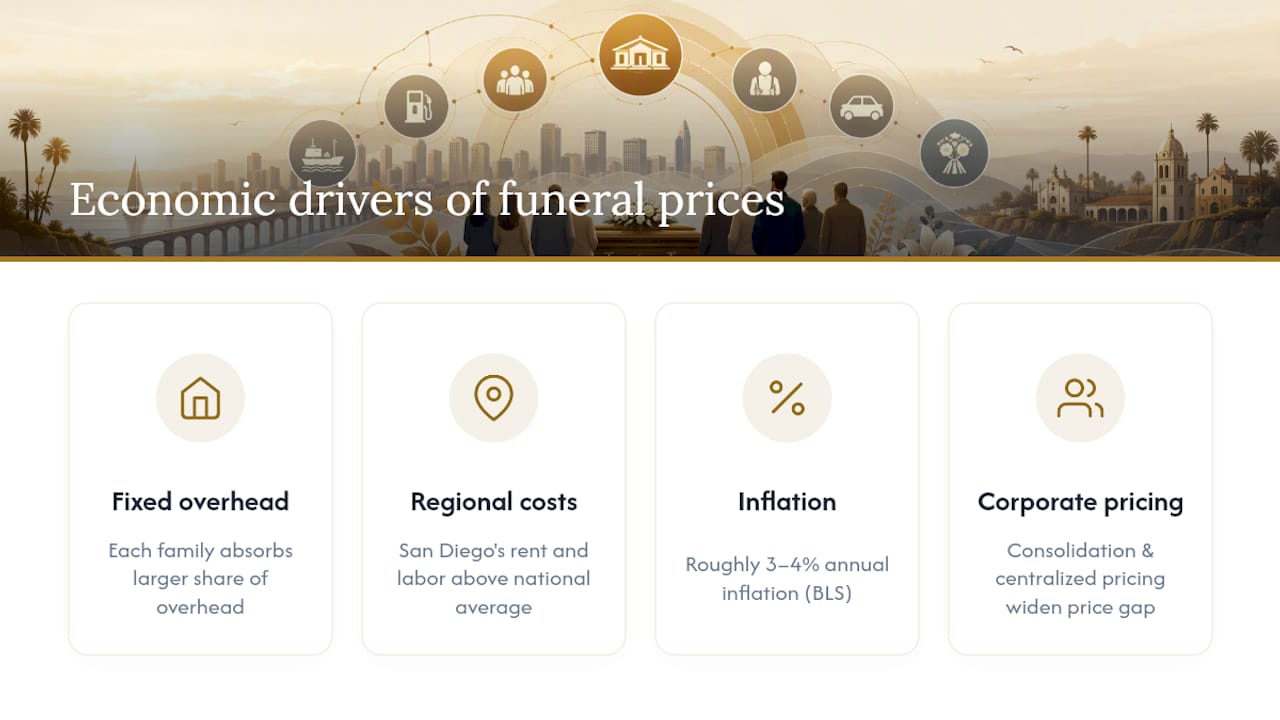
Funeral homes carry fixed costs that don’t shrink just because fewer families walk through the door in a given month. Property, round-the-clock staffing, embalming licenses, vehicle fleets, and liability insurance all run whether a home serves three families or thirty that week, and low case volume means each family absorbs a larger share of that overhead.
Regional cost differences widen the gap further. A funeral home in a high-rent, high-labor-cost urban market carries a fundamentally different cost base than one in a rural county, and that difference shows up directly in the basic services fee and facility charges. San Diego’s real estate and labor costs sit well above the national average, which is one honest reason local pricing tends to run higher than in smaller inland markets.
Inflation compounds the pressure. Funeral services have historically run roughly 3 to 4 percent annual inflation, tracked by the Bureau of Labor Statistics alongside broader consumer prices, and that steady creep affects everything from casket manufacturing costs to cemetery labor.
Corporate ownership adds another layer entirely. Investigative reporting from The American Prospect has documented how consolidation and centralized pricing at large funeral corporations can widen the gap between what a family pays and what the same service would cost at an independent home. Centralized pricing models are built for consistency across hundreds of locations, not for reflecting what any single neighborhood can reasonably afford.
How Do Grief and Sales Pressure Sustain High Markups?
Grief changes how people make decisions, and funeral providers know it. When you’re arranging services within days of a loss, exhausted and emotionally raw, comparison shopping across three funeral homes simply isn’t realistic, and that reduced capacity for research is precisely the window where higher-margin choices get accepted without much resistance.
Presentation matters more than most families expect. The order caskets are shown in, the language used to describe options (“our most popular choice” versus “our lowest-priced option”), and which model sits front and center in the display room all nudge decisions toward higher price points. Regulators and consumer researchers have long observed that bereaved buyers behave as unusually price-insensitive shoppers, which is exactly the condition that allows persistent price differences to survive even within a single city, without any family ever noticing they paid more than the family down the street.
Small framing shifts can move large sums of money. A staff member who simply says “many families choose this one” is steering a decision that might otherwise have gone toward a $2,000 cheaper option, without technically pressuring anyone.
Pro Tip: If a recommendation feels automatic, ask: “Can I see your full price list, including your lowest-cost options?” That single question resets the conversation to your terms, not the display room’s.
Typical Markup Ranges and What They Mean for Your Budget
Caskets typically show the widest gap between wholesale cost and what families pay at retail, though exact figures vary enough by manufacturer and market that any single percentage should be treated as an approximation rather than a rule. Outer burial containers and urns tend to follow similar patterns on a smaller dollar scale.
The shift toward cremation over the past two decades changed how providers recover revenue. As fewer families chose full-service burial with an owned casket, some providers responded by renting caskets for viewings, expanding memorial product lines like jewelry and keepsakes, and adding optional upgrades to standard cremation packages, all ways of preserving revenue per case even as the traditional casket sale declined.
| Line Item | What Drives the Price Gap | Practical Implication |
|---|---|---|
| Casket (full burial) | Manufacturing cost vs. retail display markup | Largest single savings opportunity if bought outside the funeral home |
| Outer burial container | Cemetery-required, minimal price shopping | Ask if a basic concrete option meets cemetery rules |
| Rental casket (cremation viewing) | Reused item, priced as a standalone service | Compare against a simple viewing without rental |
| Cash advance total | Vendor variation plus optional handling fees | Request itemized cash advance list separately |
Median totals reported by LegalClarity, around $8,300 for a burial with viewing and $6,280 for a cremation-based service, reflect the combined effect of these layered fees rather than any single markup. Knowing which layer is which is what lets you actually negotiate.
What Can You Do to Avoid Overpaying?
Protecting yourself starts with three simple requests: the GPL, a separate cash advance breakdown, and a written itemized statement before you pay anything. Every one of those is a right the FTC already guarantees you, not a favor a provider is doing you.
- Request the GPL first, before viewing any caskets or discussing arrangements in detail.
- Ask for cash advance items to be broken out separately, so you can see exactly what’s pass-through cost versus provider fee.
- Get a written, itemized final statement before paying, and read every line before signing.
- Call at least one other provider for comparison, even if you’re leaning toward a specific funeral home already.
- Confirm the provider will accept a casket or urn bought elsewhere, and ask in writing that no handling fee applies.
If you’re comparing more than one option, our guide on how to compare funeral home prices walks through the specific questions worth asking two providers side by side, and questions to ask a funeral home online gives you exact scripts for phone or email.
- On the phone: “Can you email me your General Price List before we meet?”
- In person: “Which of these items are cash advances, and do you add any fee to them?”
- Before signing: “Can I get this total broken down by line item in writing?”
Pro Tip: Pre-planning removes the time pressure entirely. When you lock in choices before a crisis, you’re negotiating from a position of calm instead of grief, which is when families almost always get the best terms.
What Does Transparent Funeral Pricing Actually Look Like?
A truly transparent invoice separates every charge into a category you can independently verify, no vague “package total,” no unexplained line items. A basic services fee, clearly labeled. A casket line, priced on its own with a comparable lower-cost option shown alongside it. Cash advance items listed individually, each marked with whether a service fee applies.
When a family can look at their invoice and immediately point to what each dollar bought, without needing to ask a follow-up question about what’s hidden inside a bundled number, that’s the standard the FTC Funeral Rule was written to guarantee. It’s not a courtesy. It’s the baseline every provider is legally required to meet.
This kind of itemized clarity is exactly what the GPL requirement was designed to produce, and it’s worth using as your own template. When you request your own price list, expect to see the basic services fee separated from merchandise, cash advances broken out individually with disclosed fee policies, and clear notation of which items you can source elsewhere. Our own transparent pricing page follows that same structure, and it’s a useful reference point when you’re evaluating whether another provider’s price list is actually complete.
A Funeral Director’s Perspective on Honest Pricing
Grief already asks enough of a family without adding a maze of unexplained charges on top of it. Pricing that hides behind bundled packages or vague line items doesn’t just cost families money, it costs them trust at the exact moment they need to trust the people helping them the most. Honest, itemized pricing isn’t a marketing angle. It’s simply what families deserve when they’re making decisions they’ve never had to make before.
Bravo Family Mortuary built its arrangement process around that idea from the start. Families can complete arrangements entirely online through our secure PartingPros portal, at 2 a.m. or 2 p.m., without ever feeling pushed toward a display room. We serve Spanish-speaking families across San Diego County with the same care and clarity we offer everyone else, and we coordinate VA burial benefits paperwork for veteran families at no additional charge, because that support shouldn’t come with a price tag attached to grief. If you have questions about any part of your arrangements, ask them. We are here whenever you are ready.
A Family-Owned Alternative to Hidden Funeral Pricing in San Diego
If everything above has you wondering whether your local options actually practice what the FTC requires, that’s a fair question, and it’s the exact gap Bravo Family Mortuary was built to close. As an independent, family-owned funeral home serving all of San Diego County, we answer to the families we serve, not to corporate shareholders setting centralized pricing across hundreds of locations.

Every service we offer, from direct cremation to traditional and green burial to celebration of life services, comes with all-inclusive, transparent pricing you can review before you ever pick up the phone. Our pre-planning options let you lock in pricing now, on your own timeline, so no future decision gets made under pressure. We hold a 5-star rating built on 47-plus Yelp reviews from San Diego families, we serve Spanish-speaking families with full bilingual support, and we handle VA paperwork for veteran families at no extra cost. Review our full range of services online anytime, day or night, and start arrangements whenever you’re ready. We are here whenever you are ready.
Frequently Asked Questions
Why are funeral markups legal if they seem so high? Markups themselves aren’t illegal. Federal law regulates disclosure, requiring itemized price lists and cash advance transparency, rather than capping what a provider can charge for merchandise.
What is the FTC Funeral Rule, exactly? It’s a federal regulation requiring every funeral home to provide a General Price List, itemize at least 16 goods and services, disclose cash advance fee markups, and allow families to buy caskets or urns from outside vendors without penalty.
Can I really buy a casket somewhere else and bring it to the funeral home? Yes. Funeral homes cannot refuse to use a casket you bought elsewhere, and they cannot charge you a handling fee for doing so, under FTC rules.
Why does cremation cost less but still have markups? Cremation eliminates the largest merchandise cost, a burial casket, but providers still charge a basic services fee, cremation fee, and often offer optional upgrades like memorial services, urns, or rental caskets for viewings.
How do I know if a funeral home is pricing me fairly? Request the GPL, ask directly whether cash advance items carry added fees, and compare the itemized total against at least one other provider before signing anything.
This article is general information, not a substitute for advice from a qualified financial advisor. Consult a qualified financial professional about your own circumstances before acting on anything here.
Sources
The FTC’s Funeral Rule enforcement page explains your legal rights and how the agency penalizes noncompliance. The FTC’s funeral costs and pricing checklist walks through cash advances and itemized statement rights in plain language. The Bureau of Labor Statistics’ CPI page tracks the inflation data behind rising service costs nationwide. Industry-consulting research from The Foresight Companies offers historical context on how modern pricing structures took shape after 1985.
- Consumer Price Index — BLS
- The Foresight Companies
- How Do Funeral Homes Make Money: Fees, Caskets, and More — LegalClarity
- Big Funeral Exploits Consumers Under Guise of Inflation — The American Prospect