
What a Funeral Home Contract Should Include

A funeral home contract is a legally binding document that specifies every service, product, and third-party cost involved in funeral arrangements. Most families encounter this paperwork during one of the hardest moments of their lives, which makes understanding the key components of funeral agreements more important than most people realize. Federal law, specifically the FTC Funeral Rule under 16 CFR § 453, gives you clear rights before you sign anything. Knowing what a funeral home contract should include protects your family from unexpected charges and helps you make decisions with confidence, not pressure.
What does a funeral home contract need to include?
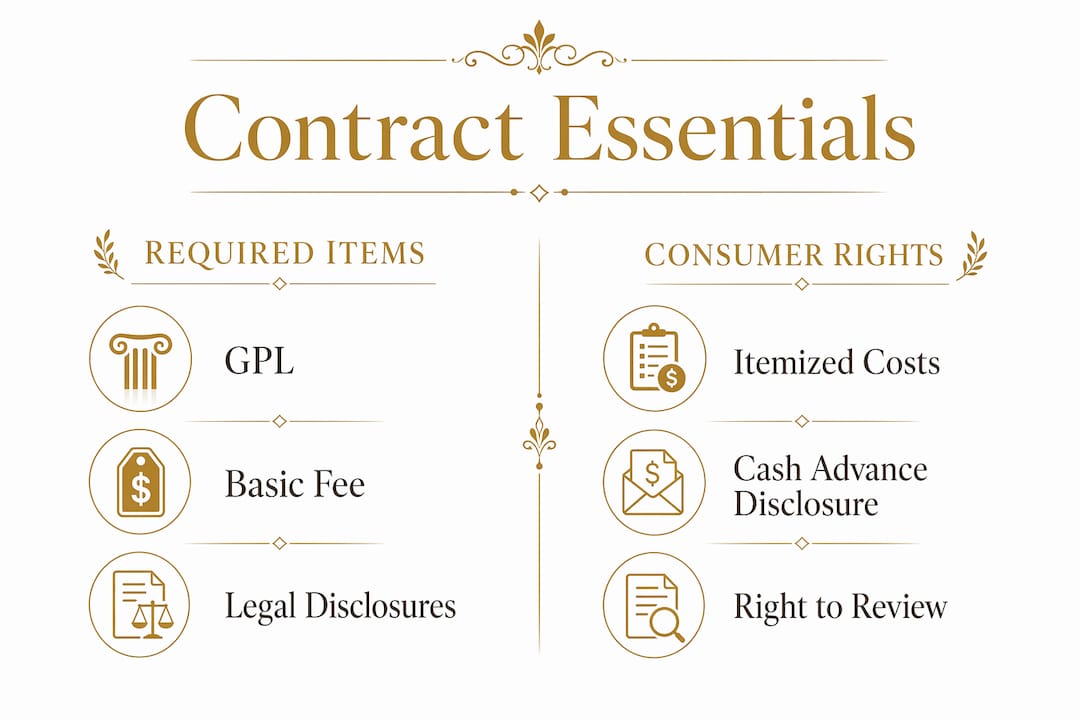
A funeral home contract must begin with a General Price List, or GPL. All U.S. funeral homes must provide a GPL at the start of any price discussion, whether in person or by phone. This is not optional. The GPL is the foundation of every funeral agreement, and it must list individual prices for every service and product the funeral home offers.
The contract then separates all charges into three distinct categories:
- Services: Professional staff time, use of facilities, transportation, and coordination
- Merchandise: Caskets, urns, outer burial containers, and memorial products
- Cash Advance Items: Third-party costs paid on your behalf, such as death certificates, cemetery fees, and clergy honorariums
The only charge you cannot decline is the Basic Services Fee. This fee covers the funeral home’s overhead, professional staff, and administrative work. Every other line item on the contract is optional and can be removed.
Legal disclosures are also a required part of any valid funeral agreement. The GPL must state that embalming is not required by federal law except in specific circumstances. Funeral homes cannot pressure you into embalming without your informed consent. The contract must also disclose your right to purchase an alternative container instead of a casket for cremation.

Pro Tip: Ask for the GPL before your arrangement meeting begins. You have the legal right to receive it immediately, without an appointment or identification.
How does the Statement of Funeral Goods and Services Selected work?
The Statement of Funeral Goods and Services Selected is the final, binding contract you sign at the end of your arrangement meeting. It summarizes every choice you made and shows the total cost. Think of the GPL as the menu and the Statement as your final bill before the meal is served.
Reviewing this document carefully is one of the most protective steps you can take. Here is how to approach it:
- Compare line by line. Place the Statement next to the GPL and verify that every price matches. Discrepancies do happen, and catching them before you sign is far easier than disputing charges afterward.
- Bring a trusted person. Bringing a trusted companion to your arrangement meeting reduces errors made under emotional distress. A friend or family member who is slightly removed from the immediate grief can catch details you might miss.
- Ask about unperformed services. If you are reviewing the contract before services have taken place, you have the right to remove or modify items that have not yet been performed.
- Request written confirmation of any changes. Verbal agreements do not protect you. Any modification to the contract should appear in writing before you sign.
The Statement is a binding legal contract, so treat it with the same care you would give any major financial document. Do not feel rushed. A reputable funeral home will give you the time you need.
Pro Tip: If you feel overwhelmed during the meeting, ask to pause and take the Statement home for 24 hours before signing. Most funeral homes will accommodate this request.
What are cash advance items, and what are your rights?
Cash advance items are third-party costs that the funeral home pays on your behalf and then bills back to you. Common examples include:
- Death certificates (typically ordered in multiples)
- Cemetery or cremation authority fees
- Clergy or officiant honorariums
- Obituary publication fees
- Flowers ordered through outside vendors
- Permit fees required by local government
Any markups or rebates on cash advance items must be disclosed in writing. This is a federal requirement. If a funeral home charges you $25 for a death certificate but pays only $21, that $4 difference must appear in your contract documentation. Ask directly whether any cash advance items carry a handling fee.
One of the most misunderstood areas of funeral contracts involves merchandise. Consumers can purchase caskets or urns from outside retailers without penalty or additional fees from the funeral home. Funeral homes must accept third-party merchandise. They cannot charge you a handling fee for using a casket you purchased elsewhere. This right can represent significant savings, and families should know it exists before they sit down at the arrangement table.
Embalming is another area where misconceptions cause families to spend money they do not need to spend. Federal law does not require embalming in most situations. The funeral home must disclose this fact, and you must give written permission before embalming takes place.
Pre-need vs. at-need contracts: what changes?
A pre-need contract is signed in advance of death, often years or decades before services are needed. An at-need contract is signed at the time of death. Both must contain the same core components, but pre-need agreements carry additional considerations that families should understand clearly.
| Feature | Pre-need contract | At-need contract |
|---|---|---|
| Pricing | May be guaranteed or non-guaranteed | Reflects current pricing at time of need |
| Revocability | Can be revocable or irrevocable | Not applicable |
| Medicaid impact | Irrevocable contracts may qualify as exempt assets | No Medicaid planning consideration |
| Fund protection | Funds typically held in escrow or trust | Payment made at time of service |
| Flexibility | Items can often be modified before death | Modifications limited once services begin |
Pre-need contracts differentiate guaranteed and non-guaranteed services. Guaranteed items are locked at the price you pay today, regardless of what costs rise to in the future. Non-guaranteed items, such as cemetery fees or death certificates, may change in price. Understanding which items fall into which category helps your family anticipate actual costs when the time comes.
Revocability matters for Medicaid planning. An irrevocable pre-need contract means you cannot cancel or transfer the funds. That restriction can qualify the contract as an exempt asset under Medicaid rules, which is relevant for families managing long-term care costs. A revocable contract gives you more flexibility but does not carry the same Medicaid benefit. Pre-planning your funeral arrangements with a trusted provider helps you navigate these distinctions without pressure.
Funds paid into a pre-need contract are typically held in a state-regulated escrow account or funeral trust. Ask your funeral home to confirm how funds are managed and what happens to the money if the funeral home closes or changes ownership.
Key Takeaways
A valid funeral home contract must include the GPL, the Basic Services Fee, itemized cost categories, and legal disclosures about embalming and merchandise rights.
| Point | Details |
|---|---|
| GPL is required by law | Every funeral home must provide a General Price List before any price discussion begins. |
| Only one non-declinable fee | The Basic Services Fee is the only charge you cannot remove from a funeral contract. |
| Cash advance markups must be disclosed | Any markup on third-party items must appear in writing in your contract documentation. |
| Third-party merchandise is your right | You can purchase a casket or urn from any retailer, and the funeral home must accept it without penalty. |
| Pre-need contracts need extra review | Understand guaranteed vs. non-guaranteed items and revocability before signing any pre-need agreement. |
What I have learned from sitting across the arrangement table
After years of working alongside families during some of the most difficult hours of their lives, I have come to believe that the contract conversation is where trust is either built or broken. Most families arrive at the arrangement table exhausted and grieving. They are not in a position to scrutinize a legal document. That vulnerability is exactly why the contract must do the heavy lifting for them.
The families who feel most at peace after arrangements are the ones who asked the questions that felt uncomfortable. “What happens if I don’t want embalming?” “Can I bring my own urn?” “Is this price guaranteed?” These are not rude questions. They are the right ones. A funeral home that hesitates or deflects when you ask them is telling you something important.
I have also seen families regret not bringing someone with them. Grief narrows your focus. A trusted friend sitting beside you can read the room differently and catch a line item that does not match the GPL. That second set of eyes has saved families real money and real heartache.
Bravo Family Mortuary publishes its full pricing online because transparency should not require a meeting. Families deserve to see the numbers before they walk through the door. That is not a policy. It is a standard of care.
— Steve Olsher
Bravo Family Mortuary is here when you are ready
Bravo Family Mortuary serves San Diego County families with clear, all-inclusive pricing and no hidden fees. Every arrangement begins with a full General Price List, and the team walks you through each line item at whatever pace feels right for your family.
You can review cremation and funeral services online at any hour through the PartingPros portal, without an in-person visit or sales pressure. Bravo Family Mortuary is family-owned, bilingual in Spanish and English, and available 24 hours a day, 7 days a week. Whether you are making arrangements now or planning ahead, the team is here whenever you are ready.
FAQ
What must a funeral home give you before discussing prices?
The FTC Funeral Rule requires every funeral home to provide a General Price List at the start of any price discussion, in person or by phone, without requiring identification or an appointment.
Can a funeral home charge extra if you bring your own casket?
No. Federal rules prohibit funeral homes from charging handling fees for caskets or urns purchased from outside retailers. They must accept third-party merchandise without penalty.
Is embalming required by law?
Embalming is not required by federal law in most circumstances. The funeral home must disclose this fact in the GPL and obtain your written permission before proceeding.
What is the difference between a guaranteed and non-guaranteed pre-need item?
Guaranteed items are locked at the price you pay today. Non-guaranteed items, such as cemetery fees, may increase in cost by the time services are needed.
What is the Statement of Funeral Goods and Services Selected?
The Statement of Funeral Goods and Services Selected is the binding contract you sign after making your arrangements. It itemizes every selected service and product and shows the total cost, and it should be compared line by line against the GPL before signing.