Get Veteran Funeral Honors in San Diego With VA Help in 48–72 Hours
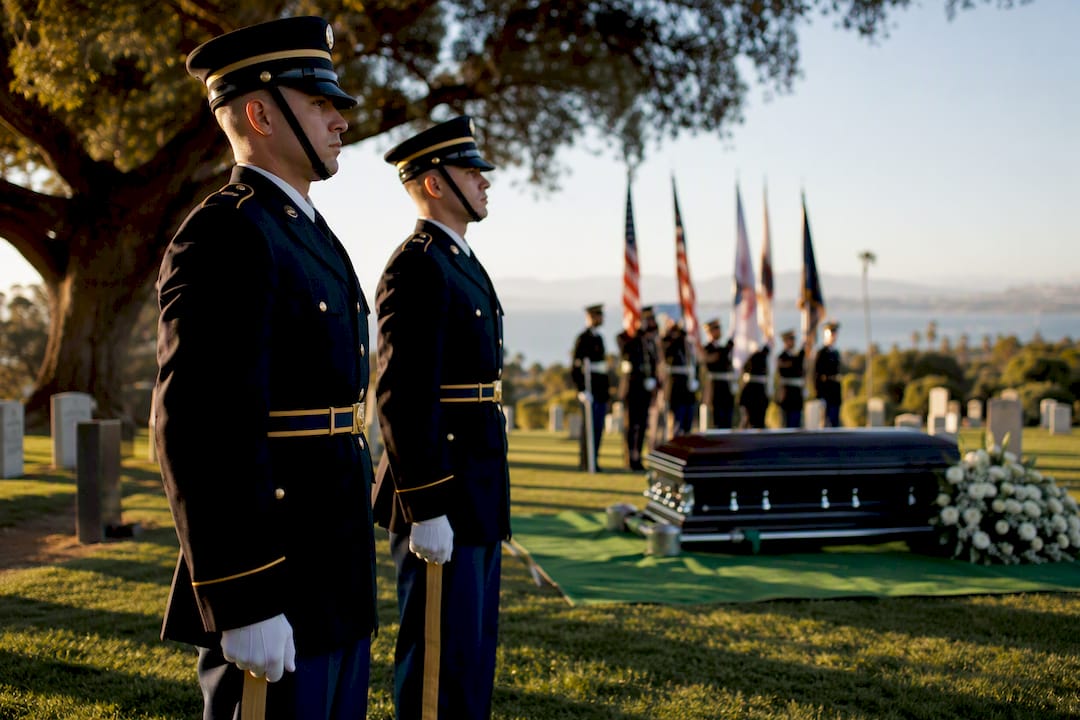
Eligible U.S. veterans are entitled by federal law to military funeral honors, and this right does not depend on rank, wealth, or how the family asks. At minimum, the ceremony includes a two-person uniformed detail, the playing of Taps, and the folding and presentation of a U.S. flag. Families almost always arrange this through their funeral director rather than contacting the military directly.
TL;DR:
- Veterans with dishonorable discharges or certain criminal convictions are ineligible for military honors, and final eligibility is determined by the service branch or state coordinator.
- Families should provide proof of service, such as a DD Form 214, at least 48 to 72 hours before the service to ensure coordination of honors details.
- The mandatory minimum honors include two uniformed service members, the playing of Taps, and flag folding and presentation, with optional additions like a rifle volley or flyover being uncertain or requiring separate approval.
- The VA only provides one burial flag per veteran at no cost, and families must file VA Form 27-2008 through a funeral director to obtain this and other memorial items.
- Common issues like missing records or unavailable honors details can usually be resolved by verifying service through the Social Security number or contacting the National Archives, and funeral homes often assist with coordination.
Table of Contents
- Who Is Eligible for Military Funeral Honors
- How to Request Military Funeral Honors: A Step-by-Step Checklist
- What Happens at the Ceremony
- The Burial Flag and Other VA Memorial Items
- Troubleshooting: Missing Records, Unavailable Units, and Denials
- How Bravo Family Mortuary Helps San Diego Veteran Families
- A Few Words From Steve Olsher
- Veteran Services Available Through Bravo Family Mortuary
- Sources
Who Is Eligible for Military Funeral Honors
Most veterans qualify. Public Law 106-65 guarantees honors for anyone who served on active duty and left with an honorable or general (under honorable conditions) discharge. Members of the Selected Reserve also qualify, along with certain commissioned officers from the NOAA Corps and the Public Health Service. Some civilians who served in active-duty-equivalent roles during specific historical periods may also be covered, though those determinations get made case by case.
A few circumstances remove eligibility:
- A dishonorable discharge or a discharge characterized as bad conduct from a general court-martial
- A final conviction for a capital crime, particularly one connected to acts of terrorism
- Any situation where the Secretary of the relevant military branch determines the veteran’s conduct would bring discredit to the honors program
The service branch or your state’s Military Funeral Honors coordinator makes the final call, not the funeral home and not the family. If there’s any doubt about a specific case, that’s the office equipped to answer it, and a funeral director, experienced with veteran services in San Diego, will already know who to ask.
How to Request Military Funeral Honors: A Step-by-Step Checklist
Requesting honors is straightforward once you know the order of operations. Here’s how it typically goes:
- Locate the DD Form 214. This discharge document is the standard proof of service. If the family can’t find it, service records or a National Archives verification letter can substitute.
- Hand it to your funeral director. They contact the local Military Funeral Honors coordinator directly or check the Military Funeral Honors Directory to identify which branch or unit will send a detail.
- Give as much lead time as possible. USAGov and VA guidance both recommend 48 to 72 hours’ notice when the schedule allows it, along with a confirmed time and location for the service.
- Let the funeral director handle follow-up. If a unit is slow to confirm or unavailable, your funeral director can escalate to VA cemetery staff or try a neighboring branch’s honors detail.
Pro Tip: Ask your funeral director this one question early: “Have you coordinated military honors before?” A director who has done it dozens of times will already have direct phone numbers for local coordinators, which shaves real time off the process when a service is happening in just a few days.
What Happens at the Ceremony
The legally required minimum is simple: two uniformed service members who are not retired, the playing of Taps live or by a high-quality recording, and the ceremonial folding and presentation of the flag, as Title 10 U.S. Code §1491 spells out. At least one member of that detail generally comes from the veteran’s own branch.
Most core ceremonies typically last a short time, reflecting the solemnity and key elements of the honors, according to Military OneSource. Families sometimes assume a bugler is required, but a recorded rendition is fully accepted under Title 10 when a live bugler isn’t available.
Beyond the statutory minimum, some families request:
- A rifle volley or firing party
- A color guard
- A horse-drawn caisson for burial at a national cemetery
- A military flyover, which depends on aircraft availability and separate approval
Flyovers and larger augmentations aren’t guaranteed and shouldn’t be promised to a grieving family in advance. When the flag is presented, the service member typically kneels before the next of kin and says words to the effect of presenting the flag “on behalf of the President of the United States, and a grateful nation.” That single moment tends to matter more to families than any additional element, according to research on veteran burial benefits and honor. If you’re curious about the flag’s meaning and the folding tradition behind it, Ultimate Flags has a helpful overview of Veterans Day observances and flag protocol.
The Burial Flag and Other VA Memorial Items
The VA provides one burial flag per veteran at no cost, and that’s a hard limit. Only one flag is authorized per service member, confirmed through congressional research on military funeral honors.
To obtain the flag and other memorial items, families or funeral directors typically:
- File VA Form 27-2008 through the funeral home, a VA regional office, or a local post office
- Order a VA headstone or grave marker, which the funeral director can arrange even for existing private cemetery plots
- Request a Presidential Memorial Certificate, a signed document honoring the veteran’s service that arrives separately by mail
None of these carry a fee. If your family isn’t sure which benefits apply in California, our VA burial benefits guide breaks down what’s available locally.
Troubleshooting: Missing Records, Unavailable Units, and Denials
Problems come up more often than people expect, but nearly all of them have a fix:
- Missing DD214: Request a replacement through the National Archives, or have your funeral director verify service using the veteran’s Social Security number while the paperwork catches up.
- No honors detail available: If the assigned branch can’t send a detail in time, the funeral director can contact the state Military Funeral Honors coordinator or ask a different branch to step in.
- Eligibility denied: Denials are rare and narrow, usually tied to discharge status or a disqualifying conviction. Ask for the specific statutory reason in writing, then request a second review through the branch’s records office if something seems wrong.
Pro Tip: Never assume “no DD214, no honors.” A Social Security number and a phone call to NARA solve this more often than families expect, and it rarely delays the service by more than a day or two.
How Bravo Family Mortuary Helps San Diego Veteran Families
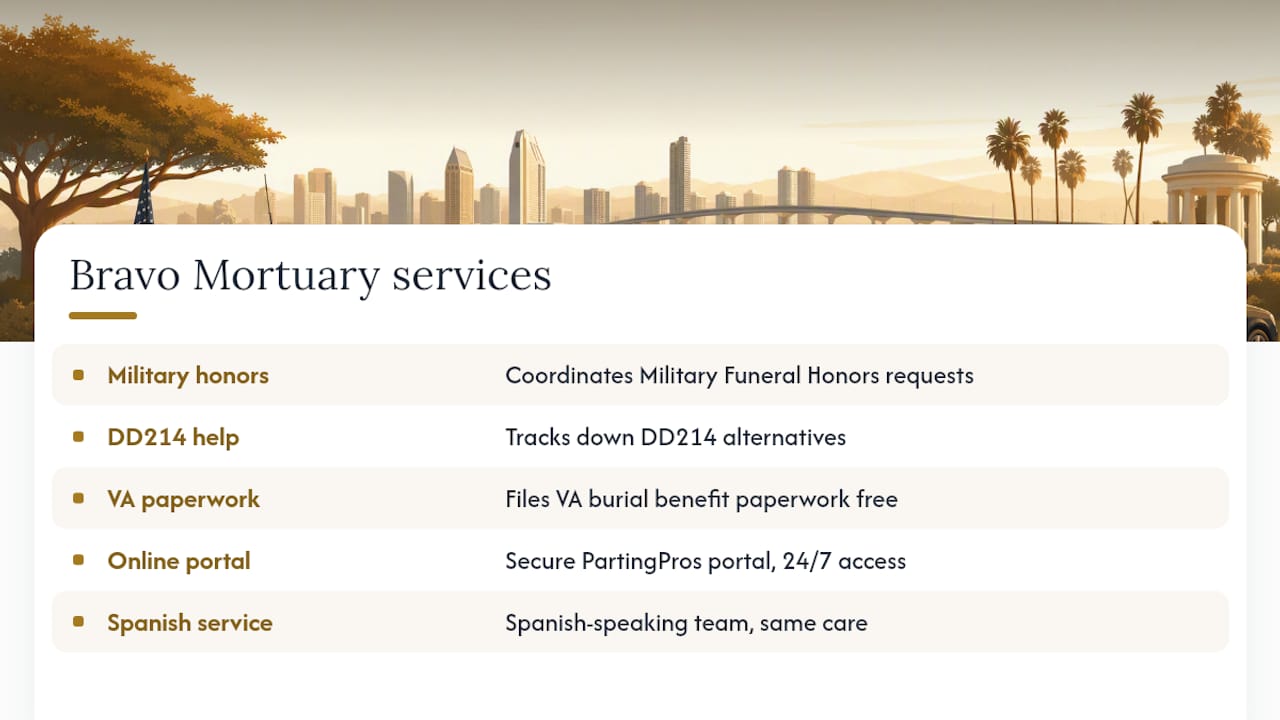
This part of the process shouldn’t fall entirely on a grieving family, and at Bravo Family Mortuary, it doesn’t have to. As a funeral home, we coordinate the Military Funeral Honors request, track down DD214 alternatives when needed, and file VA burial benefit paperwork at no additional charge.
Families who’d rather not make several separate calls in the middle of a hard week often prefer letting us manage that coordination directly. Everything can also be arranged online through our secure PartingPros portal, day or night, and our team serves Spanish-speaking families with the same care and attention in either language.
A Few Words From Steve Olsher
Grief makes even simple paperwork feel heavy. Here’s what actually matters: find the DD214 if you can, call your funeral director, and ask for honors as soon as possible. That’s it. The flag your family receives isn’t a formality. It represents a promise the country made and is legally bound to keep. You don’t have to manage this alone, and you don’t have to figure it out today. We are here whenever you are are ready.
— Steve Olsher
Veteran Services Available Through Bravo Family Mortuary
Bravo Family Mortuary is the alternative to funeral homes that bury veteran benefits paperwork in fine print or handle it as an afterthought. We coordinate Military Funeral Honors requests, VA burial flag applications, and headstone orders as a standard part of our veteran funeral services, not an upsell.
Every cost is listed upfront on our transparent pricing page, with no hidden fees added after the fact. Families can also start pre-planning arrangements now, so the honors request and paperwork are already in motion before they’re ever needed. If you’re ready to talk through options for a veteran in your family, whether that’s direct cremation, traditional burial, or a full military honors ceremony, reach out through our services page or call us any hour. We are here whenever you are are ready.
Sources
- Military Funeral Honors - National Cemetery Administration
- Military funeral honors | USAGov
- 10 U.S.C. §1491 — Funeral honors functions at funerals for veterans
- Military Funeral Honors for Veterans (CRS report)
- Frequently Asked Questions About Military Funeral Honors | Military OneSource