6 Steps for Tree Pod Burial in California: Legal Checklist & Costs
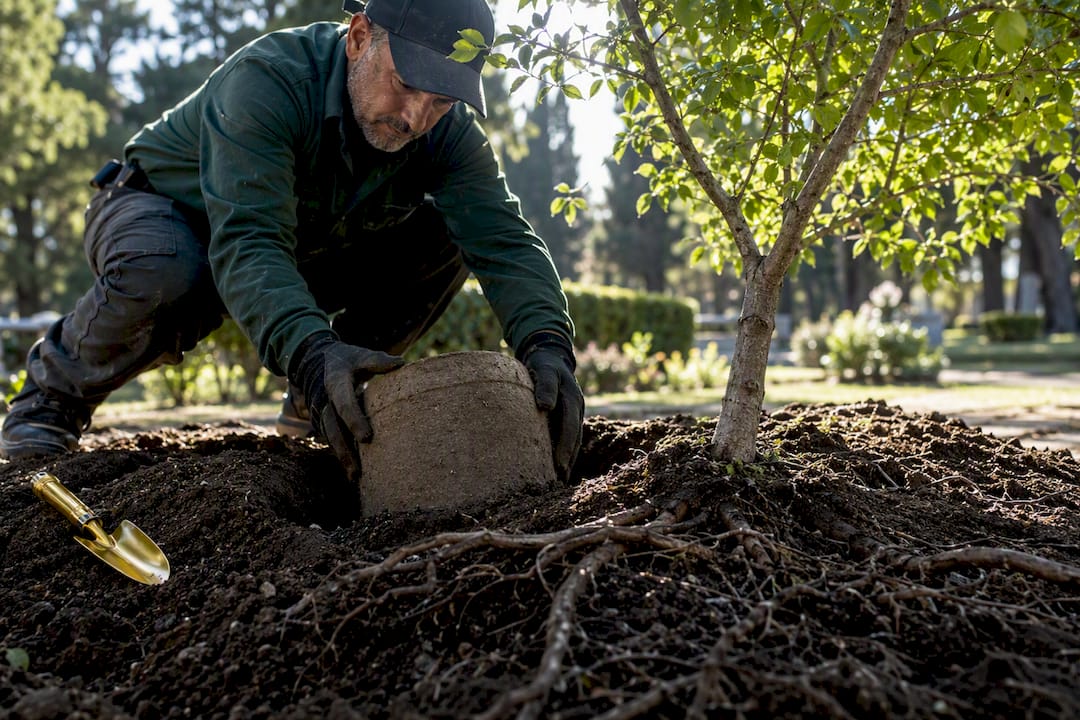
Yes, tree pod burial is available in California, but almost always in the form of a biodegradable urn holding cremated remains, planted beneath or beside a memorial tree at a certified green burial site. Whole-body pod burial, the version you may have seen in viral videos, is rarely offered anywhere and runs into real legal limits here. Cemetery rules and California’s permit requirements decide what’s possible, and both are manageable once you know the steps: get the right permit, pick a site that will honor the planting long term, and work with a funeral director who knows the process.
TL;DR:
- Fully burying a whole body in a pod outside a licensed cemetery is illegal in California, but planting cremated remains with a tree is permitted at authorized sites.
- The commonly offered tree pod burial involves a biodegradable urn with ashes and a tree, not a full-body capsule, which remains largely conceptual and unavailable locally.
- Costs for green burial options range from a few thousand dollars to over ten thousand, with charges varying by land, container, planting, permits, and funeral services.
- Families should verify site protection, record-keeping, permit requirements, and container policies in writing before committing to a cemetery or program.
- Bravo Family Mortuary manages paperwork and arrangements securely online, ensuring transparent costs and professional guidance in San Diego.
Table of Contents
- What “tree pod burial” actually means today
- Is tree pod burial legal in California?
- Where can you actually do this in California?
- What does a tree-pod memorial actually cost?
- How to arrange a tree-pod style burial: your step-by-step checklist
- How to choose a cemetery or provider for a tree-pod memorial
- Cautions worth knowing before you commit
- How Bravo Family Mortuary helps San Diego families plan this
- Where to verify the details yourself
- A practitioner’s perspective on why the pod language misleads people
- Sources
What “tree pod burial” actually means today
The phrase gets used loosely, and that’s where a lot of families get confused. When people search for “tree pod burial,” they’re usually picturing one of three very different things.
The most common, and the one that’s actually offered in California, is a biodegradable urn for cremated remains placed in the ground with a young tree planted above or beside it. The second is a memorial tree planting with no special container at all, where ashes are simply worked into the soil near the roots. The third, and the one that generates the most curiosity, is a whole-body pod, an egg-shaped capsule meant to hold an entire body in a fetal position, designed originally by the Italian project Capsula Mundi. That concept remains largely conceptual and isn’t a standard commercial offering in the United States, according to Funeral.
Container design matters more than most people expect. Cremated remains are highly alkaline, and raw ashes poured directly around a young tree’s roots can actually stunt or kill it. Practitioners recommend engineered biodegradable urns that break down slowly, buffering the pH so nutrients release gradually instead of shocking the soil, according to the background on tree pod burial design.
Here’s how the three variants actually differ in practice:
- Ashes-in-biodegradable-urn: The realistic, widely available option in California green burial grounds.
- Memorial tree planting: Sometimes done without a special urn, depending on cemetery policy.
- Whole-body pod: A design concept, not a standard offering families can currently purchase here.
If you’ve been picturing something more elaborate than an urn and a sapling, that’s normal. The idea captures the imagination. The practical version is simpler, and it’s still a genuinely meaningful way to leave something living behind.
Is tree pod burial legal in California?
Yes, in the form of cremated remains paired with a planted tree at an authorized cemetery. No, if what you’re picturing is burying a whole, unembalmed body in a pod anywhere outside a licensed cemetery, including your own backyard.
California’s Health & Safety Code generally requires that human remains be disposed of within an established cemetery, and depositing whole remains on private property is prohibited under Health & Safety Code 7054. Cremated remains have more flexibility. Families can keep or scatter ashes under specific permit conditions, but that’s a different legal category entirely from burying an intact body in the yard.
Every legal disposition, cremation or burial, requires a permit trail:
- A death certificate issued by the local registrar.
- A disposition permit stating exactly where the remains will end up, required under the state’s Health & Safety Code provisions.
- An interment authorization from the cemetery accepting the remains or the urn.
- An inter-county transfer permit, if the burial site sits outside the county where death occurred.
One detail worth knowing: natural organic reduction, sometimes called human composting, is not yet a licensed disposition method in California the way it is in a handful of other states. If that changes, it would open new pathways for tree-based memorials that go beyond cremated remains, but for now, ashes and cemetery-managed plantings remain the compliant route.
Skipping the permit sequence isn’t a paperwork inconvenience. It’s the difference between a legally protected memorial and one that could be challenged or even excavated later.
Where can you actually do this in California?
Three types of sites offer tree-planting or natural burial options, and each comes with different expectations around permanence and record keeping.
Green burial grounds operate specifically around natural, unembalmed disposition with minimal or no vaults, often within a dedicated conservation section of a larger cemetery. Conservation cemeteries go further, tying the burial ground to a protected piece of land, sometimes with a land trust involved, so the site can’t be developed later. Cemetery tree-burial programs are add-on offerings within a conventional cemetery, where a designated section allows tree planting alongside interment.
California has real examples of each. Fernwood Cemetery in Marin County operates a well-known conservation burial ground within a natural hillside setting. Tulocay Cemetery in Napa maintains a green burial section alongside its traditional grounds. Hollywood Forever, through its Ancestral Forest Project, has explored tree-planting memorials tied to interment. And Transcend promotes a tree-burial concept specifically built around planting trees over cremated remains, described on the Transcend Life-Giving Tree Burial site. These examples illustrate what’s out there. They aren’t the only options, and availability shifts, so confirm current policy directly with any site before assuming a program is active.
Before committing to any site, confirm these points in writing:
- Is the planting area protected by a conservation easement or land trust?
- How is each tree’s location mapped and recorded for future visits?
- What markers, if any, are permitted, and are they required?
- What are the visitation hours and access rules for family members?
- Is the cemetery Green Burial Council certified, or does it follow a comparable published standard?
What does a tree-pod memorial actually cost?
Costs vary by site, but families should expect a range rather than a single number. Some California green burial plots run from a few thousand dollars up to well over $10,000, depending on the cemetery, its land value, and the services bundled in, according to a guide to arranging green burial in California.
Several line items drive that range, and it helps to know which ones you can control:
- Plot or interment fee: Often the single largest cost, tied directly to the cemetery’s location and land.
- Burial container: A biodegradable urn typically costs far less than a casket, but quality and material vary.
- Tree and planting cost: Species, size at planting, and whether the cemetery handles the labor.
- Permits: Disposition permits and any inter-county transfer fees.
- Funeral director service fees: Coordination, paperwork, and cemetery liaison work.
One number worth remembering: the swing between a modest ashes-based tree memorial and a full natural burial plot at a premium conservation site can span thousands of dollars, which is exactly why an itemized quote matters before you sign anything.
When you request pricing, ask for every line item separately rather than a bundled total. A contract that lists “green burial package” with no breakdown makes it hard to know what you’re actually paying for, or to compare one provider against another.
How to arrange a tree-pod style burial: your step-by-step checklist
Arranging this kind of memorial follows a logical sequence, and skipping a step usually means backtracking later.
- Confirm the wishes. Decide whether the memorial will involve cremated remains (the realistic path) or whether you’re exploring a full-body natural burial instead, which is a separate and more limited category.
- Contact a funeral director. They’ll walk you through what’s legally required and coordinate with the cemetery directly.
- Secure the death certificate and disposition permit. The registrar issues both, and the permit must name the final disposition site.
- Confirm cemetery acceptance. Not every cemetery has a tree-planting program, so this step should happen before you finalize any other plans.
- Arrange the planting. Some sites plant the tree at the time of interment; others schedule it seasonally.
- Finalize the contract. Review every fee in writing before signing.
Timing matters more than people expect. Many cemeteries plant trees only during specific seasons, so a memorial planned for spring might mean a short gap between interment and planting. If you’re pre-planning rather than arranging services after a death, you have far more flexibility to research sites and lock in pricing ahead of time.
Pro Tip: Ask the cemetery directly whether tree planting happens immediately at interment or on a seasonal schedule. Families are often surprised to learn there’s a gap, and knowing that in advance avoids disappointment later.
How to choose a cemetery or provider for a tree-pod memorial
Start with certification. A site holding Green Burial Council certification, or following a comparable published standard, has already committed to documented practices around land use and burial methods.
On your first call or visit, ask directly:
- Is the site permanently protected by a conservation easement, and can you show me the recorded document?
- How do you map and record each planting location?
- Can I get an itemized price quote in writing before I decide?
- What happens to the tree and the site if the cemetery changes ownership?
- What container types do you allow, and do you require a specific biodegradable urn standard?
Treat certain answers as red flags. A cemetery that won’t put its pricing in writing, that gives vague answers about long-term land protection, or that has no written policy on tree maintenance after planting is not a site to trust with a permanent memorial. Permanence is the entire point of this choice, so don’t settle for a verbal promise.
Cautions worth knowing before you commit
A few practical hazards catch families off guard. Raw, unbuffered cremated remains are alkaline enough to damage a young tree’s root system, which is why an engineered biodegradable container matters more than it might seem, according to the research on tree pod burial chemistry.
Private-land burial carries its own risk. Beyond the legal prohibition on whole-body burial outside a cemetery, a family that buries ashes informally on private land loses that protection the moment the property sells. There’s no deed restriction protecting a backyard memorial the way a cemetery record protects a plot.
- Ask any site for its written planting and container policy before committing.
- Request a soil or drainage assessment if the cemetery can’t confirm tree survival rates for its planting section.
- Get a real estate or estate attorney’s input before considering any private-land memorial.
Pro Tip: If a cemetery can’t tell you what happens to unclaimed or unmaintained memorial trees after a few years, ask for that policy in writing before you commit.
How Bravo Family Mortuary helps San Diego families plan this
We know grief doesn’t leave room for chasing paperwork, so that’s the part we handle. Bravo Family Mortuary coordinates disposition permits, works directly with cemeteries on tree-planting arrangements, and keeps every cost itemized and visible from the start. Families can complete arrangements entirely online, any hour, through our secure PartingPros portal, and we serve Spanish-speaking families with the same care throughout. As an independent, family-owned mortuary, we answer to the families we serve, not shareholders. If a green memorial feels right for your family, our funeral and cremation services page is a good place to start. We are here whenever you are ready.
Where to verify the details yourself
- California Health & Safety Code disposition rules
- Green Burial Council directory
- Your county registrar’s office and a licensed funeral director
A practitioner’s perspective on why the pod language misleads people
The marketing around “tree pod burial” oversells the novelty and undersells the paperwork. That’s the honest tension at the center of this topic. Companies selling biodegradable urns lean into the romance of the egg-shaped Capsula Mundi image because it’s evocative, but almost nobody buying a memorial in California is getting that literal product. They’re getting cremated remains, a well-designed urn, and a tree planted by a cemetery that has agreed, contractually, to maintain that section of land.
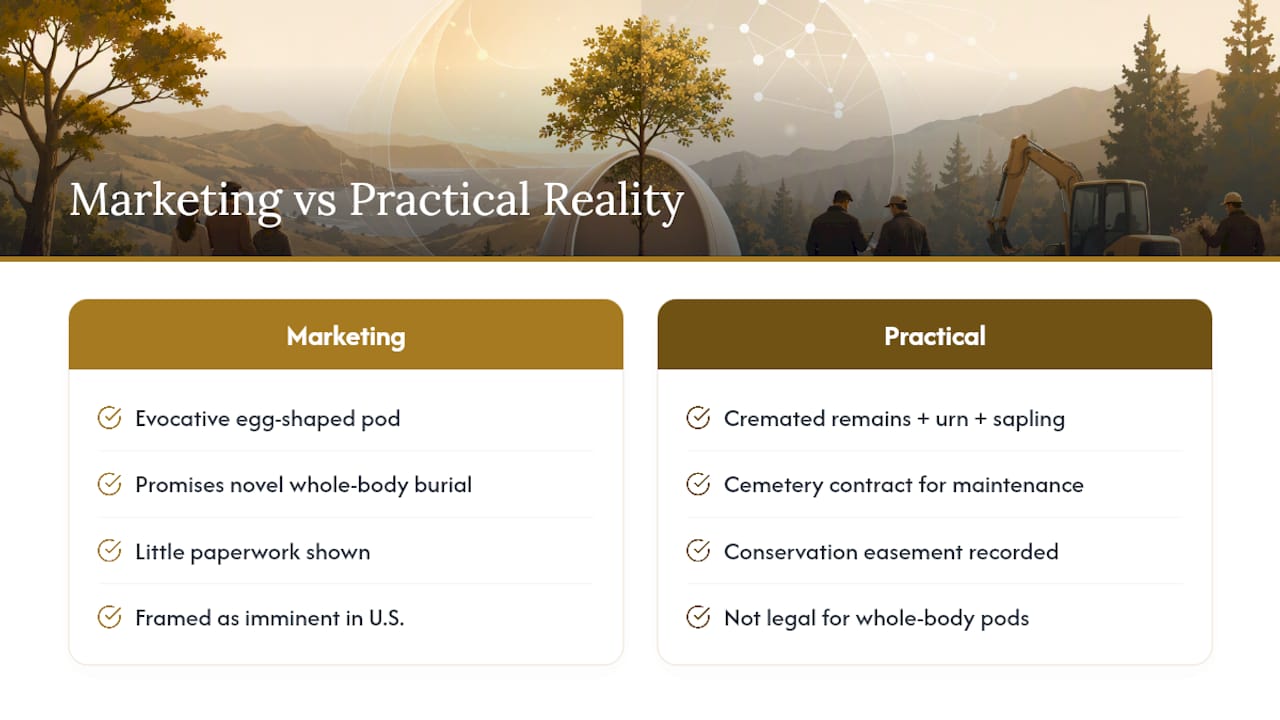
That’s not a lesser option. If anything, it’s the more durable one. A conservation easement recorded with a county, backed by a certified green burial ground, protects a memorial in a way no backyard planting ever could. The families who get this right aren’t the ones chasing the most novel-sounding product. They’re the ones who ask boring but essential questions: Is this land protected? Is the fee itemized? Will the tree still be here, and mapped, in twenty years?
What frustrates me about how this topic gets covered elsewhere is the breathless framing, as if whole-body pod burial is right around the corner in the U.S. It isn’t, not under current California law, and treating it as imminent does families a disservice when they’re trying to make a real decision under real time pressure. The practical, legal, meaningful version of this memorial already exists. It just looks like an urn and a sapling instead of a viral video.
— Steve Olsher
Sources
- California legislative information — AB501 / Health & Safety Code
- Can You Bury Someone on Your Property in California? - LegalClarity
- Funeral
- Green Burial Council
- Guide to arranging a Green Burial in California — US-Funerals