
Transparent Funeral Pricing Explained for Families

Transparent funeral pricing is the practice of disclosing all funeral costs in a clear, itemized format before any services are finalized or paid for. Federal law backs this up through the FTC Funeral Rule, which requires every licensed funeral home to provide a General Price List (GPL) showing individual prices for every service and product they offer. Understanding what transparent funeral pricing means gives your family the power to make real choices, avoid surprise charges, and spend in a way that reflects your values. Bravo Family Mortuary publishes its pricing openly because families deserve clarity, not confusion, during one of the hardest moments of their lives.
What is transparent funeral pricing and why does it matter?
Transparent funeral pricing is defined as the full, upfront disclosure of every cost associated with funeral arrangements, presented in an itemized format before any commitment is made. The industry term for this disclosure is the General Price List, or GPL. The FTC Funeral Rule, enforced by the Federal Trade Commission, mandates that every funeral provider in the United States supply this list to anyone who asks, whether in person or by phone.
The GPL covers three broad categories of costs. The first is funeral home fees, which include the basic services fee, preparation of the body, facility use, and transportation. The second is merchandise, such as caskets, urns, and outer burial containers. The third is cash advances, meaning third-party costs the funeral home pays on your behalf, like death certificates, clergy fees, and obituary notices.

Families who receive a GPL before signing anything can compare providers, decline services they do not want, and build an arrangement that fits their budget. Without it, families often default to expensive packages simply because no one explained the alternatives. Transparent pricing removes that guesswork entirely.
What is a General Price List and how does it protect you?
The General Price List is a federally mandated, itemized document that lists every service and product a funeral home offers, along with the individual price for each. Federal law requires funeral providers to hand over the GPL at the start of any in-person discussion and to read prices over the phone on request. Failure to comply can result in fines up to $50,120 per incident as of 2026. That penalty exists because Congress recognized that grieving families are especially vulnerable to unclear or misleading pricing.
The GPL must include, at minimum:
- Basic services fee: The non-declinable administrative charge covering planning, coordination, and paperwork
- Body preparation: Embalming, dressing, and cosmetic preparation (these are optional unless legally required)
- Facility use: Charges for viewing rooms, chapel services, and reception spaces
- Transportation: Transfer of the body from place of death, hearse use, and other vehicle fees
- Merchandise: Caskets, urns, vaults, and outer burial containers with individual prices
- Cash advances: Third-party fees the funeral home collects on your behalf
The GPL gives you the legal right to select only the services you want. Families can decline any optional service without being required to purchase a bundled package. That right is the foundation of informed funeral planning.
Pro Tip: Always ask for a printed or emailed copy of the GPL before any conversation about arrangements goes further. Keep it so you can compare it against other providers at your own pace, without pressure.
How do funeral costs break down?
Understanding funeral costs starts with one fixed anchor: the basic services fee. This charge is non-declinable nationwide, meaning every family pays it regardless of which services they choose. It covers the funeral home’s administrative work, licensing, coordination with cemeteries and crematories, and regulatory compliance. The median basic services fee runs about $2,195 nationwide. Knowing this number lets you compare providers on an equal footing before adding any optional services.
Beyond that anchor, costs vary widely based on the type of service chosen. The median cost of direct cremation is approximately $1,995, making it the most affordable full-service option. A traditional funeral with burial averages $6,415 to $7,736, not including cemetery expenses. Cemetery costs typically add another $2,000 to $5,000 depending on location and burial type.
| Cost category | Typical range | Notes |
|---|---|---|
| Basic services fee | ~$2,195 | Non-declinable; anchors all pricing |
| Direct cremation | ~$1,995 | Includes transfer, cremation, return of remains |
| Traditional funeral | $6,415–$7,736 | Excludes cemetery costs |
| Cemetery expenses | $2,000–$5,000 | Plot, opening/closing, marker |
| Cash advances | Varies | Death certificates, clergy, obituary, flowers |
Cash advances deserve special attention. These are costs the funeral home pays to third parties on your behalf. Some providers pass these through at cost, while others add a markup. The FTC Funeral Rule requires any markup to be disclosed in writing. That disclosure protects you from inflated charges on items like death certificates, which typically cost $20–$25 each through the county.
Pro Tip: Ask your funeral director directly: “Do you charge a service fee on cash advances, or do you pass them through at cost?” A transparent provider will answer without hesitation.
Why does pricing transparency matter during a difficult time?
Pricing transparency is a consumer protection right, not a courtesy. The FTC Funeral Rule is rooted in federal unfair and deceptive acts provisions, the same legal framework that governs car dealerships and financial institutions. Congress applied it to funeral homes specifically because families making arrangements are often in acute grief and may not think to question costs.
Clear, itemized pricing protects families in several concrete ways:
- Prevents package pressure: Bundled packages often include services families neither want nor need. The GPL lets you build an arrangement from scratch.
- Enables real comparison: Two funeral homes with similar reputations may differ by thousands of dollars. You cannot compare without itemized prices.
- Supports budget alignment: Families can prioritize what matters most, whether that is a meaningful service, a quality casket, or a simple, dignified cremation.
- Eliminates surprise invoices: Written good faith estimates for unknown cash advance costs are required before payment, so nothing appears on the final bill without warning.
- Reduces emotional stress: Knowing exactly what you are paying for lets your family focus on honoring your loved one rather than worrying about the bill.
Providers who publish prices openly build greater consumer trust than those who require an in-person visit before sharing any numbers. Refusing to share a GPL over the phone is a red flag. It signals that a provider may rely on emotional pressure rather than honest value.
How can families use transparent pricing to plan with confidence?
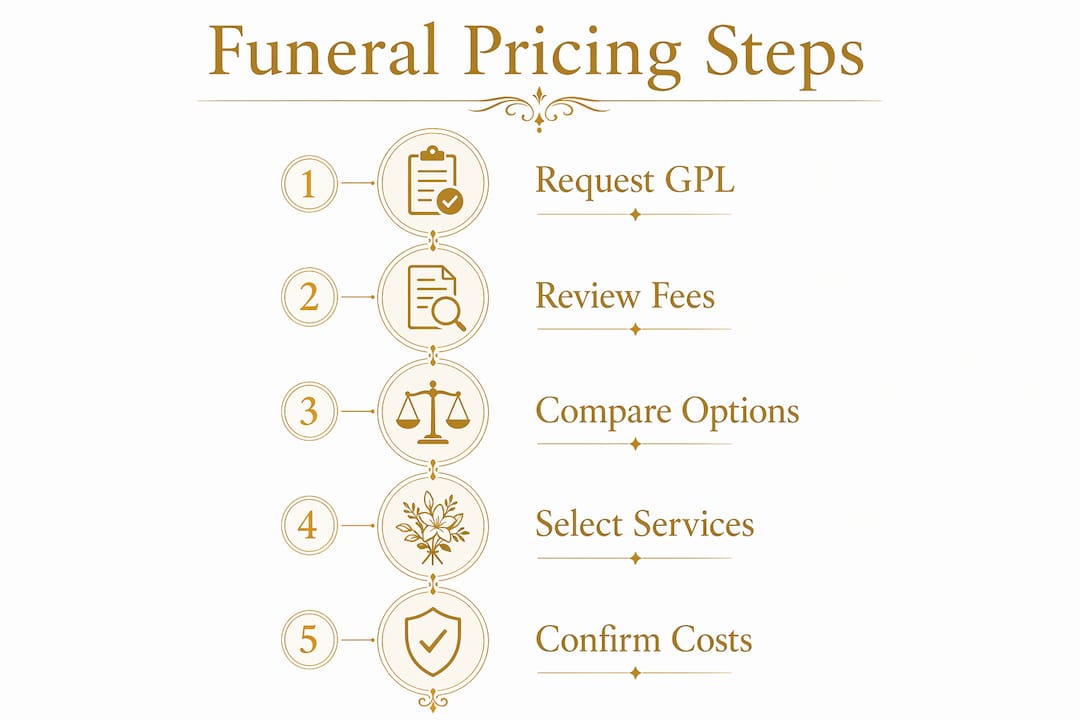
Practical funeral planning starts with requesting the GPL before any decisions are made. Here is how to use it effectively:
- Request the GPL immediately. Call or visit any funeral home you are considering and ask for the General Price List. Refusing to provide it is a legal violation and a clear sign to look elsewhere.
- Separate funeral home fees from cash advances. Review the GPL in two columns: what the funeral home charges directly, and what they collect on your behalf. These are different cost structures with different markup rules.
- Build your arrangement line by line. Start with the basic services fee, then add only the services your family actually wants. You are not required to purchase embalming, a viewing, or a specific type of casket unless you choose to.
- Ask for written estimates on unknowns. If the exact cost of a death certificate or obituary is not yet confirmed, the funeral home must provide a good faith estimate in writing before you pay.
- Compare at least two providers. Use the GPL from each to compare the same line items side by side. Focus on the basic services fee, transportation, and any merchandise you plan to purchase.
- Know your right to supply your own casket or urn. Federal law prohibits funeral homes from charging a handling fee if you bring your own casket or urn purchased elsewhere. This can reduce costs significantly.
- Use online arrangements when available. Providers like Bravo Family Mortuary offer 24/7 online arrangements through the PartingPros portal, letting you review cremation and funeral pricing and complete arrangements at your own pace, without an in-person visit.
Pre-planning is another powerful way to use transparent pricing. Locking in today’s prices through a pre-need arrangement protects your family from future cost increases and removes the burden of decision-making during grief.
Key Takeaways
Transparent funeral pricing means receiving a complete, itemized cost breakdown before any services are arranged or paid for, and the FTC Funeral Rule gives every family the legal right to demand it.
| Point | Details |
|---|---|
| GPL is your legal right | Every funeral home must provide an itemized General Price List on request, in person or by phone. |
| Basic services fee is fixed | The non-declinable basic services fee averages $2,195 and anchors all price comparisons. |
| Cash advances need scrutiny | Ask whether cash advances are passed through at cost or marked up, and get the answer in writing. |
| You can decline optional services | Federal law lets you select only the services you want and reject bundled packages. |
| Compare before committing | Request GPLs from multiple providers and compare the same line items to find honest value. |
What I have learned from families who finally saw the numbers
by Steve Olsher
The most common thing I hear from families after they receive a clear price list is not relief. It is frustration that no one showed them this sooner. They spent years assuming funerals were a fixed, unknowable expense, something you simply paid without question because asking felt disrespectful. That assumption costs families real money and real peace of mind.
Transparent pricing does not make grief easier. Nothing does. But it removes one specific source of dread: the fear of being taken advantage of while you are vulnerable. When a family can see every line item, ask questions freely, and build an arrangement that actually reflects their loved one’s life and their own budget, something shifts. They feel like participants rather than passengers.
The families I worry about are the ones who never ask for the GPL. They accept the first package presented, sign quickly to avoid the discomfort of negotiating during grief, and then feel regret later. That regret is preventable. The FTC Funeral Rule exists precisely because Congress understood this dynamic. A family-owned, independent funeral home has every incentive to be honest with you, because its reputation depends entirely on the families it serves, not on quarterly earnings reports.
Bilingual service matters here too. Spanish-speaking families in San Diego often face an additional barrier: pricing conversations in a second language, under emotional stress, with unfamiliar terminology. Clear, itemized pricing in plain language, delivered with patience, changes that experience entirely.
— Steve Olsher
Bravo Family Mortuary’s commitment to clear, upfront pricing
Bravo Family Mortuary was built on the belief that every family deserves to know exactly what they are paying for before they agree to anything. As a family-owned, 5-star rated funeral home serving all of San Diego County, Bravo publishes its pricing openly and provides itemized GPLs by phone, online, or in person, with no pressure and no hidden fees.

Bravo’s full range of services includes direct cremation, aquamation, traditional burial, green burial, cremation with memorial service, celebration of life, and military and veteran funeral services. Bilingual staff serve Spanish-speaking families with equal care. Veteran families receive full VA burial benefits coordination at no extra charge. Arrangements can be completed entirely online through the PartingPros portal, 24 hours a day, 7 days a week. We are here whenever you are ready.
FAQ
What does transparent funeral pricing mean?
Transparent funeral pricing means every cost is disclosed upfront in an itemized format before any services are arranged or paid for. The FTC Funeral Rule requires funeral homes to provide a General Price List showing individual prices for all goods and services.
Is a funeral home required to give me a price list?
Yes. Federal law requires every licensed funeral home to provide a General Price List on request, whether in person or over the phone. Refusing to share the GPL is a legal violation and a sign of poor transparency.
What is the average cost of a funeral in 2026?
Direct cremation averages about $1,995, while a traditional funeral averages $6,415 to $7,736, not including cemetery costs of $2,000 to $5,000.
Can I decline services I do not want?
Yes. The FTC Funeral Rule gives families the right to select only the services they want and decline any optional item. Funeral homes cannot require you to purchase a bundled package.
What are cash advances in funeral pricing?
Cash advances are third-party costs, such as death certificates, clergy fees, and obituary notices, that the funeral home pays on your behalf. Some providers pass these through at cost; others add a markup, which must be disclosed in writing.