Questions San Diego Families Must Ask About Mortuary vs Funeral Home

Short answer: a mortuary focuses on preparing and caring for the deceased, while a funeral home focuses on serving the family, hosting services, and handling the paperwork of loss. Many providers today do both under one roof, and on-site cremation is common but never guaranteed, so it’s worth confirming directly. Use the checklist below to match what your family needs to the right provider.
TL;DR:
- Confirm whether cremation is performed on-site or outsourced, as on-site care often simplifies processes and reduces transfer costs.
- Beware providers that cannot produce a license number, refuse to provide an itemized price list, or avoid answering who handles preparation and custody of the remains.
- A funeral home typically offers chapel space and family gatherings, while a mortuary focuses on technical care like embalming, storage, and cremation.
- Choosing a provider based solely on the name or building signage is unreliable; ask directly about licensing, services, and custody procedures.
- Bravo Family Mortuary combines both functions, offering transparent pricing, bilingual support, VA paperwork assistance, and online arrangements tailored to family needs.
Table of Contents
- Mortuary vs Funeral Home: What Each One Actually Provides
- What a Mortuary Does and When It’s the Right Fit
- The Differences That Actually Affect Your Decision
- How to Choose Between a Funeral Home and a Mortuary
- What Bravo Family Mortuary Offers San Diego Families
- Why This Distinction Matters Less Than You Think
- Ready to Talk Through Your Family’s Options?
- Sources
Mortuary vs Funeral Home: What Each One Actually Provides
A funeral home is a licensed establishment built for the family side of loss. It arranges viewings and memorial services, walks you through the paperwork a death requires, and gives your family a physical place to gather. State law backs this up: California’s Business and Professions Code requires licensed funeral establishments to maintain proper storage and preparation rooms and to employ a licensed funeral director to run the place. That’s not a branding detail. It’s a legal floor every legitimate provider has to meet.
What you’ll typically find inside a funeral home:
- A chapel or viewing room sized for your gathering, whether that’s twelve people or two hundred
- Arrangement offices where a director walks you through decisions, one at a time
- Support for grief resources and referrals, since the loss doesn’t end when the service does
- Coordination with cemeteries or crematories when disposition happens off-site
Cremation handling varies by provider. Some funeral homes operate their own crematory; others outsource it to a nearby facility and manage the transfer for you. Ask which applies before you sign anything. If your family needs services in Spanish, or if grief support matters as much as logistics, ask about both directly. Bravo Family Mortuary’s own grief support resources exist because the paperwork is rarely the hardest part.
Pro Tip: Ask about chapel capacity and language support in the same phone call you ask about pricing. A provider who answers both without hesitation usually runs a well-organized operation.
What a Mortuary Does and When It’s the Right Fit
A mortuary is built around technical care of the deceased, not the ceremony around it. It’s the facility where embalming, restorative preparation, refrigeration, and often cremation itself take place. Industry guides consistently describe mortuaries as the technical counterpart to a funeral home, with less emphasis on chapel space and more on secure, climate-controlled storage.
The technical work at a mortuary typically includes:
- Embalming and restorative preparation, performed by licensed embalmers or funeral service technicians
- Refrigerated or secure storage for the deceased before final disposition
- On-site cremation, when the facility has its own crematory
- Documentation of custody from intake through final disposition
Families usually don’t walk through a mortuary’s preparation area. Instead, you work with a funeral director who represents the mortuary’s capabilities and translates the technical side into decisions you can actually make. A mortuary-only arrangement often fits families choosing direct cremation with no service, or anyone prioritizing lower cost over a ceremony space. If that’s your family, confirm the facility’s license, ask who physically performs the preparation, and get clear on the chain of custody for cremation before you commit to anything.
The Differences That Actually Affect Your Decision
Here’s where the terms stop mattering and the specifics start. The line between “mortuary” and “funeral home” has blurred industry-wide, so the name on the building tells you less than a five-minute phone call will.
Facilities and staff. A funeral home is built around chapel and viewing space; a mortuary is built around a preparation room. Staffing reflects that split. Funeral directors coordinate your family’s decisions and the ceremony; embalmers and technicians handle physical preparation. Some providers, including Bravo Family Mortuary, employ both under one license so you’re not shuttled between two businesses during the worst week of your life.
On-site cremation. Facilities that both prepare and cremate under one roof keep the decedent under a single team’s care from start to finish, which matters for peace of mind and can also reduce cost by cutting out a transfer fee to an outside crematory. Ask directly whether cremation happens on-site or gets outsourced.
Pricing. A statement from either type of provider usually breaks into three buckets: a basic services fee (the provider’s professional and facility overhead), disposition costs (cremation or burial itself), and optional items like a viewing, urn, or casket. Families consistently do better when they ask for this breakdown in writing before agreeing to anything.
Paperwork and timeline. Whoever you choose typically files the death certificate, coordinates the transfer permit, and handles cremation or burial permits. Most straightforward cases move from transfer to final disposition within a week to ten days, though viewings and out-of-town family can extend that window.
| What to check | Funeral home | Mortuary |
|---|---|---|
| Primary space | Chapel, viewing rooms | Preparation, storage rooms |
| Lead staff | Funeral director | Embalmer, technician |
| Typical use | Ceremonies, memorials | Direct cremation, preparation |
| On-site cremation | Sometimes | Often, not always |
How to Choose Between a Funeral Home and a Mortuary
Whichever provider you’re calling, ask these questions in roughly this order:
- Are you licensed as a funeral establishment in this state, and can I see that license number?
- Do you perform cremation on-site, or does it get transferred elsewhere?
- Who physically performs embalming or preparation, and are they licensed?
- Can you send me an itemized price list before I decide anything?
- What’s your chapel or viewing room capacity, and can I see it?
- Do you offer bilingual Spanish support throughout the process?
- Will you coordinate VA burial benefits paperwork for veterans, and is there a charge for that?
Watch for red flags while you’re asking. A provider who can’t produce a license number, quotes a single vague “package price” with no breakdown, refuses to put anything in writing, or gets evasive about who handles the deceased between transfer and disposition is not one you want handling your family’s arrangements.
Your decision flow can stay simple: figure out your priority first (ceremony space and family gathering versus a straightforward, lower-cost preparation), then match that priority to the provider type built for it, then call or start arrangements online if you’re not ready for a phone call yet.
Pro Tip: Request a written, itemized price list and a copy of the service contract before you pay anything. A provider who hesitates to hand either over is telling you something.
What Bravo Family Mortuary Offers San Diego Families
Bravo Family Mortuary operates as both, so families never have to choose between ceremony space and technical care. Here’s what that looks like in practice:
- Transparent, all-inclusive pricing with no hidden line items, visible on our pricing page before you ever pick up the phone
- Direct cremation, aquamation, traditional burial, green burial, and celebration-of-life services under one roof, detailed on our services page
- 24/7 availability, with arrangements completable entirely online through PartingPros for families who can’t or don’t want an in-person visit
- Bilingual Spanish and English support, so language is never a barrier to care
- Free coordination of VA burial benefits paperwork for veteran families, handled at no additional charge
- Independent, family-owned status, meaning we answer to the families we serve, not to corporate shareholders, backed by 47-plus five-star Yelp reviews
If your family needs Spanish-language support, VA paperwork handled correctly, or a price list you can actually read before deciding, those aren’t extras here. They’re built into how we operate. Verify any of it yourself on our services and pricing pages, or call when you’re ready. We are here whenever you are ready.
Why This Distinction Matters Less Than You Think
The mortuary versus funeral home debate gets more attention than it deserves. Most consumer confusion isn’t about definitions. It’s about not knowing which questions to ask a provider before money changes hands, and that gap is where families get overcharged or underserved.
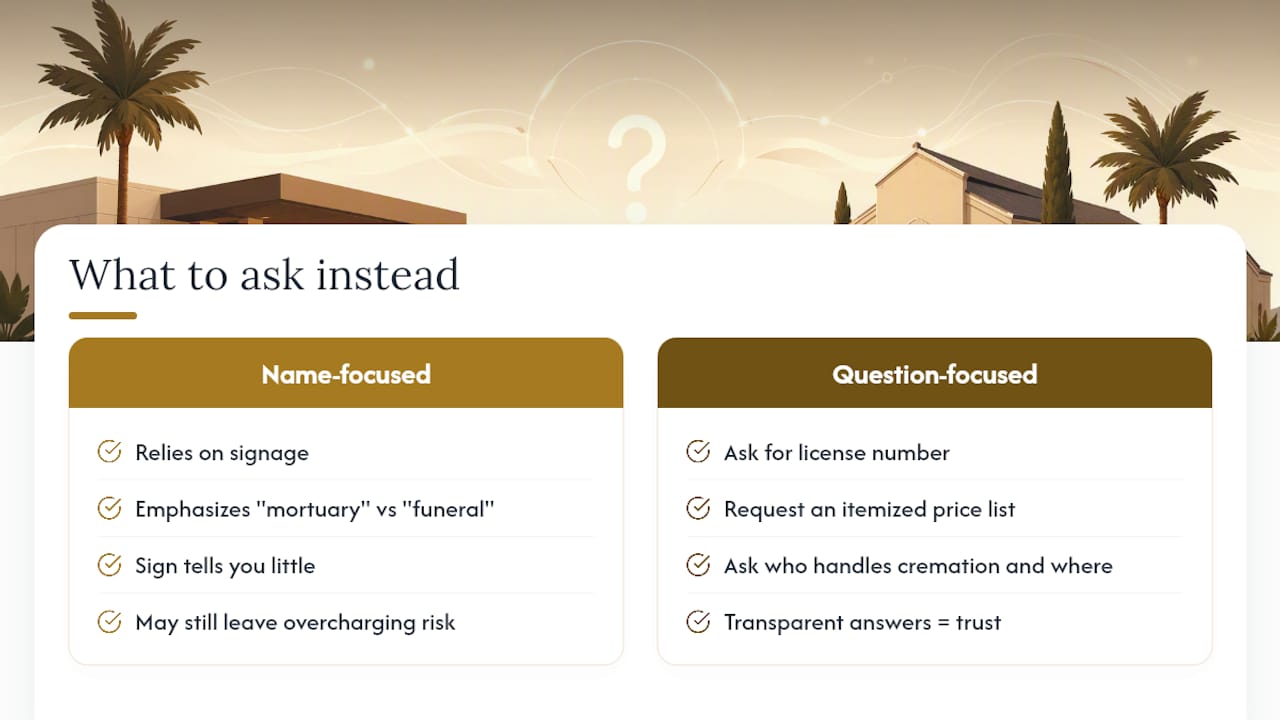
The conventional advice, “figure out if it’s a mortuary or a funeral home,” puts the emphasis in the wrong place. Naming conventions have blurred enough industry-wide that the sign on the building tells you almost nothing reliable. What tells you something is whether the provider will show you a license number, an itemized price list, and a straight answer about who handles cremation and where.
If I had to boil this down to one instruction: stop asking what to call the place and start asking what it actually does. A facility that answers every licensing, pricing, and custody question without hesitation is worth your trust regardless of what’s painted on the door. One that dodges those same questions is a red flag no amount of tasteful branding can cover up.
— Steve Olsher
Ready to Talk Through Your Family’s Options?
Bravo Family Mortuary exists because San Diego families deserve a provider who handles both sides of this without forcing a choice between them. We’re independent and family-owned, which means every decision about your loved one’s care answers to you, not to a corporate parent counting quarterly numbers.
We offer direct cremation, aquamation, traditional burial, green burial, celebration-of-life services, and military honors, all with pricing you can see in full before you commit to anything on our pricing page. Families who can’t manage an in-person visit right now can complete every arrangement online through PartingPros, any hour of the day. If you’re planning ahead rather than responding to a loss today, our pre-planning options let you lock in decisions and pricing now, sparing your family that burden later. For families navigating end-of-life questions beyond logistics, Kells Care’s guide to end-of-life care is a solid place to start. When you’re ready, whether that’s today or six months from now, reach out to arrange services and we’ll walk you through it at your pace.
Sources
- What is the difference between a mortuary and a funeral home? — Funeral Vision
- Understanding Mortuary vs Funeral Home Differences — MERI
- California Business and Professions Code — Funeral Establishments And Directors (selected sections)