
Avoid Losing the Burial Flag: Military Funeral Flag Etiquette for San Diego
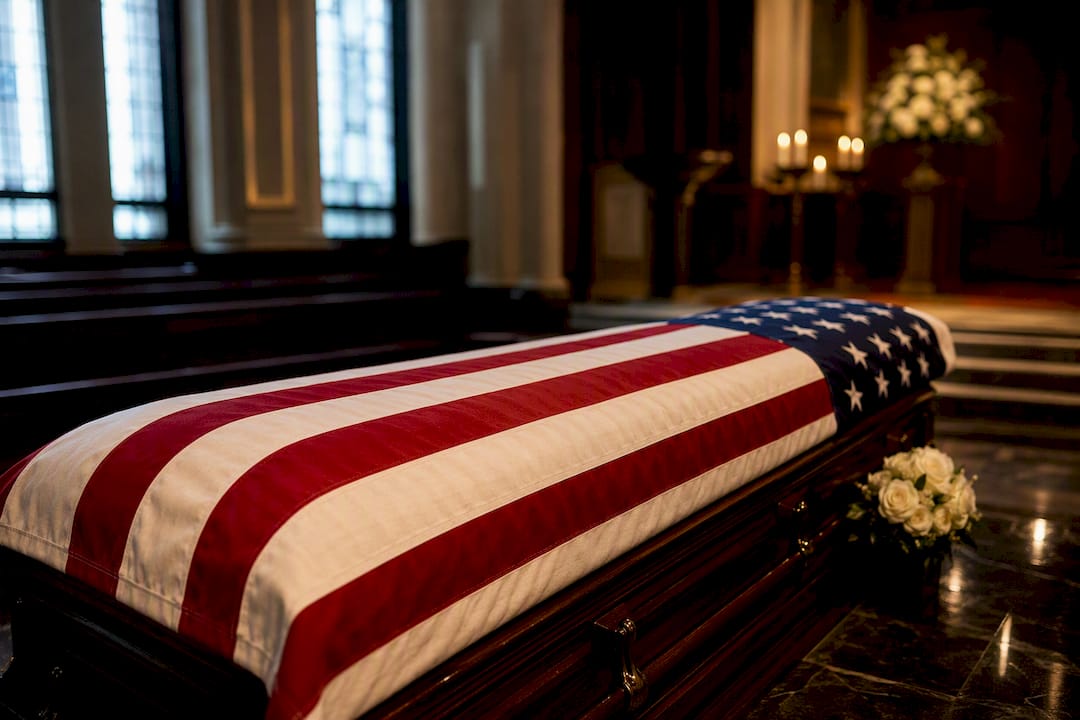
The burial flag draped over a veteran’s casket, or folded beside the urn, is provided free by the Department of Veterans Affairs to honor the deceased’s military service. The VA furnishes exactly one flag per eligible veteran, and after the ceremony, a service member presents it to the next of kin. If your family is planning a service now, ask your funeral director to request military funeral honors and the burial flag, or file VA Form 27-2008 yourself.
TL;DR:
- Most honorable service during wartime or after January 1955 qualifies a veteran for a burial flag, but dishonorable discharges and short service may disqualify eligibility.
- The flag is placed with the union at the head of the casket or urn, following strict protocols for placement based on coffin type and ensuring respectful display.
- The flag is folded into a tricorn and presented with a standardized speech, which remains unchanged since 2012, during a brief, emotionally significant moment.
- The VA provides only one cotton burial flag per veteran, which is intended for indoor memorial use and should be stored carefully to prevent damage or fading.
- Families must request the honors and flag at least 48 to 72 hours in advance, provide discharge papers, and confirm the details with their funeral director to ensure a proper ceremony.
Table of Contents
- Who Qualifies for a Burial Flag and How to Request One
- How the Flag Is Displayed on a Casket or Urn
- Folding, Presentation, and the Words That Are Always Spoken
- Requesting Military Funeral Honors: Timing and What to Expect
- Caring for the Flag After the Service
- Who Receives the Flag, and What Happens With Multiple Claimants
- Your San Diego Checklist: From Notification to Graveside
- A Funeral Director’s Perspective on Getting This Right
- How Bravo Family Mortuary Supports Veteran Families
- Sources
- FAQ
Who Qualifies for a Burial Flag and How to Request One
Not every discharge qualifies, but most honorable service does. The VA extends eligibility to veterans who served during wartime, veterans who served after January 31, 1955, and members of the Selected Reserve who met specific service or disability criteria before their death. Dishonorable discharges are excluded, and a handful of edge cases (very short service periods, certain training-only enlistments) can complicate eligibility, which is exactly why a funeral director’s help matters here.
Getting the flag itself is more straightforward than most families expect. You have three paths:
- Ask your funeral director to request it on your behalf, which is the route most San Diego families take because it requires no extra paperwork on their end.
- File VA Form 27-2008 yourself at a VA regional office, along with a copy of the veteran’s discharge papers.
- Pick one up at a local post office, though it’s worth calling ahead since not every branch keeps flags in stock.
One detail catches families off guard every time: the VA provides only one flag per veteran, and it generally will not replace one that’s lost, damaged, or stolen. That single-flag rule is written into VA policy, not a funeral home’s, so double-check with your director that the flag has actually arrived before the service date. If you have questions about eligibility or paperwork status, the VA benefits hotline can walk you through it, and our own guide to VA burial benefits in California breaks down the state-specific steps in more detail.
How the Flag Is Displayed on a Casket or Urn
Flag placement follows a fixed rule, and getting it right matters to families who want the ceremony to feel correct and respectful. On a closed casket, the flag drapes so the union, the blue field of stars, rests at the head and over the left shoulder of the deceased. Picture standing at the foot of the casket facing the head: the stars should be on your left.
Open caskets change the picture slightly:
- Half-couch caskets (where only the upper half is open) carry the flag draped over the closed lower half, with the union still positioned at the head.
- Full-couch caskets (fully open) have the flag draped completely over the casket, tucked so it doesn’t touch the floor, again with the union at the head.
- Urns are handled differently. The flag is folded into the military tricorn and placed beside or beneath the urn rather than draped, and body bearers handle it with the same care given to a casketed flag.
None of this is something you should have to manage alone in the moment. Pro Tip: Walk through the exact placement with your funeral director before the service, not during it. A five-minute conversation the day before spares the family from watching staff figure out casket type and flag orientation in front of guests.
Folding, Presentation, and the Words That Are Always Spoken
The flag folding you’ll see at a military funeral isn’t ceremonial improvisation. It follows a fixed sequence: the flag is folded lengthwise twice, then folded into a series of triangles, ending in a tight tricorn shape that shows only the blue field of stars, no red or white stripe visible. Thirteen folds total, each one deliberate.
The presentation that follows has its own choreography:
- The presenter faces the recipient directly, squares up, and holds the folded flag waist-high.
- The straight edge of the triangle faces the recipient, never the presenter.
- The presenter leans slightly toward the recipient as the flag changes hands, a small gesture that makes the moment feel personal rather than procedural.
- The presenter speaks the standardized wording as the flag is placed in the recipient’s hands.
That wording hasn’t changed since the Department of Defense standardized it on April 17, 2012, and it’s the same regardless of which cemetery, chaplain, or honor guard is present:
The branch named in parentheses depends on where the veteran served, which is specified in the DOD’s flag presentation protocol brochure. Knowing this wording ahead of time helps families brace for a moment that’s often the most emotional part of the entire service. It’s short, it’s the same every time, and it’s meant to be.
Requesting Military Funeral Honors: Timing and What to Expect
Federal law sets a floor for what military honors must include: at least two uniformed service members, the playing of Taps, and the folding and presentation of the flag. That’s the minimum honor guard detail required by law for any eligible veteran, regardless of rank or branch.
Getting that detail scheduled is usually the funeral director’s job, though families can request it directly. Either way, plan ahead:
- Notify the funeral director as soon as the date is set, since honors requests typically need 48 to 72 hours of advance notice to coordinate branch representatives.
- Have the veteran’s DD214 or branch and service dates ready. Funeral directors use this to verify eligibility and speed up the request.
- Ask whether Taps will be played live or recorded. A live bugler is preferred and often used at larger installations like Arlington National Cemetery, but recorded ceremonial bugle calls are common and entirely dignified when a bugler isn’t available locally.
- If an honor guard can’t be scheduled in time, ask about rescheduling a graveside honors ceremony for a later date, or contact local veteran service organizations, who sometimes step in when official details are booked solid.
For San Diego families, this coordination is one of the areas where a funeral director earns their keep. Our veteran funeral honors guide walks through how that 48 to 72 hour window plays out locally, and what to expect from base representatives at Fort Rosecrans and beyond.
Caring for the Flag After the Service
The flag you receive is cotton, not the heavier weather-rated polyester you’d fly outside on a flagpole. That’s a deliberate material choice by the VA, and it means the burial flag isn’t built for prolonged outdoor display — sun and rain will fade and fray it within a season.
Keep it as an indoor keepsake instead:
- Store it folded in its tricorn shape, in a dry, dark place away from direct sunlight.
- Avoid pinning, stapling, or writing on the fabric, even for labeling purposes.
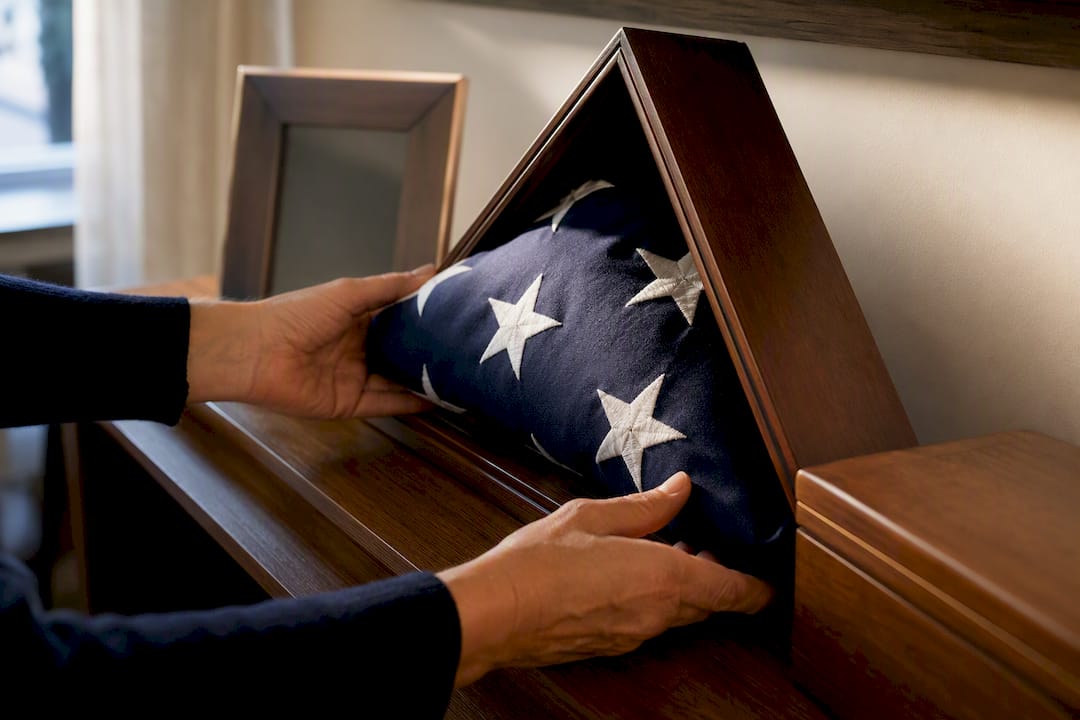
- Consider a shadow box display case designed for burial flags, which protects the fabric while still showing it prominently in the home.
Because VA rules generally don’t allow replacement of a lost or damaged flag, this is one area worth taking seriously from day one. If your family wants a flag to actually fly outdoors on Memorial Day or Veterans Day, a separate weather-rated display flag is the better option; keep the burial flag itself as an indoor memorial only. And if a flag has genuinely reached the end of its life through wear rather than neglect, the respectful path is retirement through a veterans organization or, when necessary, ceremonial burning, never the trash.
Who Receives the Flag, and What Happens With Multiple Claimants
Federal regulation lays out a clear order of who’s entitled to the flag when a veteran dies, and it starts with the closest family relationship. Under 38 CFR § 1.10, entitlement runs in this order:
- Surviving spouse (widow or widower) first.
- Children, generally by age, if there’s no surviving spouse.
- Parents of the deceased veteran.
- Siblings, if no spouse, children, or parents survive.
- More distant next of kin, and finally a close friend, if no other relative can be found.
When more than one person believes they’re entitled, the local VA field facility has the authority to determine who actually receives it, based on the documented order of precedence rather than family agreement alone. Most families never hit this complication, but if a veteran’s relationships were complicated, it’s worth raising with your funeral director early.
Once the flag is in hand, what families do with it varies. Some display it in the home, some pass it down as an heirloom to grandchildren, and some donate it to a veterans organization or a local VA cemetery program in the veteran’s honor.
Your San Diego Checklist: From Notification to Graveside
Here’s the sequence that actually works, based on how these requests move through the system locally:
- Call your funeral director as soon as possible after the loss. This starts the clock on honors requests, which need lead time.
- Gather the veteran’s DD214 or, at minimum, their branch and approximate service dates. This is the single fastest way to verify eligibility.
- Complete VA Form 27-2008 if you’re not going through a post office or funeral home for the flag itself.
- Confirm the honors request 48 to 72 hours before the service, and ask directly whether the detail will include a live bugler or recorded Taps.
- Walk through flag placement with your funeral director the day before, so nobody is guessing at casket type or fold orientation during the service itself.
- Call the VA benefits hotline if paperwork stalls or eligibility questions come up that your funeral director can’t answer on the spot.
Pro Tip: Keep a single folder with the DD214, discharge papers, and any VA correspondence. Families who have this ready when they call cut their coordination time significantly, because everything a funeral director needs is already in one place.
Some funeral homes coordinate this entire process for veteran families, including the VA paperwork most families find intimidating to navigate alone.
A Funeral Director’s Perspective on Getting This Right
The flag presentation is usually the moment a family remembers most clearly from the entire service, more than the eulogy, more than the burial itself. That’s not an accident. It’s the one part of a military funeral where the country, through a uniformed stranger, looks a grieving spouse or parent in the eye and says thank you out loud.
I think families sometimes worry they’ll get something wrong: the wrong casket type for the flag, an awkward moment during presentation, uncertainty about who’s supposed to receive it. You don’t need to memorize the CFR order of precedence or the thirteen folds. That’s what your funeral director is for. What matters is that you show up, and the details get handled around you with the same care the flag itself represents.
If you’re planning ahead or standing in the middle of this right now, reach out. We are here whenever you are ready.
— Steve Olsher
How Bravo Family Mortuary Supports Veteran Families
Some funeral homes assist veteran families by coordinating the burial flag request, the honors detail timeline, and the VA Form 27-2008 filing, helping families focus on the service rather than the paperwork.

As a family-owned, independent funeral home rather than a corporate chain, we answer to the families we serve in San Diego County, not to shareholders. Our team includes bilingual Spanish-speaking staff, so language never becomes a barrier during an already difficult week. Every arrangement, including veterans and cremation services, can be completed entirely online through our secure PartingPros portal, available 24 hours a day, without an in-person visit or sales pressure. Pricing is posted transparently on our funeral and cremation pricing page, with no hidden fees added later.
If your family needs help coordinating military honors, the burial flag, or any part of a veteran’s service, call us or start arrangements online. We are here whenever you are ready.
Sources
- Military Funeral Honors - National Cemetery Administration
- Burial Flag FAQs (VA PDF)
- VA form guidance on flag display and folding (VBA-27-2008-ARE)
- Expectations During Military Funeral Honors | Military OneSource
FAQ
How Is the American Flag Presented at a Military Funeral?
A uniformed service member folds the flag into a tricorn shape, faces the next of kin, holds it waist-high with the straight edge forward, leans slightly toward the recipient, and recites the DOD-standard presentation wording naming the veteran’s branch.
Is It Proper to Salute the Flag If You’re Not a Veteran?
Civilians are not required to salute, though it’s considered respectful to place your right hand over your heart during the flag folding and presentation, following the same etiquette used during the national anthem.
What Should a Family Do With a Military Funeral Flag?
Store it folded, indoors, away from sunlight, ideally in a shadow box display case; the cotton burial flag is a keepsake, not an outdoor flag, and the VA generally will not replace one that’s lost or damaged.
Can You Fly a Military Funeral Flag Outdoors?
No. VA burial flags are cotton and not built for weather exposure, so families who want to fly a flag outdoors on Memorial Day or Veterans Day should buy a separate weather-rated display flag and keep the burial flag as an indoor memorial.
Who Receives the Flag If There’s No Immediate Family?
Federal regulation extends entitlement to more distant relatives, and finally to a close friend of the deceased, if no spouse, child, parent, or sibling survives to receive it.