
Mexican Funeral Traditions for Attendees: What to Bring and Expect
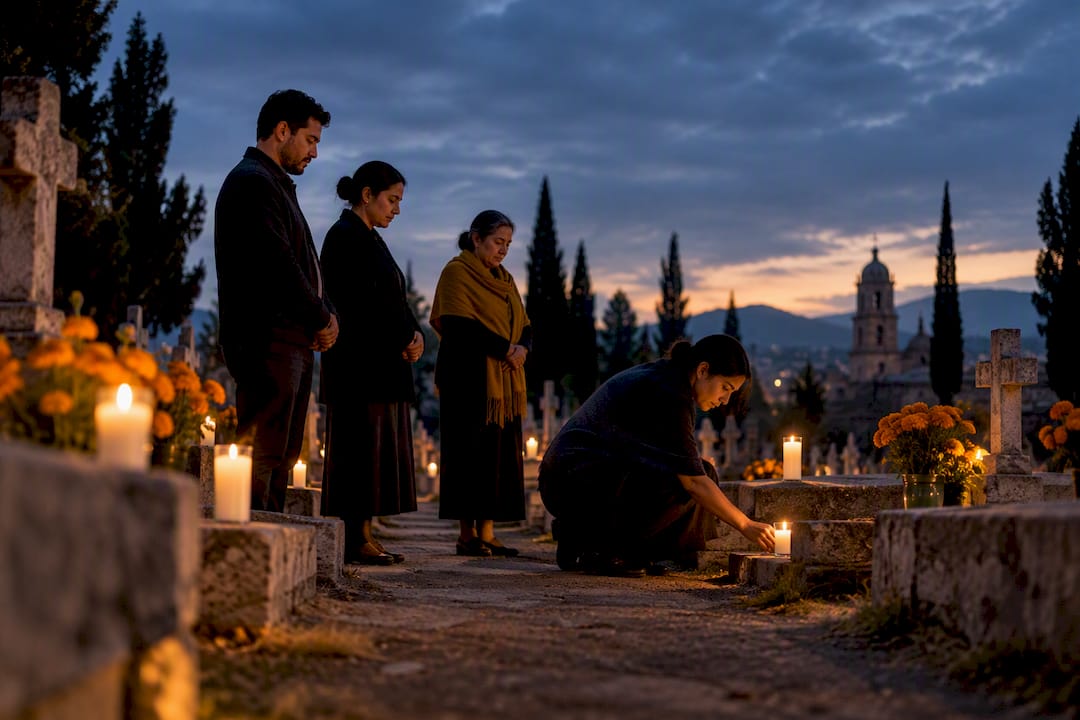
Mexican funeral traditions center on accompaniment: a velorio (wake), a funeral Mass and graveside committal, followed by a novenario of several nights of prayer. Expect prayer, food, music, and family storytelling at nearly every stage. The single most important rule of etiquette is simple: show up, stay present, and follow the family’s lead rather than worrying about saying the perfect thing.
TL;DR:
- The velorio often blends Catholic prayer with indigenous customs, emphasizing community presence, storytelling, music, and long overnight vigils in Mexico.
- The funeral mass typically occurs the morning after the velorio, with processions to the cemetery and a focus on blessing the casket rather than eulogies.
- Mourning continues through nine nights of rosary prayers at home or graveside, with a formal year-end memorial mass called cabo de año.
- Attending food offerings, dressing modestly in dark clothing, and offering brief condolences are the most supportive gestures for mourners.
- Customs vary regionally, with some communities practicing multi-night rites and others condensing phases, but the core value of accompaniment remains constant.
Table of Contents
- Velorio: What to Expect at the Wake or Vigil
- The Funeral Mass and Graveside Committal
- Novenario, Luto, and the Cabo de Año
- Day of the Dead vs. Funeral Rites
- Etiquette: What to Bring, Wear, and Say
- Why Customs Vary by Region
- A Quick Checklist for Attendees and Hosts
- A Publisher’s Perspective on Honoring These Traditions
- How Bravo Family Mortuary Supports Families Honoring These Traditions
- Sources
- FAQ
Velorio: What to Expect at the Wake or Vigil
The velorio is where mourning begins, and it rarely looks like a quiet, hushed viewing. Families historically held wakes in the home, with the body present so relatives could keep watch overnight. Many families now hold the velorio at a funeral home instead, though the emotional shape of the evening stays the same, according to contemporary practice notes on wake traditions. Candles, a crucifix, and images of saints usually surround the casket, and the room often stays open late into the night.
Here’s roughly how the evening unfolds:
- Arrival and greeting. Guests arrive throughout the evening, greet the immediate family first, and often light a candle near the casket.
- Rosary rotation. Small groups take turns leading decades of the rosary; a priest or lay minister may lead the first round, with family and friends continuing afterward.
- Food and conversation. Coffee, pan dulce, tamales, and sometimes a full meal appear as the night goes on, and conversation shifts naturally from prayer to shared memories.
- Storytelling and music. Someone almost always tells a story that makes the room laugh, and a guitar or a recording of the person’s favorite songs is common.
Mexican wakes commonly blend Catholic prayer with older indigenous customs, and that blend is exactly what gives the velorio its particular warmth. In Mexico, an overnight vigil is typical; in the United States, funeral-home hours usually compress the wake into a single evening. Family members handle hosting, so visitors help most by bringing food, sitting quietly with the family, and staying as long as feels natural.
The Funeral Mass and Graveside Committal
The misa de cuerpo presente, or funeral Mass with the body present, follows the velorio and typically happens the next morning. It carries the same structure as any Catholic Requiem Mass: readings, a homily focused on resurrection and comfort, incense, and the priest blessing the casket with holy water. Families who choose cremation before the Mass sometimes adjust these rites, and it’s worth reviewing Catholic guidance on cremation if that question comes up in planning.
What typically happens between the church and the cemetery:
- A procession forms after Mass, with pallbearers, usually close male relatives or godsons, carrying the casket to the hearse.
- At the cemetery, the priest offers final prayers and a blessing over the grave.
- Family members often lower flowers or a handful of earth onto the casket as a last physical gesture.
- Personal remarks, if there are any, tend to happen at the graveside or back at a gathering afterward, not during the Mass itself.
Eulogies are less common inside the liturgy than they are in Protestant or secular American services. If you’re unsure whether it’s appropriate to speak, ask a family member beforehand rather than assuming.
Novenario, Luto, and the Cabo de Año
Grief in Mexican tradition doesn’t end at the graveside. It continues through the novenario, several consecutive nights of rosary prayer said in the home or at the deceased’s grave, followed by a longer period of mourning called luto.
- The novenario itself: family and close friends gather each evening for nine nights, praying a rosary and often sharing a light meal afterward, a structure documented in ethnographic research on popular-indigenous Catholicism.
- Luto: a mourning period, historically marked by wearing black and stepping back from celebrations, that can last weeks or up to a year depending on the family.
- Cabo de año: a one-year memorial Mass that formally closes out the mourning cycle, often followed by a smaller gathering.
- Invitations matter: being asked to a novenario night is a genuine invitation to accompany the family, not a formality you can skip lightly if you’re close to them.
In the United States, families frequently shorten this cycle, sometimes condensing the novenario into a single rosary service or a weekend gathering, while still keeping the cabo de año as a meaningful marker.
Day of the Dead vs. Funeral Rites
Día de los Muertos, celebrated November 1 and 2, is an annual public commemoration of the dead in general. It is not a funeral, and confusing the two is one of the most common missteps outsiders make.
- Day of the Dead centers on the ofrenda, a home altar built with marigolds, candles, photographs, and the deceased’s favorite foods.
- Families often build a special ofrenda during the first Day of the Dead after a loss, a detail reporting on the holiday’s origins highlights as especially meaningful.
- Public rituals like cemetery vigils and town parades are regional and communal, while funerals remain private, family-led events.
- Treat a Day-of-the-Dead invitation and a funeral invitation as two separate social signals. Showing up to one doesn’t substitute for attending the other.
Etiquette: What to Bring, Wear, and Say
Practical support matters more than polished words at a Mexican funeral. If you’re unsure what’s welcome, food is nearly always the safest offering.
- Food: tamales, pan dulce, coffee, or a casserole are all appropriate and genuinely appreciated, per guidance on Mexican funeral customs.
- Money: cash gifts aren’t required but are common among close family and friends, often given quietly in an envelope to help with costs.
- Clothing: dark, modest clothing is standard; avoid bright colors or casual wear at the velorio and Mass.
- Condolence phrases: “Lo siento mucho” (I’m so sorry) or “Mi más sentido pésame” (my deepest condolences) both work well in Spanish.
- Can’t attend? Sending food ahead, mailing a card, or attending a single novenario night later are all acceptable substitutes.
Pro Tip: You don’t need eloquent words. Quietly refilling someone’s coffee or helping set up chairs communicates more solidarity than any speech, a pattern noted in research on Spanish-speaking condolence customs.
Why Customs Vary by Region
Mexican funeral practice isn’t one uniform script. Scholars describe it as a living syncretism, Catholic liturgy woven through with older indigenous ritual, producing forms that shift from state to state and even town to town. One academic analysis frames this blend as a kind of moral ecology, a system flexible enough to absorb new circumstances while keeping one value fixed at its center.
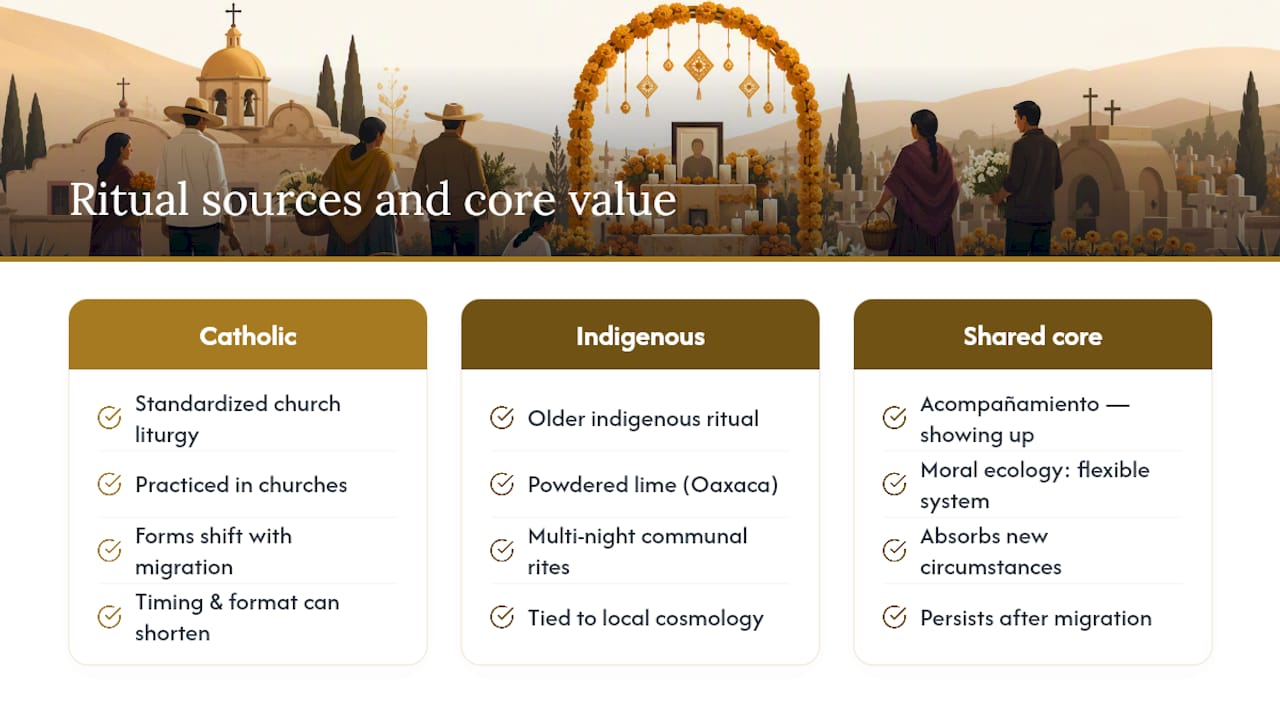
In Oaxaca and parts of the Mixteca region, some communities still practice household rites involving powdered lime and multi-night communal observances tied to local cosmology, not standardized church liturgy, according to fieldwork on southern Mexican Catholicism. Michoacán, especially the island of Janitzio, is known for elaborate public cemetery vigils each November. Migration to the United States has reshaped timing and format, home vigils becoming funeral-home visitations, nine nights becoming one, but the underlying value, acompañamiento, showing up and staying present, tends to survive the move intact.
A Quick Checklist for Attendees and Hosts
Before you go:
- Ask a family member about food needs, whether children are welcome, and what language the service will be in.
During the service:
- Follow the family’s lead on when to kneel, pray, or speak, and keep any condolences brief and sincere.
Afterward:
- Attend at least one novenario night if you’re able, and offer concrete help, a ride, a meal, an afternoon of childcare, rather than vague offers.
Common missteps to avoid:
- Skip the platitudes (“everything happens for a reason” lands poorly), and never photograph the casket or family without asking first.
A Publisher’s Perspective on Honoring These Traditions
At Bravo Family Mortuary, we’ve learned that cultural respect isn’t a checkbox, it’s showing up bilingual, unhurried, and ready to adapt. Our Spanish speaking staff and 24/7 availability mean a family can start arrangements at 2 a.m. without waiting for office hours. We coordinate VA paperwork at no charge for veteran families, and our pricing stays transparent because grief shouldn’t come with financial surprises layered on top.
— Steve Olsher
How Bravo Family Mortuary Supports Families Honoring These Traditions
Planning a velorio, a funeral Mass, or a full novenario cycle takes coordination, and it helps to work with a funeral home that won’t rush you or hide costs in fine print. Bravo Family Mortuary is family-owned, not answerable to corporate shareholders, and that independence shows up in pricing you can actually read before you commit to anything.

Our services include traditional burial, cremation, and celebration-of-life ceremonies that can incorporate a rosary, an altar, or a novenario schedule exactly how your family wants it. Our pricing page lists all packages in full, so there’s no guessing before you sit down with us. Military and veteran families can also lean on our veteran funeral services, where we coordinate VA benefits paperwork at no added charge. Families preserving cultural or religious wishes ahead of time can also look into pre-planning, which locks in choices, and often pricing, well before they’re needed. Everything can be arranged online at any hour through our secure portal, in English or Spanish, with no pressure and no sales script.
We are here whenever you are ready.
Sources
- Mexican Wakes Explained: Traditions, Customs, and Their Meaning – Memorial Locator
- Popular-Indigenous Catholicism in Southern Mexico (MDPI)
- Mexico’s Day of the Dead celebrations blend Indigenous customs and European thinking in surprising ways — The Conversation
- Mexican Funeral Traditions and Eulogy Guide — Eulogy Expert
FAQ
What Do Mexican Families Do When Someone Dies?
Families typically hold a velorio (wake) with an overnight or evening vigil, followed by a funeral Mass, a graveside committal, and a novenario of several nights of prayer. Food, music, and storytelling accompany nearly every stage, reflecting the blend of Catholic and indigenous customs that shapes Mexican mourning.
What Should You Bring to a Mexican Funeral?
Food is always welcome, tamales, pan dulce, or coffee are common choices, along with dark, modest clothing. Cash gifts to help with costs are appreciated but not required, per common funeral etiquette guidance.
Do You Give Money at a Mexican Funeral?
Giving money is optional but common, usually offered quietly in an envelope to close family to help cover costs. It’s a gesture of support, not an obligation, and food or your presence at the velorio matters just as much.
How Long Does a Traditional Mexican Funeral Last?
The core rites, velorio, Mass, and burial, usually happen within one or two days, but mourning continues through the nine-night novenario and can extend through a year-long cabo de año. In the United States, families often compress this timeline to fit funeral-home schedules while keeping the same overall structure.
What Is a Novenario?
A novenario is nine consecutive nights of rosary prayer held after a death, usually in the family’s home or at the gravesite. It closes out the most intensive period of communal mourning before the longer luto period begins.