Memorial Service Music Ideas for Every Mood and Moment
The simplest way to choose memorial service music is to pick songs that sound like the person you’re honoring, then assign each one to a specific moment in the service. You don’t need a music degree or hours of scrolling through “best funeral songs” lists to get this right.
Here are eight songs that work well as a starting point, spanning different moods:
- “What a Wonderful World” by Louis Armstrong (uplifting, prelude or slideshow)
- “Amazing Grace” (traditional hymn, any moment)
- “Fields of Gold” by Sting (reflective, during service)
- “Tears in Heaven” by Eric Clapton (comforting, after a reading)
- “You Raise Me Up” by Josh Groban (uplifting, recessional)
- “In My Life” by The Beatles (contemporary, slideshow)
- “How Great Thou Art” (hymn, prelude)
- “Somewhere Over the Rainbow” (Israel Kamakawiwoʻole version, gentle send off)
Stop browsing generic lists once you have a handful that fit. The strongest celebration of life music playlist almost always starts with the person’s own music collection, not someone else’s idea of what a funeral should sound like.
Key Takeaways
Music that reflects the person, placed deliberately at each service moment, matters more than any generic ranking of the “best” funeral songs.
| Point | Details |
|---|---|
| Start with their music | Begin with the person’s own favorite songs and milestone moments before browsing generic lists. |
| Use spine and spark | Pair one familiar, universally known song with one deeply personal, unexpected choice. |
| Match songs to moments | Assign each track to prelude, reflection, or recessional based on the mood that moment needs. |
| Know the licensing basics | In-person playback is usually covered; livestreaming needs a separate webcasting license around $350. |
| Bravo Family Mortuary helps | Bravo Family Mortuary confirms venue audio and licensing details through 24/7 online PartingPros arrangements with transparent pricing. |
Table of Contents
- Songs for Memorial Services Organized by Mood and Genre
- When Should Each Song Play During the Service?
- Instrumental and Slideshow-Friendly Music Without Lyrics
- A Simple Framework for Choosing Songs That Reflect the Person
- Live Musicians or Recorded Playback: What Works Better?
- What Are the Copyright Rules for Funeral Music?
- How Bravo Family Mortuary Helps Families Get the Music Right
- Tips for Involving Family and Friends in Music Selection
- Considerations for Cultural and Religious Music Traditions
- Guidance on Incorporating Live Music Performance Options
- Sample Short Playlists and Timing Guidance
- Copyright and Licensing Basics for Funeral Homes and Livestreaming
- A Publisher’s Perspective on Building a Meaningful Playlist
- How Bravo Family Mortuary Takes Music Logistics Off Your Plate
- Sources
Songs for Memorial Services Organized by Mood and Genre
Grief doesn’t move in a straight line, and neither should your playlist. A service that’s all somber hymns can feel heavy from start to finish, while one that’s all upbeat can feel like it’s rushing past the loss. Most families mix tones across the service so guests get room to feel both the sadness and the gratitude.
Here’s how to build out songs for memorial service selections by category.
1. Uplifting and celebration of life songs
These work well for arrivals, recessionals, or slideshow moments where you want warmth rather than weight.
- “What a Wonderful World” — Louis Armstrong
- “Don’t Stop Believin’” — Journey
- “Here Comes the Sun” — The Beatles
- “Ain’t No Mountain High Enough” — Marvin Gaye and Tammi Terrell
- “Somewhere Over the Rainbow” — Israel Kamakawiwoʻole
- “You’ve Got a Friend in Me” — Randy Newman
- “I Lived” — OneRepublic
- “Good Riddance (Time of Your Life)” — Green Day
- “Three Little Birds” — Bob Marley
- “Forever Young” — Rod Stewart
2. Reflective and comforting songs
These fit quiet stretches, right after a eulogy, or the moments guests need to just sit with their thoughts.
- “Fields of Gold” — Sting
- “Someone Like You” — Adele
- “Tears in Heaven” — Eric Clapton
- “The Wind Beneath My Wings” — Bette Midler
- “In My Life” — The Beatles
- “Wind Beneath My Wings” alternate: “You’ll Be in My Heart” — Phil Collins
- “Hallelujah” — Jeff Buckley or Leonard Cohen versions
- “See You Again” — Wiz Khalifa featuring Charlie Puth
- “Angel” — Sarah McLachlan
- “My Heart Will Go On” — Celine Dion
3. Traditional hymns and religious songs
These remain the backbone of many services, especially for families who want the service to feel rooted in faith.
- “Amazing Grace”
- “How Great Thou Art”
- “It Is Well with My Soul”
- “Nearer, My God, to Thee”
- “On Eagle’s Wings”
- “Abide with Me”
- “The Old Rugged Cross”
- “Be Not Afraid”
4. Contemporary, country, gospel, and instrumental picks
For families wanting a more genre-specific tone: country selections like “Go Rest High on That Mountain” by Vince Gill or “The Dance” by Garth Brooks carry a similar comfort to hymns without the church association. Gospel choices such as “I’ll Fly Away” or “Order My Steps” bring energy that suits a true celebration of life. Classical listeners often choose Pachelbel’s Canon in D or Barber’s “Adagio for Strings” for their quiet, unhurried pacing.
When Should Each Song Play During the Service?
Music does different work depending on where it sits in the program. The prelude should settle the room as guests arrive, ideally calm enough that conversation can happen underneath without feeling disrespectful. A song placed right after the eulogy gives guests a chance to exhale and process what they just heard. The recessional usually leans toward release rather than reflection, helping carry people out the door.
For a typical service, plan on a handful of songs total, each lasting a few minutes. Longer songs can be faded at a natural verse break rather than played in full.
Sample short playlist, 20 minutes:
- Prelude: “How Great Thou Art” (instrumental, plays as guests arrive)
- Mid-service, after remarks: “Fields of Gold”
- Recessional: “You Raise Me Up”
Sample short playlist, 30 minutes with slideshow:
- Prelude: “Amazing Grace”
- Slideshow: “In My Life”
- After eulogy: “Tears in Heaven”
- Recessional: “Here Comes the Sun”
Instrumental and Slideshow-Friendly Music Without Lyrics
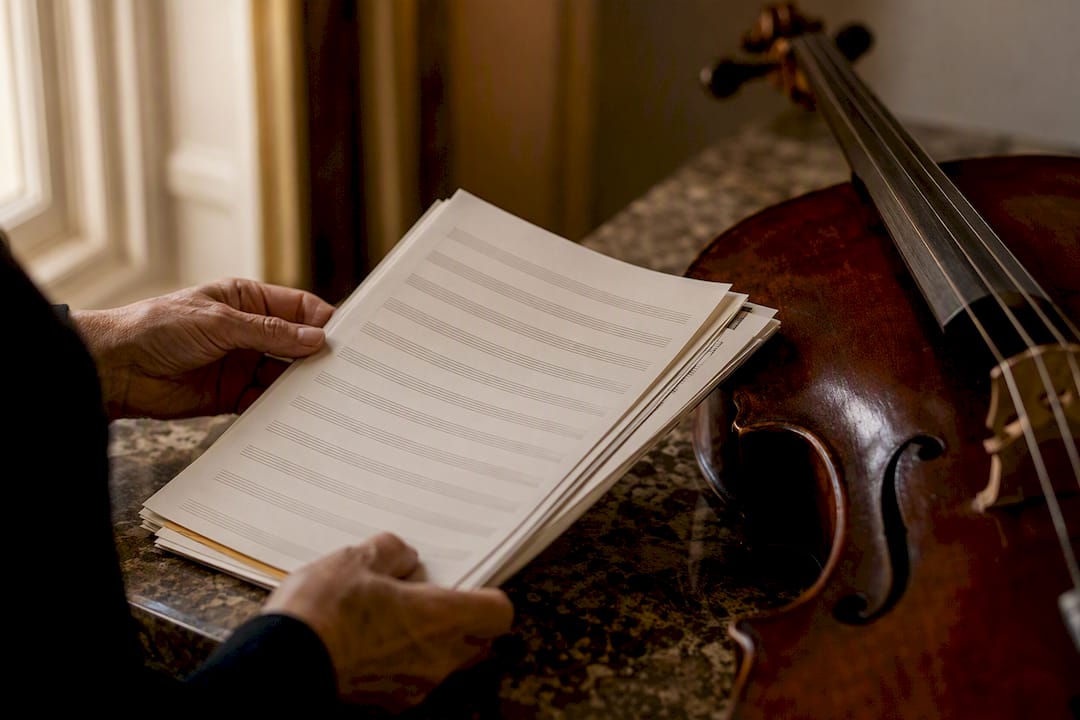
A memorial slideshow often works better with instrumentals, since lyrics can compete with photos and narration for a guest’s attention. Solo piano pieces, gentle acoustic guitar, and ambient string arrangements tend to hold emotional weight without pulling focus. Consider “Clair de Lune” by Debussy, “River Flows in You” by Yiruma, or any well recorded solo cello arrangement of a favorite hymn.
If a favorite song can’t be cleared for an online video, look for an instrumental cover in the same key and tempo. It preserves the feeling without the legal complication.
- Piano: “River Flows in You,” “Comptine d’un autre été”
- Strings: solo cello hymn arrangements, string quartet versions of pop songs
- Ambient: gentle acoustic guitar instrumentals for photo montages
Pro Tip: Keep two versions of any slideshow you plan to post online: one with the original copyrighted song for the in-person service, and a separate version using royalty-free music for the upload. It avoids Content ID flags entirely and saves you a headache during an already hard week.
A Simple Framework for Choosing Songs That Reflect the Person
Skip the endless list-scrolling. Three steps get most families to a finished playlist in under an hour.
- Inventory their music. Think through albums they played on repeat, songs from their wedding, or whatever came on the radio during long drives. This beats starting from a generic “top funeral songs” list because it starts with what they actually loved.
- Pick a spine and a spark. Choose one familiar, universally recognized song (the spine) and one deeply personal, maybe unexpected pick (the spark) that says something true about who they were. This balances personal meaning with what guests expect.
- Give each family group one moment. If siblings disagree, let one choose the prelude and another choose the recessional instead of debating every song.
Confirm venue rules, audio equipment, and do a quick rehearsal run before the day arrives.
Pro Tip: Sometimes silence works better than a song. Leaving a few quiet seconds after a reading gives guests room to feel something instead of rushing straight into the next track.
Live Musicians or Recorded Playback: What Works Better?
Live musicians bring warmth and a sense of occasion that recordings can’t quite match, especially a solo vocalist or a violinist playing a requested piece. They cost more, though, and add one more moving piece to coordinate on the day.
Recorded playback is dependable, affordable, and gives you complete control over exact timing and fades. The tradeoff is a bit less emotional immediacy.
- Always keep a recorded backup even if you’ve booked a live musician; instruments and voices have off days
- Test your actual playback equipment in the actual room beforehand, not just at home
- Reverberant chapels distort spoken-word-heavy tracks and dense orchestral mixes, so favor solo piano or acoustic guitar arrangements with clear midrange
- Run a short soundcheck with the real recording, not a similar substitute, to catch any low-frequency rumble or distortion
What Are the Copyright Rules for Funeral Music?
Most families assume playing a favorite song at a funeral carries legal risk. It almost never does. The real risk shows up only when that same service gets livestreamed or uploaded afterward.
Playing copyrighted music during an in-person service is typically covered by the venue’s existing performance license, so you generally don’t need to clear anything yourself. Livestreaming is different. The NFDA’s music licensing program covers webcasting for around $65 on top of roughly $350 for the base performance license, covering the ASCAP, BMI, and SESAC catalogs that make up most commercial music.
Uploading a recorded video afterward is the trickiest scenario, since that requires a separate synchronization license that’s rarely practical to obtain for a single event. The workaround: use royalty-free music for anything posted online, and save the original songs for the live moment only.
How Bravo Family Mortuary Helps Families Get the Music Right
Music logistics shouldn’t be one more thing you’re figuring out alone at 11 p.m. the week of the service. Bravo Family Mortuary helps San Diego County families confirm venue audio setups, check whether a livestream needs webcasting coverage, and sort out timing so the music actually lands where it should.
- Arrangements can be completed entirely online, 24/7, through our secure PartingPros portal
- We serve San Diego’s Spanish-speaking families with the same care and attention as everyone else
- We coordinate VA burial benefits paperwork for veteran families at no additional charge
- Our reviews reflect 47-plus five-star ratings on Yelp from San Diego families we’ve supported through exactly this kind of planning
If you’re not sure whether your venue needs a webcasting add on or how to plan the logistics of an online memorial, we can walk through it with you.
Tips for Involving Family and Friends in Music Selection
Music choices tend to surface old family dynamics fast. One sibling wants something reverent, another wants their parent’s favorite karaoke song, and someone else just wants it over with. None of those instincts are wrong.
Start by asking everyone the same simple question separately: “What song reminds you of them?” Collecting answers individually, rather than in a group discussion, tends to produce more honest picks and fewer arguments in the moment.
Once you have the list, sort responses into categories rather than debating which single song wins. Give the eulogy giver’s pick the after-eulogy slot. Give the grandchild’s pick the slideshow. Give the spouse’s pick the recessional. This turns a potential conflict into a shared project, and it usually means more people feel represented in the final service than if one person had made every call.
If the disagreement runs deeper than song preference, that’s usually about something else entirely, often unresolved feelings about roles or decision-making authority within the family. A clear breakdown of who handles what during funeral planning can defuse a surprising amount of that tension before it reaches the music conversation at all.
Kids and teens in the family often want to contribute too. Even a two-minute voice memo of a young grandchild saying what a song reminds them of, played before that track, can turn a music choice into something the whole family remembers.
Considerations for Cultural and Religious Music Traditions
Faith and culture shape memorial music more than almost any other factor, and getting this part right matters more than getting the “best songs” list right.
Catholic funeral Masses typically require music approved by the officiating priest or parish, often limiting selections to specific hymns during Communion and the recessional. Protestant services tend to allow more flexibility, though many pastors still prefer hymns during the formal portions of the service. Jewish funerals generally avoid instrumental music entirely, or use it sparingly, with more emphasis on prayer and readings. Buddhist services often incorporate chanting rather than Western-style songs, while some Hindu ceremonies include specific mantras tied to the cremation ritual itself.
If the deceased belonged to a specific cultural tradition, whether Filipino, Mexican, Vietnamese, or another community with its own musical customs, family elders often know which songs or hymns carry the most meaning even if the person themselves wasn’t especially religious. It’s worth asking before assuming a generic playlist will feel appropriate.
Bravo Family Mortuary works with families across San Diego County’s many cultural and faith communities, and our bilingual Spanish and English service means these conversations happen without a language barrier getting in the way of getting the details right.
Guidance on Incorporating Live Music Performance Options
A live musician changes the emotional texture of a service in a way recorded playback simply can’t replicate. A solo vocalist singing “Ave Maria” or a guitarist performing an acoustic version of a favorite song adds a sense of occasion and presence that many families remember years later.
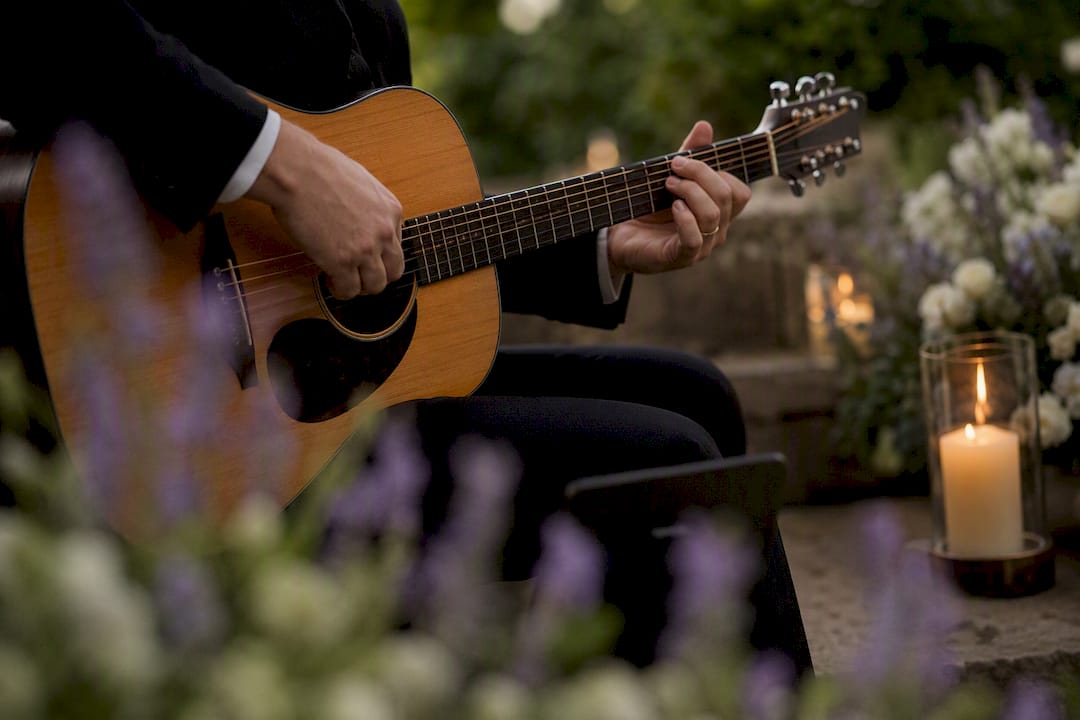
The tradeoff is coordination. Live performers need advance booking, a confirmed arrival time, and a brief rehearsal or at minimum a walkthrough of the room’s acoustics. Ask the venue whether it has a piano on site, whether there’s space for a small ensemble, and whether amplification is available if the musician needs it.
Cost varies significantly by musician and region, so get a clear quote in writing before committing, and confirm what happens if the performer cancels last minute. This is exactly why a recorded backup, even for a service built around live music, remains worth having.
Community connections often help here too. Church choirs, local musician friends of the family, or even a favorite teacher who plays an instrument can sometimes perform for little or no cost, adding a deeply personal touch that a hired professional couldn’t replicate.
Sample Short Playlists and Timing Guidance
Building a playlist gets easier once you think in blocks rather than individual songs. Most services need a prelude, one or two mid-service moments, and a recessional, roughly three to five songs total for a standard hour-long service.
Traditional service, 45 to 60 minutes:
- Prelude: “How Great Thou Art” (5 minutes as guests arrive)
- Scripture reading transition: “It Is Well with My Soul”
- After eulogy: “On Eagle’s Wings”
- Recessional: “Amazing Grace” (bagpipes optional)
Celebration of life, 30 to 45 minutes:
- Arrival: “What a Wonderful World”
- Slideshow: “In My Life”
- After remarks: “See You Again”
- Recessional: “Forever Young”
Keep each transition song under four minutes unless it’s carrying a slideshow, where five to seven minutes works better for pacing photos naturally. Fade any song at a clean verse break rather than cutting it off abruptly, and always cue the next track with at least a few seconds of silence in between so transitions don’t feel rushed.
Copyright and Licensing Basics for Funeral Homes and Livestreaming
Funeral homes handle music licensing very differently depending on whether the service stays in the room or goes online. In-person playback is almost always covered under the venue’s existing performance license, which most established funeral homes already carry as part of standard operations.
Livestreaming introduces a separate requirement. A webcasting license, available through NFDA at rates covering the major performing rights organizations, specifically covers music played during an online broadcast. Without it, a livestream technically violates copyright even if the in-person portion is fully compliant.
One added wrinkle: even licensed livestreams sometimes get muted on platforms like YouTube or Facebook due to those platforms’ own content matching systems. NFDA recommends hosting webcasts through the funeral home’s own site, Zoom, or Vimeo instead, since those platforms don’t run the same automated muting checks.
Uploading a recorded version afterward requires a synchronization license, which is rarely obtainable for a single private event. The practical solution funeral homes and families both use: swap in royalty-free music for anything posted publicly, and reserve the original songs for the live or livestreamed moment only.
A Publisher’s Perspective on Building a Meaningful Playlist
The conventional advice, “browse 100 best funeral songs and pick your favorites,” gets the order backward. Start with the person, not the list. A spine and spark approach, one familiar anchor plus one deeply personal pick, produces a service that feels intentional in twenty minutes flat, where scrolling generic rankings for hours produces a playlist that could belong to anyone.
What’s overrated: trying to fill every silence with a song. A few seconds of quiet after a eulogy often does more emotional work than another track ever could. What’s underrated: asking family members individually rather than in a group, which surfaces more honest, less negotiated answers.
Licensing confusion causes more last-minute stress than it should, mostly because families assume risk where there isn’t any and miss it where there is. In-person playback almost never needs special clearance. Livestreaming and uploads do, and that’s exactly where a good funeral home earns its keep, checking those details quietly in the background so the family never has to think about it on the day itself.
Prioritize the person’s own music first. Everything else, hymn or genre, timing or licensing, is logistics that a competent team can handle around that core decision.
— Steve Olsher
How Bravo Family Mortuary Takes Music Logistics Off Your Plate
Bravo Family Mortuary is the alternative to guessing your way through licensing forms and venue audio questions alone, at exactly the moment you have the least energy for it. Every arrangement can be completed online through our secure PartingPros portal, any hour of the day, without an in-person visit or sales pressure.
We’ll help confirm the venue’s audio setup, check whether your service needs webcasting coverage for a livestream, and walk through timing so the music lands where it should. Our pricing stays transparent from the first conversation, with no hidden fees added later. We serve San Diego’s Spanish-speaking families with equal care, and we coordinate VA burial benefits paperwork for veteran families at no additional charge.
Whether you’re planning a traditional funeral, cremation with memorial service, or celebration of life, reach out whenever you’re ready to talk through the details, including music. We are here whenever you are ready.
Sources
- Funeral Music Licensing & Webcasting | NFDA
- Funeral Music Copyright & Licensing: What You Need to Know
- Funeral