
How to Compare Funeral Home Prices: A 2026 Guide

Comparing funeral home prices means requesting itemized General Price Lists (GPLs) from multiple providers and reviewing every fee side by side before making any decisions. The FTC Funeral Rule, first enacted in 1984 and reaffirmed through 2026, gives you the legal right to receive a GPL during any in-person visit and to ask for pricing over the phone. Knowing how to compare funeral home prices protects your family from paying thousands more than necessary. Costs for identical services can vary by $2,000 to $5,000 or more within the same city. That gap is not random. It reflects differences in the basic services fee, add-ons, and how transparently each provider discloses their charges.
How to compare funeral home prices using the General Price List
The GPL is the single most important document in any funeral price comparison. Federal law requires every funeral home to hand you a GPL at the start of any in-person arrangement discussion and to provide pricing over the phone upon request. Violations of the Funeral Rule can result in federal penalties up to $50,120 per incident. That penalty exists because the law takes your right to clear pricing seriously.
A GPL is divided into three main categories:
- Basic services fee. This is the non-declinable charge every provider adds to every arrangement. It covers overhead, staff time, and coordination. You cannot opt out of it, so it is the first number to compare across providers.
- Optional goods and services. These include embalming, caskets, urns, viewing rooms, and transportation. You choose which ones you want.
- Cash advances. These are third-party costs the funeral home pays on your behalf, such as death certificates, obituary notices, and clergy honoraria.
When you call a funeral home, ask directly: “Can you email me your current General Price List and an itemized quote for a direct cremation?” A reputable provider will send it without hesitation. Transparent funeral homes readily provide GPLs by email or mail. Resistance to sharing that document is a clear signal to look elsewhere.
Pro Tip: Request GPLs from at least three providers before making any decisions. Compare the basic services fee line first, since that single number often explains most of the price difference between providers.
Key fees to compare beyond the headline price
The headline price on a funeral home’s website rarely tells the full story. Understanding each fee category prevents surprise charges on the final bill.
The basic services fee
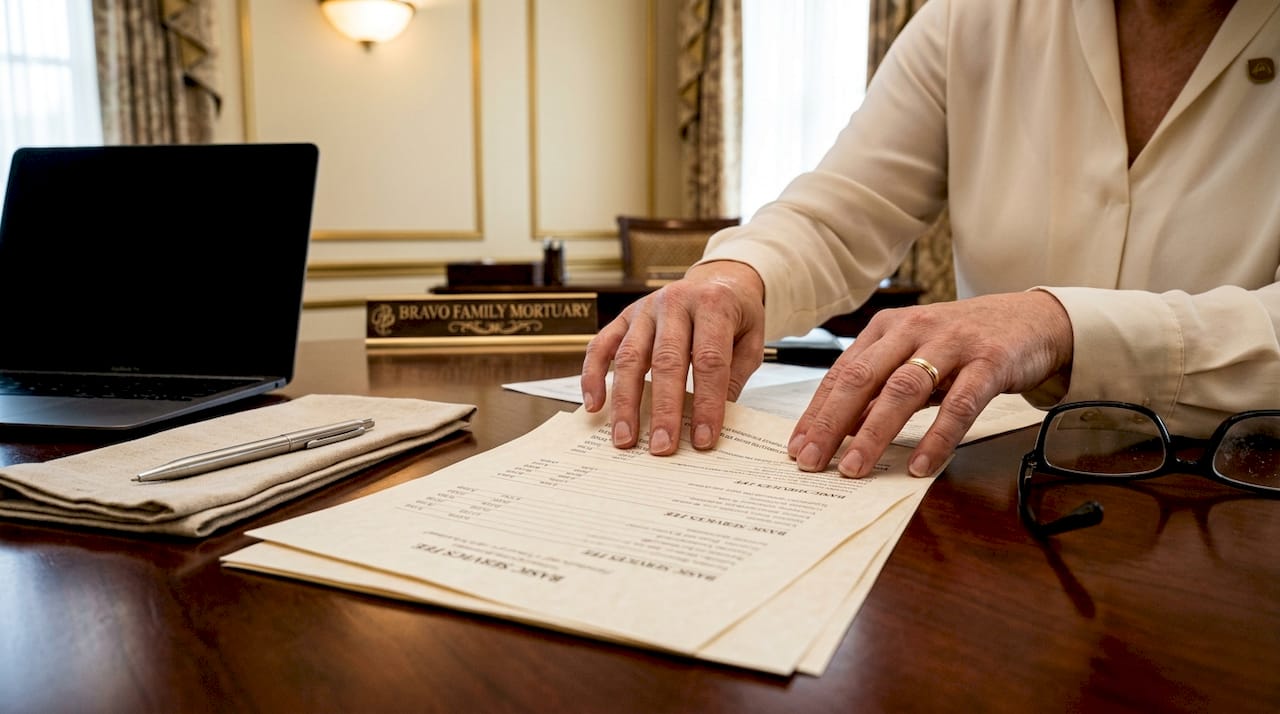
The basic services fee typically ranges from $2,000 to $3,500, though some providers charge more. This fee is non-declinable, meaning it appears on every arrangement regardless of what else you choose. Comparing this number across providers is the fastest way to gauge overall cost level.
Common add-ons
Add-ons are where costs climb quickly if you are not watching. Common examples include:
- Embalming: Often presented as required, but it is legally optional in most circumstances.
- Refrigeration: Ranges from $100 to $300 and is sometimes listed separately from the basic services fee.
- Transportation: Moving a loved one between locations can add $500 to $1,500 depending on distance and timing.
- After-hours charges: Removal calls outside business hours often carry surcharges of $300 to $800.
Hidden operational fees like these can add several hundred to over a thousand dollars to the final price if you do not ask about them early.
Cash advances explained
Cash advances are third-party costs the funeral home collects and passes along. The FTC requires funeral homes to disclose cash advance markups, but does not require them to state the exact markup amount. This means cash advances can quietly inflate your total. Always ask: “Are your cash advance fees passed through at cost, or do you add a markup?”
| Fee Category | Typical Range | Notes |
|---|---|---|
| Basic services fee | $2,000–$3,500 | Non-declinable; compare this first |
| Embalming | $500–$900 | Optional in most cases |
| Refrigeration | $100–$300 | Sometimes bundled, sometimes separate |
| Transportation surcharge | $500–$1,500 | Varies by distance and time of day |
| After-hours removal | $300–$800 | Ask specifically; often not on GPL |
| Death certificates (each) | $15–$25 | Third-party fee; ask about markups |
How to use standardized scenarios for a fair price comparison
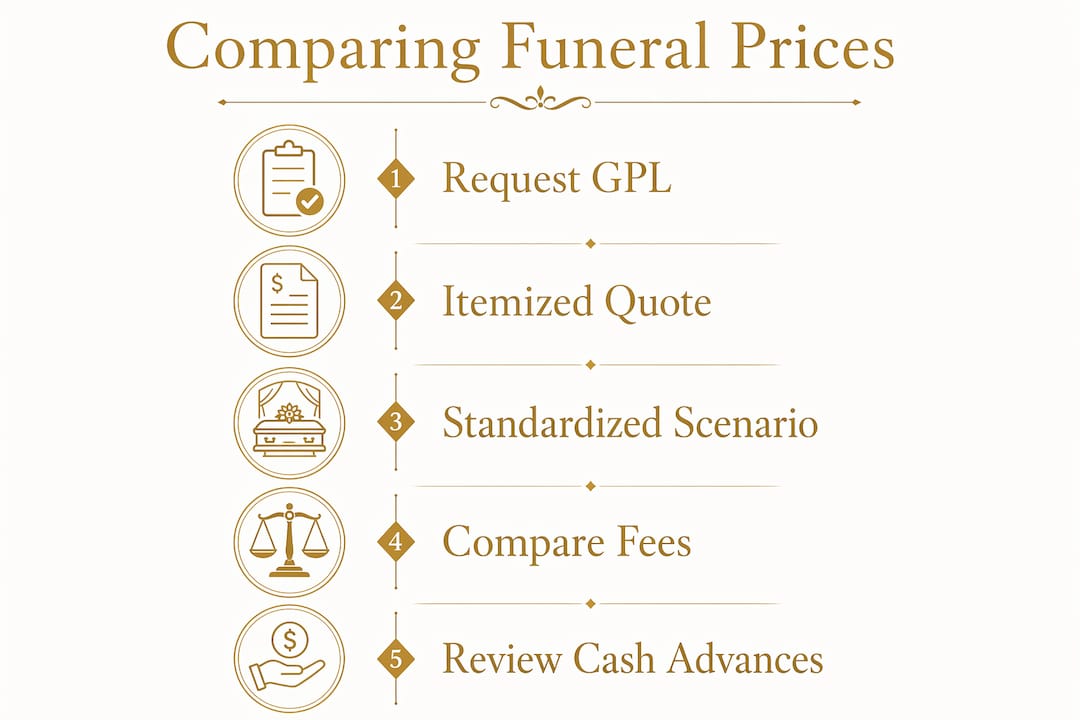
The most reliable way to compare funeral service costs is to describe the exact same arrangement to every provider you contact. This is called a standardized scenario approach, and it prevents you from accidentally comparing a basic package at one home to a premium package at another.
- Choose your scenario. Pick one service type: direct cremation, cremation with a memorial service, or traditional burial with graveside service. Use the same scenario for every call.
- List every item you need. Write down the specific services: transportation, death certificates (specify how many), an urn or casket, and any viewing or service time.
- Request an itemized total. Ask each provider to give you a written quote that lists every charge separately, including the basic services fee and all cash advances.
- Add the totals yourself. Do not rely on a provider’s summary number. Add each line item to confirm the total matches what they quoted.
- Note what is excluded. Ask each provider: “Is there anything that would add to this total that is not listed here?” Write down the answer.
The lowest headline price often excludes services you will need. Using a standardized scenario forces every provider to quote the same scope of work.
Package deals that bundle multiple items can obscure individual costs. Always ask for the GPL first, then request itemized prices for each component within any package. This lets you remove services you do not need and see exactly what you are paying for.
Pro Tip: Ask for written estimates that include all required disclosures under the FTC Funeral Rule. A provider who gives you a verbal quote only is not meeting the standard you deserve.
How to avoid hidden fees when comparing funeral homes
Hidden fees are the most common source of frustration for families after the arrangement is complete. Asking the right questions upfront eliminates most of them.
Questions to ask every provider before signing anything:
- “Do you charge extra for after-hours or weekend removals?”
- “Is transportation between the funeral home, crematory, and cemetery included, or billed separately?”
- “Are there any fees not listed on your GPL that could apply to my arrangement?”
- “Do your cash advance fees include any markup above the actual third-party cost?”
- “Will you provide a written estimate that separates your direct charges from cash advances?”
Written estimates that clearly separate funeral home charges from cash advances give you the clearest picture of total cost. They also make it easier to negotiate or remove items you do not want.
The FTC Funeral Rule gives you the right to refuse any service you do not want. No funeral home can legally require you to purchase a package. If a provider tells you that certain services are required when they are not, that is a red flag. You can say calmly: “I would like to select services individually from your GPL rather than choose a package.” A reputable provider will respect that request without pressure.
Cremation vs. traditional burial: comparing costs line by line
The cost difference between cremation and burial is significant at the national level. The median cost of a funeral with cremation is approximately $6,280, while traditional burial averages around $8,300. That $2,000+ gap reflects the cost of a casket, burial plot, and grave liner, none of which apply to cremation.
| Service Component | Cremation | Traditional Burial |
|---|---|---|
| Basic services fee | Included | Included |
| Crematory or burial fee | $300–$800 | $1,500–$3,500 (plot + opening) |
| Container (urn or casket) | $100–$1,500 | $1,000–$10,000+ |
| Grave liner or vault | Not required | $1,000–$2,000 |
| Memorial or graveside service | Optional add-on | Often included |
| Death certificates | Same for both | Same for both |
Direct cremation offers the most affordable baseline and is a useful starting point when budget is a priority. It excludes viewing and formal service fees, which are added separately if your family wants them. Bravo Family Mortuary lists cremation service options and burial services with transparent, all-inclusive pricing so you can compare both paths without guessing.
When comparing providers for either service type, ask each one to quote the same components. A cremation quote that excludes the death certificate fee and a burial quote that includes it are not comparable. Standardize the line items, then compare the totals.
Key Takeaways
Comparing funeral home prices accurately requires itemized GPLs, standardized service scenarios, and direct questions about hidden fees and cash advance markups.
| Point | Details |
|---|---|
| Request GPLs from multiple providers | The GPL is your legal right and the only reliable basis for a fair price comparison. |
| Compare the basic services fee first | This non-declinable charge often explains most of the price difference between providers. |
| Ask about hidden fees directly | After-hours, transportation, and refrigeration charges frequently do not appear on the GPL. |
| Use standardized scenarios | Describe the same arrangement to every provider to get comparable, apples-to-apples totals. |
| Separate cash advances from direct charges | Cash advances may include markups; always ask and get the breakdown in writing. |
What I have learned from watching families navigate this process
I have sat across from hundreds of families at some of the hardest moments of their lives. The ones who felt most at peace with their decisions were not necessarily the ones who spent the least. They were the ones who felt informed. They asked questions, they got answers in writing, and they chose services that reflected what actually mattered to them.
The families who struggled most were the ones who felt rushed. Grief creates urgency, and some providers use that urgency to skip the GPL conversation entirely. A family agrees to a package before they have seen a single line-item price. Weeks later, they realize they paid for embalming they did not want or a casket rental that was never explained.
My honest advice: slow down by one hour. That one hour spent requesting GPLs from two or three providers, comparing the basic services fee, and asking about cash advances can save your family $1,000 to $3,000. You are not being difficult by asking for a written, itemized quote. You are exercising a right the federal government put in place specifically to protect you.
Family-owned mortuaries tend to handle these conversations differently than large corporate chains. When the person answering your questions is also the person who will care for your loved one, transparency is not a policy. It is personal. That is the difference you feel when you work with a provider who answers to families rather than shareholders.
— Steve Olsher
Bravo Family Mortuary: transparent pricing for San Diego families
Bravo Family Mortuary provides all-inclusive, clearly itemized pricing for every service, with no hidden fees and no pressure to purchase packages you do not need. You can review funeral and cremation pricing online at any hour, or explore the full range of funeral and cremation services available across San Diego County.

Arrangements can be completed entirely online through the secure PartingPros portal, 24 hours a day, 7 days a week. Bravo Family Mortuary is bilingual, serving Spanish-speaking families with equal care, and coordinates VA burial benefits paperwork for veteran families at no additional charge. We are here whenever you are ready.
FAQ
What is a General Price List and why do I need it?
A General Price List is a federally required document that itemizes every service and product a funeral home offers with its price. Requesting it from multiple providers is the foundation of any fair funeral home price comparison.
Can I ask for funeral home prices over the phone?
The FTC Funeral Rule guarantees your right to receive pricing information over the phone. Any funeral home that refuses to provide prices by phone is not complying with federal law.
What is the difference between a basic services fee and a package price?
The basic services fee is a non-declinable charge that covers the funeral home’s overhead and staff coordination. A package price bundles multiple services together, which can make it harder to see what each item costs individually.
How much can I save by comparing funeral home prices?
Costs for identical services can vary by $2,000 to $5,000 or more within the same city. Requesting itemized quotes from at least three providers and comparing the basic services fee directly is the most reliable way to find the best value.
Is direct cremation always the least expensive option?
Direct cremation is typically the most affordable service type because it excludes viewing, embalming, and formal service fees. Adding a memorial service or celebration of life increases the total, so ask for itemized pricing on each add-on separately.