
How Remote Funeral Planning Works: A Family Guide

Remote funeral planning lets you arrange a loved one’s services entirely from a distance, using phone, video calls, secure online portals, and trusted local contacts to handle every detail. You do not need to be physically present to make meaningful, dignified arrangements. Here is what the process looks like in practice:
- Decisions happen remotely. You choose services, sign authorizations, and review pricing online through a funeral home’s digital portal.
- Local tasks get delegated. A trusted person on the ground handles flowers, venue setup, and any paperwork that requires a physical signature.
- Communication stays centralized. One family member acts as the main contact with the funeral home to prevent conflicting instructions.
- Digital tools connect everyone. Video platforms, shared documents, and live streaming bring family members together across any distance.
When a funeral home offers 24/7 online arrangements and transparent, all-inclusive pricing, the entire process becomes manageable even during the hardest moments.
How remote funeral planning works: establishing clear communication
Fragmented communication is the most common source of errors in remote arrangements. When multiple family members contact the funeral home independently, conflicting requests create confusion and delays. Designating one person as the single point of contact solves this immediately.
That person relays decisions to the funeral home, collects updates, and shares them with the rest of the family through a shared document everyone can view in real time. Google Docs or a shared notes app works well for this. Everyone sees the same information, and no detail gets lost in a text thread.
- Assign one family member as the primary liaison with the funeral home.
- Use a shared, real-time document to log decisions, questions, and confirmations.
- Schedule brief check-in calls at set times rather than sending scattered messages throughout the day.
- Address misunderstandings in writing so there is a clear record of what was agreed.
Pro Tip: Ask the funeral home to send all confirmations by email, not just verbally over the phone. A written record protects your family if any detail is disputed later.
How to choose a funeral home that supports remote arrangements
Not every funeral home is equipped for remote coordination. The right provider makes the process feel supported, not stressful. Pricing transparency is the clearest signal of a trustworthy partner. Under the FTC Funeral Rule, funeral homes are required to provide an itemized General Price List so families can select only the services they actually want.
When evaluating a funeral home remotely, look for these qualities:
- Published, all-inclusive pricing with no hidden fees, available online before you call.
- Responsiveness — a provider that answers calls and emails promptly, including evenings and weekends.
- Bilingual service if your family includes Spanish-speaking members who need clear communication.
- Family-owned independence, which typically means decisions are made by people who answer to families, not corporate shareholders.
- Online arrangement capability, including a secure portal for document uploads and service selections.
Bravo Family Mortuary, for example, publishes its full pricing online and allows families to complete every step through its PartingPros portal at any hour, without an in-person visit. That kind of access matters when you are coordinating from another city or state.

Which digital tools help you coordinate from a distance?
Modern funeral homes increasingly offer digital portals where families complete legal authorizations, upload documents, and confirm service selections with legally compliant e-signatures, all without setting foot in an office. That capability removes the single biggest barrier to remote planning.
Beyond the funeral home’s own portal, a few other tools carry real weight:
- Video platforms like Zoom or Google Meet for family meetings and consultations with the funeral director.
- Live streaming services to bring remote mourners into the service in real time. Audio quality matters more than video here. Using a dedicated microphone and testing the stream 24–48 hours in advance prevents disruptions during the service itself.
- Cloud storage such as Google Drive or Dropbox for sharing signed documents, photos, and written tributes securely.
- Shared calendar apps to coordinate timing across time zones for family members joining virtually.
For families planning a virtual or hybrid memorial, interactive elements like calling guests by name, shared rituals, and structured participation reduce passive viewing and keep remote attendees genuinely connected to the service.
Delegating in-person tasks to someone you trust
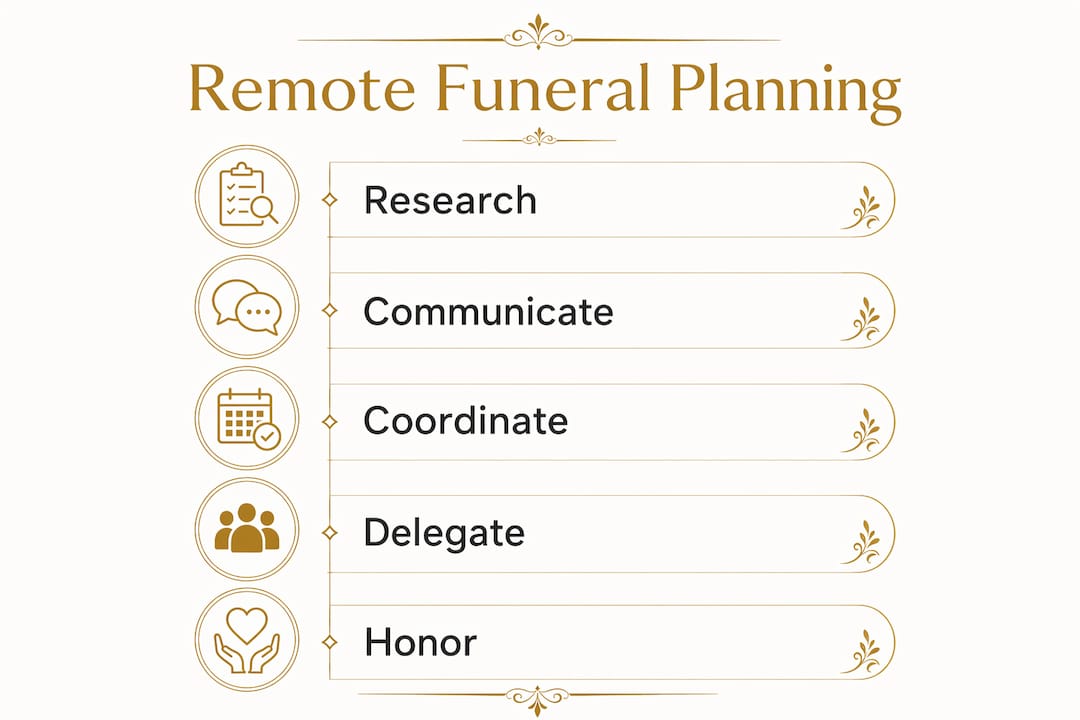
Some tasks simply require a physical presence. Flowers need to be ordered and delivered. A venue may need setup. Certain documents require a wet signature. Identifying these tasks early and assigning them to a reliable local contact prevents last-minute scrambles.
Your local delegate does not need to make decisions. Their role is execution, based on clear instructions from you.
- List every task that requires physical presence before the service date.
- Choose a delegate who is organized, calm under pressure, and available during the days surrounding the service.
- Provide written instructions for each task, including vendor contacts, addresses, and timing.
- Build in a daily check-in so you know each item is on track.
Pro Tip: Give your local delegate a small discretionary budget for unexpected costs, like last-minute supply runs, so they are not waiting on your approval for minor decisions.
Organizing documents securely from anywhere
Death certificates, cremation or burial authorizations, and signed contracts are the paperwork backbone of any funeral arrangement. Managing them remotely requires a secure, organized approach. Funeral homes that accept e-signatures for legal authorizations make this process far smoother.
- Death certificates: The funeral home typically files these, but you will need certified copies for banks, insurance companies, and estate matters. Order more than you think you need.
- Authorization forms: Most states allow electronic signatures for cremation or burial authorizations. Confirm this with your funeral home before assuming.
- Contracts: Review every line before signing. Understand what is guaranteed versus what may be subject to price adjustment.
- Digital repository: Store all signed documents in a password-protected cloud folder accessible to the family members who need them. See what a funeral contract should include before you sign anything.
Honoring cultural and religious traditions from a distance
Cultural and religious preferences do not become less important because you are planning from afar. They require more deliberate communication, not less. Share specific traditions, rituals, and any restrictions in writing with the funeral home early in the process.
- Provide written descriptions of any required rituals, prayers, or ceremonial elements.
- Coordinate with clergy or religious leaders directly via video call so they can participate or guide the service remotely.
- Ask the funeral home whether they have experience with your family’s traditions. A provider who has handled similar services before will anticipate details you might not think to specify.
- For virtual attendees joining a cultural ceremony, brief them in advance on what to expect and how they can participate meaningfully.
Families navigating complex care decisions alongside funeral planning may also find guidance on coordinating family responsibilities helpful when multiple people are involved from different locations.
Staying connected after the service
The work does not end when the service concludes. Post-service follow-up matters both practically and emotionally, and most of it can be handled remotely.
- Paperwork and payments: Confirm that all invoices are settled and that you have received every document you need for estate purposes.
- Death certificate distribution: Send certified copies to financial institutions, the Social Security Administration, and any relevant insurance carriers.
- Virtual memorials: A follow-up gathering on Zoom or a private online memorial page gives family members who could not attend a chance to share memories and grieve together.
- Grief resources: Organizations like the National Alliance for Grieving Children and the American Foundation for Suicide Prevention offer remote support programs. Your funeral home may also provide referrals to local grief counselors.
Checking in with your local delegate after the service is also worth doing. They carried real responsibility during a difficult time, and a direct acknowledgment of that goes a long way.
Expert insights on getting remote planning right
The most consistent advice from funeral professionals comes down to one principle: separate what requires a physical presence from what does not, and handle each category accordingly. Technology handles decisions; trusted people handle errands. Keeping those two tracks clear prevents the confusion that derails remote arrangements.
A few other insights worth knowing:
- Preplan when possible. Preplanning saves money by locking in prices before inflation and removing the pressure of making financial decisions while grieving. It also gives your family a clear roadmap when the time comes.
- Understand prepaid plan risks. Financial advisor Dave Ramsey advises against prepaying funeral expenses because funds are often locked in low-return accounts and can be difficult to recover if a funeral home closes. Preplanning your wishes while saving separately gives you more flexibility.
- Know your contract type. Guaranteed prepaid contracts lock in today’s prices; non-guaranteed contracts leave your family responsible for any price increases at the time of need. Always ask which type you are signing.
- Engage virtual attendees actively. Passive video viewing creates emotional distance. Address remote guests by name, include them in moments of silence, and share the order of service in advance so they can follow along.
- Request itemized pricing. The FTC Funeral Rule gives you the right to an itemized General Price List and the right to decline any service you do not want. Use both.
Key Takeaways
Remote funeral planning works best when decisions are handled digitally, local tasks are delegated clearly, and one family member serves as the single point of contact with the funeral home.
| Point | Details |
|---|---|
| Centralize communication | Designate one family liaison and use shared real-time documents to prevent conflicting instructions. |
| Choose a transparent provider | Look for published, itemized pricing and a secure online portal that accepts e-signatures. |
| Delegate local tasks in writing | Assign a trusted on-site contact with clear written instructions for every task requiring physical presence. |
| Preplan rather than prepay | Preplanning locks in your wishes and saves money; prepaying ties up funds with limited flexibility. |
| Prioritize audio for virtual services | Test streams 24–48 hours in advance and use a dedicated microphone for clear sound quality. |
Bravo Family Mortuary is here whenever you are ready
Bravo Family Mortuary is a family-owned, 5-star rated funeral home serving all of San Diego County, 24 hours a day, 7 days a week. Whether you are planning from across the country or across town, you can complete every arrangement through our secure PartingPros portal at any hour, with transparent all-inclusive pricing and no hidden fees. We serve English and Spanish-speaking families with equal care, and we coordinate VA burial benefits paperwork for veteran families at no additional charge.
Explore our funeral and cremation services or review our full pricing online. We are here whenever you are ready.