
How Cremation Identification Works: A Family Guide

Cremation identification is defined as the secure, multi-step process that confirms a deceased person’s identity from the moment they are transferred into care through the return of their ashes to the family. Understanding how cremation identification works gives you something real to hold onto during an incredibly difficult time. The Cremation Association of North America (CANA) recognizes a chain-of-custody system built on physical ID tags, signed legal authorization, and repeated verification checks. At Bravo Family Mortuary, this process is carried out with full transparency so your family always knows your loved one is in the right hands.
How cremation identification works: intake and first verification
The first step in cremation process identification happens the moment a person is transferred into the mortuary’s care. A staff member matches the deceased’s government-issued ID or hospital wristband to the paperwork received from the facility. Any discrepancy stops the process immediately until it is resolved.
Identity verification begins at transfer, matching government or facility IDs to paperwork before the deceased is moved. This step is not a formality. It is the foundation of every verification that follows.

The signed cremation authorization form is the legal cornerstone of the entire chain of custody. Without signed authorization, the cremation process cannot legally proceed. This document is signed by the next of kin and kept on file throughout every stage.
Once identity is confirmed and authorization is signed, the mortuary assigns a unique identification number and opens a chain-of-custody log. Every person who handles the remains, and every location the remains move through, is recorded in that log. This creates a verifiable paper trail from day one.
- Government-issued ID or hospital wristband is matched to intake paperwork
- Signed cremation authorization form is collected from next of kin
- A unique identification number is assigned and the chain-of-custody log is opened
- All discrepancies are flagged and resolved before any further steps proceed
Pro Tip: Ask the mortuary to confirm in writing that the chain-of-custody log has been opened at intake. This simple request sets a clear expectation for documentation from the very start.
What ID tags and tracking systems do during cremation
The physical centerpiece of cremation ID methods is the stainless steel identification tag. Reputable crematories assign a unique metal ID disc at intake that stays with the deceased throughout the entire process. Stainless steel is used because cremation reaches temperatures of 1,400–2,000°F, and the tag must survive intact.
The tag is stamped with a unique number that links directly to the deceased’s file. It is placed inside the cremation chamber with the remains. A duplicate tag is also placed on the exterior of the container or urn, adding a second layer of redundancy. Doubling the identification tags prevents mix-ups even if one tag is damaged or misread.
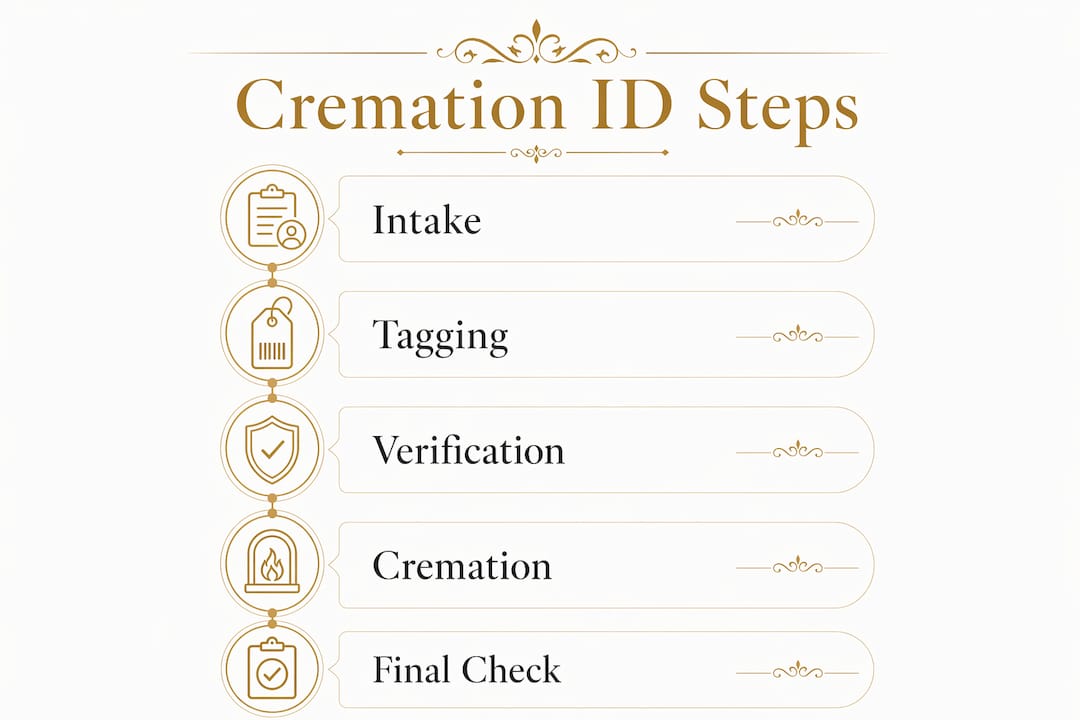
Technology adds another layer of protection on top of the physical tags. Barcodes are scanned at intake, loading, and recovery to prevent errors and create a full audit trail. Each scan is time-stamped and logged, so there is a digital record of every point in the process.
| Identification method | When it is used | Purpose |
|---|---|---|
| Stainless steel ID tag (interior) | Placed at intake, stays in chamber | Survives cremation and confirms identity of remains |
| Duplicate tag (exterior container) | Applied before cremation | Matches urn or container to the correct file |
| Barcode scanning | Intake, loading, and recovery | Creates a digital audit trail at each step |
| Video surveillance | Throughout the facility | Provides oversight and supports accountability |
| Chain-of-custody log | Every transfer and handling event | Documents who handled remains and when |
Pro Tip: Ask your provider whether their facility uses barcode scanning at every stage. A mortuary that can answer this question specifically is one that takes identification seriously.
What verification checks happen before, during, and after cremation
Identification is not a single event. Funeral professionals emphasize that it is an iterative process with repeated checks at every critical transition. This matters because human error is most likely at handoff points, and repeated checks catch mistakes before they become irreversible.
The most critical moment is the three-point verification check immediately before cremation begins. All three of the following must match exactly:
- The name on the cremation authorization paperwork
- The physical identification on the deceased (wristband or tag from the facility)
- The unique number on the stainless steel ID tag assigned at intake
If these three points do not match, cremation is halted until the discrepancy is resolved. No exceptions. This single protocol is the strongest safeguard in the entire process.
After cremation, the remains are processed and the ID tag is recovered from the chamber. The tag number is verified again against the file before the remains are packaged. The tag is then placed inside the urn or container along with the ashes, so your family receives it as part of the final return.
Each cremation is performed individually. Remains from different individuals are never placed in the chamber at the same time. This prevents any possibility of commingling and is a standard practice across reputable providers.
The chain-of-custody log documents every transfer, including the hospital transfer, intake, authorization, cremation, processing, and return of ashes. Every entry includes who handled the remains and the exact time. This log is the complete record of your loved one’s care.
How families can confirm identity and find peace of mind
You have the right to ask questions and request documentation. Industry experts recommend that families ask providers about their internal identification systems, how often verification checks occur, and what documentation is available. A trustworthy provider answers these questions directly and without hesitation.
Families can request photographs of the stainless steel ID tag before cremation begins. The photograph shows the unique number stamped on the tag, which you can match to your paperwork. This visual confirmation is a simple but powerful way to feel certain before the process starts.
Families have the right to request chain-of-custody logs to review every documented step. Seeing the log reduces anxiety because it replaces uncertainty with a clear, factual record. You can see exactly who handled your loved one and when.
- Request a photograph of the ID tag before cremation
- Ask for a copy of the chain-of-custody log at any point
- Ask whether the facility uses barcode scanning and video surveillance
- Inquire about the three-point verification check and when it is performed
- Ask whether you may be present at the start of cremation
Some crematories allow families to witness or even initiate the start of cremation. Private viewings before cremation are also available at many providers. Both options give families a direct, personal confirmation of identity and provide meaningful closure.
Pro Tip: Write your questions down before you call or meet with the mortuary. Grief makes it easy to forget what you wanted to ask. A short list gives you confidence and helps you get the answers you need.
Key takeaways
Cremation identification works through a continuous chain of custody that begins at intake, relies on a stainless steel ID tag that survives the cremation process, and is confirmed through a mandatory three-point verification check before cremation begins.
| Point | Details |
|---|---|
| Chain of custody starts at intake | Identity is confirmed against government ID and paperwork before any other step proceeds. |
| Stainless steel ID tag travels with remains | The tag survives temperatures up to 2,000°F and is recovered and verified after cremation. |
| Three-point verification is mandatory | Paperwork name, physical ID, and tag number must all match before cremation can begin. |
| Families can request documentation | Chain-of-custody logs and ID tag photographs are available to families who ask. |
| Individual cremations prevent commingling | Each cremation is performed separately, with no mixing of remains from different individuals. |
Why I believe transparency is the most important thing a mortuary can offer
When families come to me with questions about identifying cremated remains, the fear underneath those questions is always the same. They are not asking about metal tags or barcodes. They are asking: “How do I know this is really my person?” That question deserves a direct, honest answer, not a reassuring phrase.
The mortuaries that earn real trust are the ones that show their work. They hand you the chain-of-custody log without being asked. They send you the photograph of the ID tag before you think to request it. They explain the three-point verification check in plain language because they are proud of it, not because they are required to. That kind of transparency is not a feature. It is a reflection of how a provider views the families they serve.
Family-owned mortuaries like Bravo Family Mortuary operate differently from large corporate providers because their reputation is personal. Every family they serve is a neighbor, not a transaction. That accountability changes how identification protocols are practiced, not just described. When you ask a family-owned mortuary a hard question, you get a real answer from a real person who will be at your side through the entire process.
My honest advice: if a provider hesitates when you ask about their identification process, that hesitation tells you something. Ask the question. A good provider will welcome it.
— Steve Olsher
Bravo Family Mortuary’s approach to cremation identification
At Bravo Family Mortuary, cremation identification is not a background process. It is something we walk families through directly, because you deserve to understand exactly how your loved one is cared for.

Our team follows a full chain-of-custody protocol from the moment your loved one comes into our care. We use stainless steel ID tags, barcode tracking, and thorough documentation at every stage. Families can request ID tag photographs and chain-of-custody logs at any time. Our San Diego cremation services are available 24 hours a day, 7 days a week, with online arrangements through our secure PartingPros portal. We are family-owned, 5-star rated, and bilingual. We are here whenever you are ready.
FAQ
What is a cremation ID tag?
A cremation ID tag is a stainless steel disc stamped with a unique number that is assigned to the deceased at intake and remains with the remains throughout the entire cremation process. It survives temperatures up to 2,000°F and is placed inside the urn with the ashes upon return to the family.
How does the three-point verification check work?
Before cremation begins, the operator confirms that the name on the authorization paperwork, the physical ID on the deceased, and the number on the stainless steel tag all match exactly. If any of the three points do not match, cremation is stopped until the discrepancy is resolved.
Can I request proof of how my loved one was identified?
Yes. Families can request photographs of the ID tag before cremation and a copy of the chain-of-custody log at any point. These documents record every transfer, every verification, and every person who handled the remains.
Are remains from different people ever cremated together?
No. Reputable providers perform each cremation individually. Remains from different individuals are never placed in the chamber at the same time, which prevents any commingling.
What questions should I ask a cremation provider about identification?
Ask whether they use stainless steel ID tags, barcode scanning, and video surveillance. Ask when the three-point verification check is performed and whether you can receive a photograph of the ID tag. A provider who answers these questions clearly and willingly is one you can trust.