
Hospice vs Palliative Care: Medicare’s 6-Month Rule for San Diego

Palliative care is comfort-focused support available at any stage of a serious illness, while hospice is a Medicare-aligned, comfort-only benefit for people nearing the end of life, usually when a doctor estimates life expectancy at six months or less. The National Institute on Aging, Medicare, and the American Cancer Society all draw the same line: hospice is technically one form of palliative care, just narrowed to a specific timeline and a specific goal.
TL;DR:
- Hospice care requires a prognosis of about six months or less and stops curative treatments, while palliative care can start immediately after diagnosis without prognosis restrictions.
- Medicare covers hospice in two 90-day periods followed by unlimited 60-day periods with ongoing recertification, but patients can leave hospice if their condition changes.
- Hospice provides around-the-clock symptom management, emotional support, and medical equipment, whether at home, in a facility, or in a hospice inpatient unit.
- Palliative care teams work mainly inside hospitals or outpatient clinics, coordinating with existing doctors, while hospice teams usually visit the patient at home or in care facilities.
- Families should prepare and gather documentation early, as hospice and palliative care referrals are quick processes that can be paused or revoked if circumstances change.
Table of Contents
- What Palliative Care Actually Covers
- What Hospice Care Means for a Family
- Hospice vs Palliative Care: The Differences That Actually Matter
- Medicare Hospice Rules: The 6-Month Prognosis and What Gets Covered
- Who Shows Up and Where Care Happens
- How to Get Palliative or Hospice Care Started
- When Hospice Care Leads to Funeral Planning
- Bravo Family Mortuary Is Here When You’re Ready
- Where These Facts Come From
- Sources
- FAQ
What Palliative Care Actually Covers
Palliative care exists to make a serious illness more livable, whether that illness lasts six months or six years. It works alongside chemotherapy, dialysis, surgery, or any other treatment aimed at curing or controlling disease. The goal, according to the NIA, is to anticipate, prevent, and treat suffering, not just react to it after the fact.
A palliative care team typically handles:
- Pain and symptom management, including nausea, fatigue, and breathing trouble
- Medication review to reduce side effects or drug interactions
- Coordination between specialists so treatment plans don’t conflict
- Counseling for the patient and family, including help processing a diagnosis
- Advance care planning conversations, well before any crisis hits
That team usually includes a physician, a nurse or nurse practitioner, a social worker, and often a chaplain or counselor, all working together rather than in separate silos. Cleveland Clinic notes that people who start palliative care early tend to manage symptoms better and avoid unnecessary hospital trips. You’ll find palliative teams in hospitals, outpatient clinics, and increasingly through home visits, usually reached through a referral from your primary doctor or a hospital’s palliative consult service.
What Hospice Care Means for a Family
Hospice shifts the goal entirely. Once curative treatment stops, hospice care exists purely to protect comfort, dignity, and quality of life for whatever time remains. It’s not a facility. It’s an approach, and Medicare confirms it can happen at home, in a nursing facility, in a hospital, or in a dedicated hospice inpatient unit.
Families enrolled in hospice typically receive:
- 24/7 access to a nurse or on call clinician for symptom crises
- Medications aimed at comfort, like pain relief and anti anxiety drugs
- Medical equipment such as hospital beds, wheelchairs, or oxygen
- Spiritual and emotional support for the patient and the whole family
- Short term respite care so exhausted caregivers can rest
- Bereavement support for the family that continues after the death
Hospice is legally and clinically a specialized branch of palliative care, but it comes with rules palliative care doesn’t have: a doctor must certify a terminal prognosis, and the patient has to formally elect to receive comfort focused care instead of curative treatment. That election, not the illness itself, is what triggers the hospice benefit.
Hospice vs Palliative Care: The Differences That Actually Matter
The distinction between hospice and palliative care usually comes down to four practical questions.
- Timing. Palliative care starts the day of diagnosis if you want it. Hospice generally starts when a physician expects a life expectancy of about six months or less.
- Goal. Palliative care manages symptoms while treatment continues. Hospice manages symptoms after curative treatment has stopped.
- Treatment rules. Palliative care places no restrictions on what other treatments you pursue. Electing Medicare hospice typically means Medicare stops paying for curative treatment of the terminal illness.
- Coverage and prognosis. Hospice eligibility hinges on a prognosis, which is a clinical estimate, not a guarantee. Patients who stabilize or improve may leave hospice and resume other care.
That last point trips up a lot of families. A six month prognosis is a professional judgment, not a countdown clock, and it can be revisited.
Medicare Hospice Rules: The 6-Month Prognosis and What Gets Covered
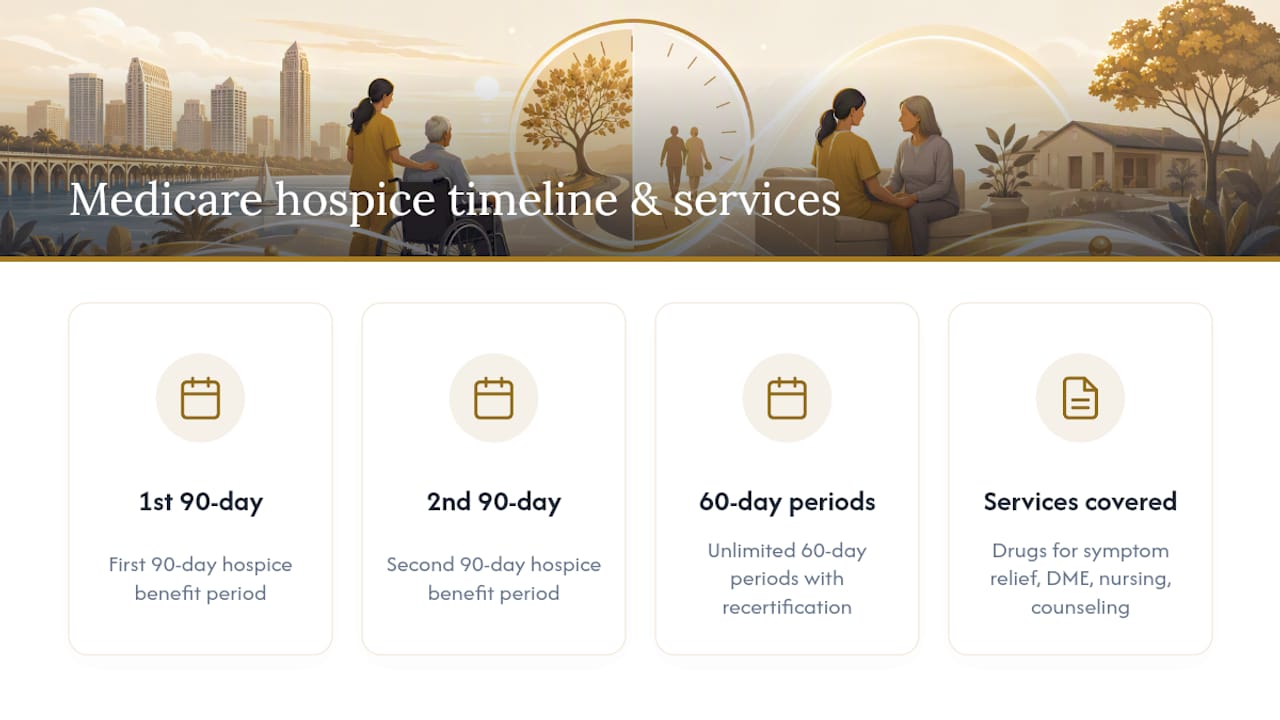
Medicare Part A covers hospice once a hospice doctor and the patient’s attending physician both certify a terminal illness with a life expectancy of six months or less, assuming the disease runs its usual course. The patient then signs an election statement choosing comfort care over curative treatment for that illness.
Coverage runs in structured periods. According to CMS, the benefit starts with two 90-day periods, followed by unlimited 60-day periods, as long as recertification confirms the prognosis still holds.
Medicare hospice benefit periods: two 90-day periods, then unlimited 60-day periods with ongoing recertification.
Medicare.gov lists what’s included: drugs for symptom relief, durable medical equipment, skilled nursing, social work, counseling, short-term inpatient care, and bereavement services. Curative treatments tied to the terminal diagnosis are typically waived once hospice starts. Children on Medicaid or CHIP get an important exception under the Concurrent Care for Children provision, allowing curative and hospice care at the same time. VA benefits, Medicaid, and private insurance each have their own hospice rules, so it’s worth confirming coverage details directly with the plan. And if a patient improves or wants to pursue treatment again, hospice election can be revoked.
Who Shows Up and Where Care Happens
Both palliative and hospice care rely on an interdisciplinary team, not a single doctor working alone. Expect some combination of a physician, a nurse, a social worker, a chaplain or spiritual counselor, a home health aide, and trained volunteers.
- Palliative teams often work inside hospitals or outpatient clinics, coordinating directly with your existing oncologist, cardiologist, or primary care doctor.
- Hospice teams usually come to the patient, whether that’s a private home, an assisted living facility, or a hospice inpatient unit.
- Availability varies by agency and by county, and pediatric hospice programs are less common, so it’s worth asking directly what a given provider offers.
- Veterans have additional options through VA-coordinated hospice benefits, which a knowledgeable funeral provider can help families navigate when the time comes.
How to Get Palliative or Hospice Care Started
Getting care in motion usually takes three phone calls and a bit of paperwork, not a complicated application process.
- Call the treating physician first. Ask directly whether a palliative consult makes sense now, even if curative treatment continues.
- Ask a hospital’s palliative or hospice intake team for an evaluation. Most hospitals and many home health agencies can arrange this within days.
- Gather documentation. Insurance cards, a current medication list, and any advance directive or power of attorney paperwork speed up intake significantly.
When you talk to a hospice or palliative team, ask about 24/7 phone coverage, how medications and equipment get delivered, what caregiver respite looks like, and how much (if anything) falls outside insurance. If prognosis feels uncertain, a palliative consult is a lower-commitment way to add support without electing hospice yet, and hospice itself can be revoked later if circumstances change.
Pro Tip: Keep one folder with insurance information, a current medication list, and any advance directive. Hospice intake and palliative referrals both move faster when that paperwork is ready before the first call.
When Hospice Care Leads to Funeral Planning
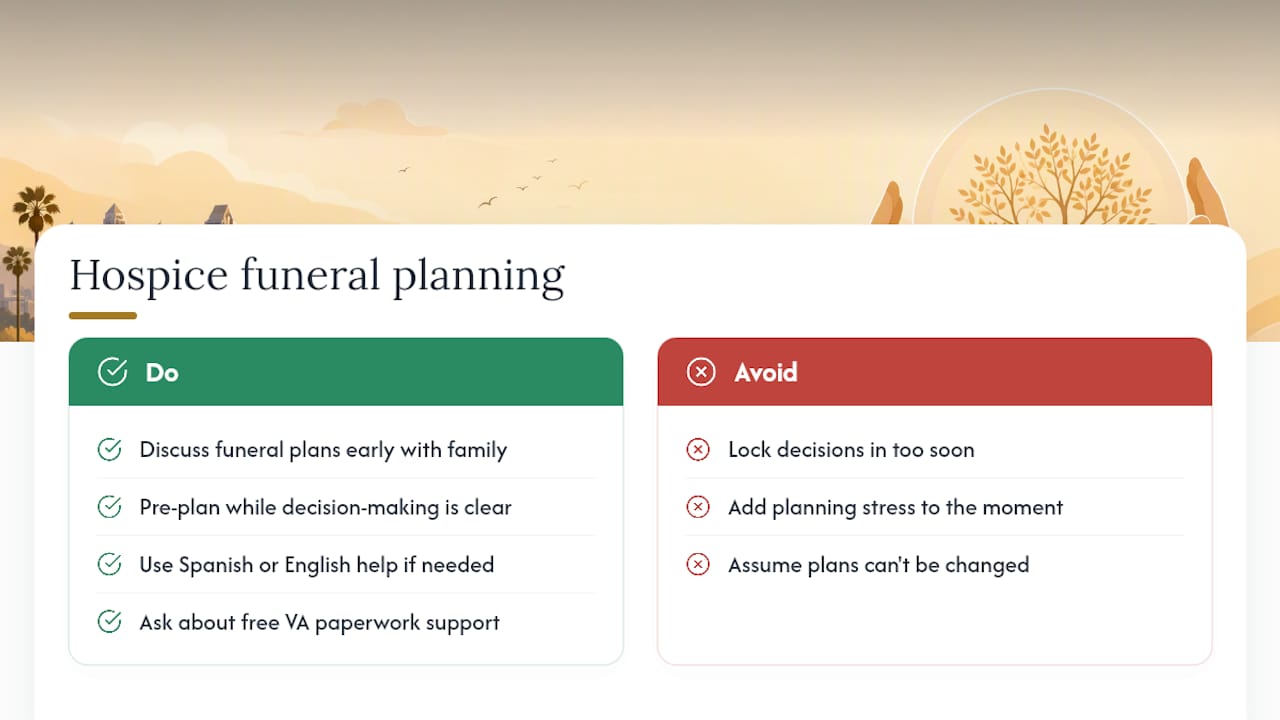
Hospice conversations almost always lead to another set of questions families didn’t expect to face yet: what happens after, and how to plan for it without adding to the stress of the moment. It’s one of the most common calls we get at Bravo Family Mortuary, often from an adult child trying to plan ahead while a parent is still receiving hospice care at home.
Whether a family is transitioning from hospice care to funeral arrangements or wants to pre-plan while there’s still time to think clearly, help is available in Spanish or English, and VA paperwork support is included at no extra cost for veteran families. Hospice decisions can be revoked and revisited, and so can funeral plans. Nothing has to be locked in before a family feels ready.
Bravo Family Mortuary Is Here When You’re Ready
If a hospice conversation has you thinking ahead, Some funeral homes offer pricing you can see in advance, without a phone call or a sales pitch. As an independent provider with positive reviews, these providers typically answer to the families they serve, not to a corporate office.

Services commonly include direct cremation, memorial and celebration of life services, traditional and green burial, and support for military and veteran families, including assistance with VA burial benefits paperwork. Many funeral homes offer the option to complete arrangements securely online, any hour of the day, whether planning ahead or needing help immediately. You can review full, all-inclusive pricing before you ever pick up the phone. We are here whenever you are ready.
Where These Facts Come From
The Medicare and eligibility details in this article come directly from federal and medical sources: the National Institute on Aging for palliative and hospice definitions, CMS for hospice benefit periods, the American Cancer Society for reversibility guidance, and Cleveland Clinic for early referral benefits. For hospice benefit forms and program specifics, Medicare.gov and CMS remain the most current, authoritative starting points.
This article is general information, not a substitute for advice from a qualified doctor. Consult a qualified healthcare professional about your own circumstances before acting on anything here.
Sources
- What Are Palliative Care and Hospice Care? — NIA (NIH)
- Hospice — CMS / Medicare
- Palliative care — Cleveland Clinic
FAQ
Which Is More Serious, Hospice or Palliative Care?
Hospice generally applies to more advanced illness, since it requires a prognosis of about six months or less. Palliative care can start immediately after any serious diagnosis and doesn’t imply a shorter life expectancy.
How Long Will Medicare Pay for Hospice Care?
Medicare covers hospice through two initial 90-day periods, then unlimited 60-day periods as long as a doctor recertifies the terminal prognosis, according to CMS.
What Are the Main Types of Palliative Care Services?
Palliative care commonly covers pain and symptom management, medication review, care coordination between specialists, and counseling or advance care planning support for the patient and family.
What Determines the Level of Hospice Care a Patient Receives?
Hospice care level depends on medical need at a given time, ranging from routine home care to short-term inpatient care during a symptom crisis, with respite care available to give family caregivers a break.
Can a Family Leave Hospice Once It Starts?
Yes. Hospice election can be revoked at any time if a patient wants to pursue curative treatment again, and re-enrollment is possible later if the prognosis still qualifies.
What Should We Do About Funeral Planning During Hospice?
Many families begin quiet, no-pressure planning during hospice care. Bravo Family Mortuary offers transparent pricing and secure online arrangements through PartingPros, so families in San Diego County can plan on their own timeline, in English or Spanish.