
How to Recover Funeral Costs From an Estate: Step-by-Step

Yes, you can be reimbursed for funeral costs from the decedent’s estate. Funeral expenses are generally treated as a high-priority debt the estate owes, and reimbursement is common but not automatic — you must file a valid creditor claim, back it with documentation, and the estate must have sufficient assets. The funeral costs estate reimbursement steps are: (1) notify the executor or personal representative that you paid and intend to file a claim, (2) preserve every itemized invoice and proof of payment, and (3) submit a formal written creditor claim to the executor or probate court within your state’s deadline.
Quick Answer:
- Funeral costs are reimbursable from the estate when properly documented and filed as a creditor claim.
- Notify the executor immediately, preserve receipts, and file a written claim.
- Reference IRS Publication 559 for tax reporting guidance on estate income.
Key Takeaways
Funeral costs are reimbursable from a decedent’s estate when you file a formal creditor claim with complete documentation and the estate has sufficient assets to pay.
| Point | Details |
|---|---|
| File a formal creditor claim | Submit an itemized invoice, proof of payment, and a written request to the executor within your state’s deadline. |
| Funeral costs are high priority | Most states, including California and Texas, place funeral expenses near the top of the estate payment order. |
| “Reasonable and necessary” is the limit | Executors and courts can reduce claims for extravagant upgrades; stick to standard, documented expenses. |
| Never pay yourself from estate funds | Withdrawing estate assets before executor authorization creates personal liability and probate complications. |
| Bravo Family Mortuary | Provides line-item invoices, digital document copies, and VA paperwork coordination to support reimbursement claims. |
Table of Contents
- What to do right away if you paid funeral costs
- How to file a formal creditor claim for funeral expense reimbursement
- Which funeral costs are usually reimbursable?
- How the executor handles payments and what happens when the estate is short
- Tax and reporting notes for funeral reimbursements
- How long do you have to file, and what if you missed the deadline?
- Your documentation checklist and a sample claim letter
- What to do if the executor denies or delays your claim
- A funeral director’s perspective on documentation and dignity
- What most guides get wrong about funeral cost reimbursement
- Bravo Family Mortuary is here to help with documentation and paperwork
- Sources
What to do right away if you paid funeral costs
Time matters here, and so does your paper trail. The first 72 hours after paying funeral expenses are the most important for protecting your right to reimbursement.
Notify the executor. Contact the estate’s personal representative as soon as possible. State clearly that you paid funeral costs out of pocket and that you will be submitting a formal reimbursement claim. This puts the executor on notice before they begin distributing assets.
Preserve your documents. Gather the original itemized funeral invoice, the signed funeral contract, your cleared check or bank/credit card statement showing the exact payment, and at least one certified copy of the death certificate. If you used a digital payment method, online funeral payment records such as a bank transfer confirmation work as proof — just make sure the amount matches the invoice exactly.
Do not pay yourself from estate funds. Withdrawing money from the decedent’s bank account or estate assets before the executor authorizes payment exposes you to personal liability and can complicate the entire probate process. Route everything through the executor.
Pro Tip: If you no longer have the original invoice, call the funeral home immediately and request a duplicate itemized statement. Executors require a line-item breakdown, not just a total, so a single-line receipt will not be enough.
How to file a formal creditor claim for funeral expense reimbursement
Submitting a formal creditor claim requires an itemized invoice, proof of payment, and a written statement requesting reimbursement. Here is the exact sequence:
-
Confirm probate status. Find out whether probate has been opened and who the court-appointed personal representative is. If the estate is administered through a trust rather than probate, the trustee handles reimbursement directly, and the process may move faster.
-
Assemble your claim packet. You need: the funeral home’s itemized invoice, proof of payment that matches the invoice dollar-for-dollar, a written reimbursement request letter, and your full name, address, and contact information.
-
Deliver the claim. Send the packet to the executor by certified mail and keep the return receipt. Many states also require you to file the claim with the probate court within a statutory window. Check your state’s probate rules — California’s creditor-claim procedures fall under Probate Code sections 9000–9399.
-
Follow up in writing. After delivery, send a brief email or letter confirming receipt. Every communication should be in writing.
Which funeral costs are usually reimbursable?
Not every expense on the funeral bill will pass the executor’s review. California Probate Code §11420 limits reimbursement to expenses that are “reasonable and necessary,” and most states apply the same standard.
Commonly accepted items:
- Funeral home basic services fee
- Casket or urn at a reasonable price point
- Burial plot or cremation fee
- Death certificates (multiple certified copies)
- Clergy or officiant fees
- Standard obituary notices
Items that may be challenged:
- Premium casket or urn upgrades well above the median cost
- Large catered receptions not considered part of the funeral service itself
- Flowers, programs, or décor beyond what is customary
Attorney Steven F. Bliss notes that extravagant costs are subject to challenge in California probate, and executors have both the authority and the obligation to reduce claims that exceed what is “reasonable and necessary.” When in doubt, review funeral cost price breakdowns before the service so you know what a court would consider standard.
How the executor handles payments and what happens when the estate is short
Executors pay estate debts in a legally defined order. Funeral expenses sit near the top of that list in virtually every state.
Typical priority order:
- Estate administration costs (court fees, executor fees, attorney fees)
- Funeral and burial expenses
- Final medical and last-illness bills
- Family allowance (where applicable)
- Taxes owed
- General unsecured creditors
Texas law gives funeral and last-illness expenses a priority claim up to $15,000, with emergency access mechanisms for immediate needs. California’s Probate Code §11420 similarly places funeral costs in the second tier of priority payments, ahead of most other debts.
In a solvent estate, reimbursements are typically processed after the executor inventories assets, opens an estate bank account, and confirms there are no outstanding priority claims ahead of yours. That process often takes 3–6 months. In an insolvent estate, the executor prorates payments across creditors in the same priority tier, which may mean partial reimbursement. Court approval is required before any distribution in an insolvent estate.
Pro Tip: Executors should build documentation, open the estate account, and run an insolvency check before issuing any payments. If the executor is moving too quickly, that is a warning sign — not a benefit.
Tax and reporting notes for funeral reimbursements
Keep these points brief but clear, because the IRS rules here are often misunderstood.
IRS Publication 559 is the governing reference: funeral expenses are not deductible on the decedent’s final Form 1040. They may be deductible on Form 706 (the federal estate tax return) for large taxable estates, but most estates do not reach the federal estate tax threshold.
If an insurance policy or pre-paid funeral plan reimburses the estate for funeral costs, those proceeds may become estate income and get reported on the estate’s Form 1041. Give your executor all receipts and insurance documents so the estate’s CPA can record them correctly.
Before filing a reimbursement claim, confirm whether a pre-paid funeral plan or burial insurance already covered part of the bill. If so, that amount must be applied first; you can only claim the out-of-pocket remainder.
How long do you have to file, and what if you missed the deadline?
Creditor-claim deadlines vary by state. Common windows run 60–120 days after the executor publishes a notice to creditors, though some states allow up to one year for certain claims.
- Find the notice date. The executor is required to publish a notice to creditors in a local newspaper or court filing. That publication date typically starts the clock.
- File before the deadline. Late claims are often barred entirely. Courts rarely grant exceptions without compelling cause.
- If you missed the window, notify the executor immediately, provide complete documentation, and ask whether the executor has discretion to consider the claim. In some states, you may petition the court directly.
- Consult an attorney if the deadline has passed and the amount is significant. A probate attorney can assess whether a late-claim petition is viable in your state.
Your documentation checklist and a sample claim letter
A complete reimbursement packet contains these items:
| Document | What it proves |
|---|---|
| Itemized funeral invoice | Exact services rendered and their individual costs |
| Signed funeral contract | Agreement between payer and funeral home |
| Proof of payment (cleared check or statement) | That you, specifically, paid the amount on the invoice |
| Certified death certificate | Confirms the decedent’s identity and date of death |
| Written reimbursement request letter | Formal creditor claim with your contact information |
Review what a funeral home contract should include so you know whether your paperwork meets the executor’s standard before you submit.
Sample creditor-claim letter (adapt as needed):
Pro Tip: Label every document with the decedent’s full name, date of death, and your name before you submit. Executors managing multiple claims will find your packet faster, and it signals you know what you are doing.
What to do if the executor denies or delays your claim
A denial is not the end of the road. Work through these steps in order:
- Get the denial in writing. Ask the executor to state the reason for the denial or reduction in a written letter or email.
- Review your documentation. Confirm that your proof of payment matches the invoice exactly and that every line item is within a “reasonable and necessary” range.
- Request a formal estate accounting. You have the right to see how estate assets are being distributed and in what order.
- Ask for mediation. Many probate courts encourage or require mediation before a formal dispute hearing.
- Petition the court. If the executor refuses a valid, documented claim, you can file a petition with the probate court to compel payment.
- Hire a probate attorney when the estate accounting conflicts with your evidence, when the executor is unresponsive, or when the estate is insolvent and you need to protect your priority position.
A funeral director’s perspective on documentation and dignity
Working with families in San Diego, we see the same documentation gap repeat itself: the family paid for the funeral, the estate has funds, but the reimbursement stalls because the invoice is a single-line total rather than an itemized breakdown.
The role a funeral home plays in estate settlement goes beyond the service itself. A well-documented invoice from a licensed funeral home is the foundation of every successful reimbursement claim.
What most guides get wrong about funeral cost reimbursement
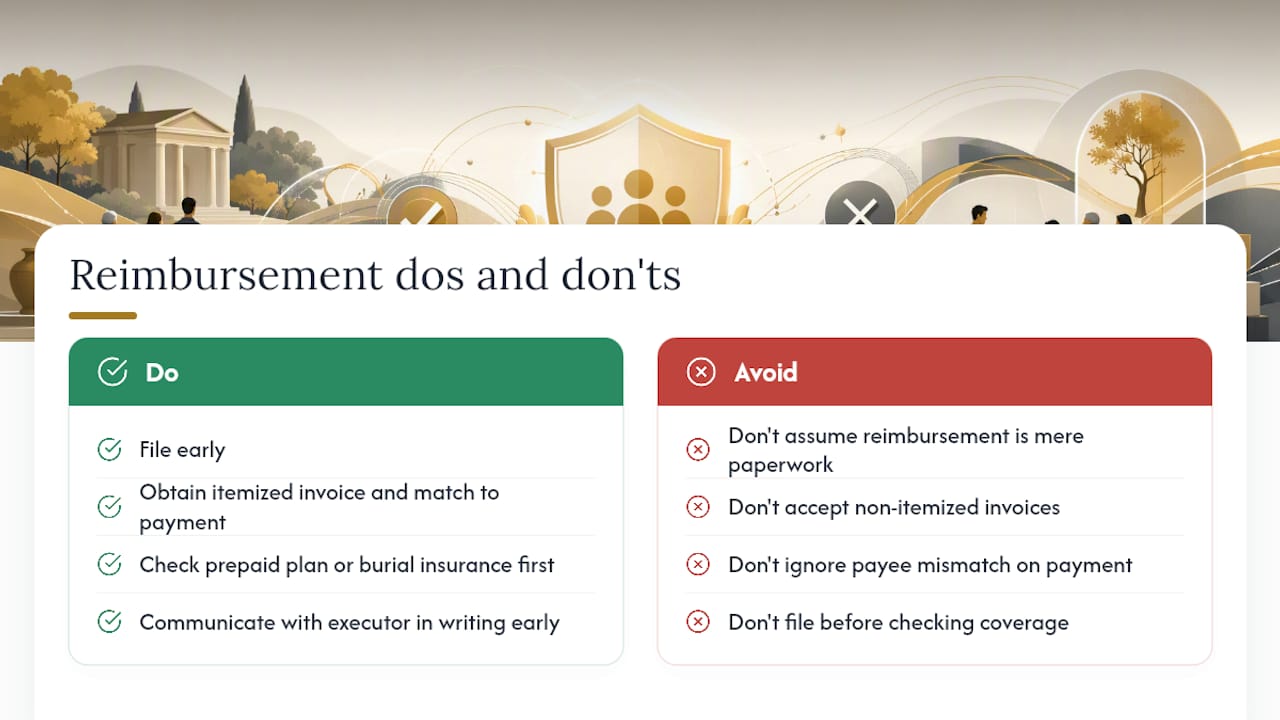
Most articles on this topic treat the reimbursement process as a paperwork formality. It is not. The real obstacle is almost never the law — funeral expenses are high-priority in every state. The obstacle is documentation that does not match.
An itemized invoice with a $12,000 total means nothing if your bank statement shows a $12,000 payment to a different payee name, or if the funeral home listed “services rendered” without a line-item breakdown. Executors are legally obligated to protect the estate from beneficiary challenges, and a claim that cannot be traced dollar-for-dollar will be held or reduced.
The second thing most guides understate: check for a pre-paid funeral plan or burial insurance before you file anything. If coverage existed and you did not apply it first, the executor will reduce your claim by that amount anyway — and you will have delayed the whole process.
File early, document precisely, and communicate with the executor in writing from the first conversation. Those three habits resolve the vast majority of reimbursement disputes before they become disputes at all.
Bravo Family Mortuary is here to help with documentation and paperwork
Transparent, itemized invoices are the starting point for every successful reimbursement claim, and that is exactly what Bravo Family Mortuary provides to every family we serve in San Diego County.

As a family-owned funeral home with all-inclusive, clearly listed pricing, we issue line-item invoices that meet executor and probate court standards from day one. Families can complete arrangements entirely online through our PartingPros portal, 24 hours a day, and receive digital copies of all documents immediately. We coordinate VA burial benefits paperwork for veteran families at no charge, and our bilingual team serves Spanish-speaking families across San Diego County with the same care and clarity. When you are ready to talk, or simply need a duplicate invoice for an estate claim, we are here. See our services and pricing whenever you are ready.
Sources
- Funeral Expenses And Reimbursement: What Executors Track So It Doesn’t Turn Into A Fight - Executor Checklists
- Publication 559 (IRS)
- Are Funeral Expenses Paid Before Other Debts - The Law Firm of Steven F. Bliss Esq.
- Can Estate Pay for Funeral? (w/Examples) + FAQs - TaxShark
- Can I Be Reimbursed by the Estate for Funeral Expenses? | Trust & Will
This article is general information, not a substitute for advice from a qualified lawyer. Consult a qualified legal professional about your own circumstances before acting on anything here.