
Get Ashes in 1–2 Weeks After Death, San Diego Cremation Timeline
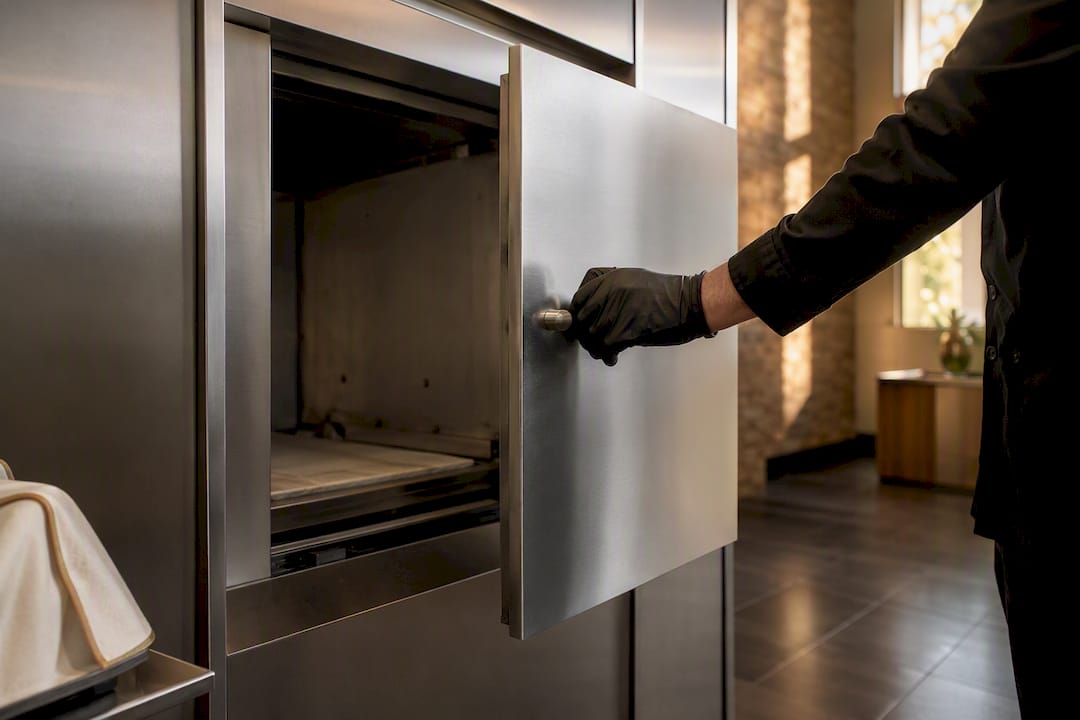
Most families receive their loved one’s ashes within about one to two weeks after a death, though straightforward cases can complete more quickly. The cremation itself takes a few hours. What actually sets the calendar is paperwork: the death certificate, the disposition permit, and any waiting period or medical examiner hold that has to clear first.
TL;DR:
- Most families wait one to two weeks for their loved one’s ashes, with delays often caused by paperwork and jurisdictional requirements rather than the cremation process itself.
- The paperwork, including the death certificate, disposition permit, and authorization forms, typically takes the longest, with delays exacerbated by medical examiner involvement or unsigned documents.
- Signing cremation authorization early can significantly reduce wait times, especially if paperwork can be completed online or outside business hours.
- The actual cremation process lasts 1.5 to 3 hours, but scheduling and cooling add another 1 to 2 hours before families receive the ashes.
- Delays are most often due to administrative hold-ups; families should gather necessary documents and sign forms promptly to avoid unnecessary waiting.
Table of Contents
- Cremation Timeline After Death: A Stage-by-Stage Snapshot
- What Happens in the First Hours After Death?
- How Long Does the Paperwork Take?
- Are There Mandatory Waiting Periods Before Cremation?
- How Long Does the Actual Cremation Take?
- What Happens Between Cremation and Receiving Ashes?
- What Causes Delays, and What Can You Do About Them?
- What Should Families Have Ready?
- How Bravo Family Mortuary Handles Timing for San Diego Families
- What Actually Matters Most in This Timeline
- How We Can Help When You’re Ready
- Sources
Cremation Timeline After Death: A Stage-by-Stage Snapshot
Here’s how the days typically break down once a family calls a funeral home. Some of these stages overlap, which is why the full range varies so much from one family to the next.
- Transfer to the funeral home: 1 to 4 hours after the call is made
- Paperwork and death certificate completion: 1 to 3 days
- Mandatory waiting period: 24 to 48 hours (runs alongside paperwork in most states)
- Scheduling at the crematory: 1 to 3 days, depending on demand
- The cremation itself typically takes approximately 1.5 to 3 hours
- Cooling and processing into ashes usually requires 1 to 2 hours
- Return of ashes to the family: 1 to 5 days
A simple case with no medical examiner involvement, a family that signs authorization forms right away, and a crematory with open slots can move through this whole cremation process timeline in under a week. Add a weekend, a busy crematory, or a medical examiner review, and two weeks becomes the more realistic number.
What Happens in the First Hours After Death?
Once a family calls, the funeral home typically arranges transfer of the deceased within 1 to 4 hours, whether the death occurred at a hospital, hospice facility, nursing home, or private residence. A licensed transport team handles the move, and most homes coordinate directly with hospital staff or hospice nurses so the family doesn’t have to manage logistics in the middle of the worst day of their lives.
At this stage, funeral homes usually ask for basic identification and next-of-kin information to begin the intake paperwork. That’s really all that’s required in the first few hours. Decisions about the urn, a memorial service, or how ashes will be returned can wait. What actually moves the timeline forward is getting the cremation authorization signed as soon as the family is ready, since that single form is often the first domino in the whole process.
How Long Does the Paperwork Take?
Paperwork is where most families lose time, not the cremation itself. A coherent but limited body of guidance on state permitting suggests the death certificate is usually the pacing document for everything downstream.
Three documents typically have to come together before cremation can happen:
- Death certificate: The attending physician or medical examiner generally has up to 72 hours to certify the cause of death, and the certificate can’t be finalized until that happens.
- Burial-transit or disposition permit: This permit authorizes moving and disposing of the remains, and it’s usually tied directly to the death certificate. Permit issuance commonly cannot happen until the death is officially registered, which makes the disposition permit the real bottleneck in most timelines, not the crematory schedule.
- Cremation authorization: Most states require a signed authorization from next of kin, separate from the death certificate, specifically because cremation is irreversible in a way burial isn’t.
Some jurisdictions allow a provisional death certificate that authorizes transport of the body but stops short of authorizing cremation until the final cause of death is certified. A funeral home typically handles the filing and pickup of these permits so families aren’t standing in line at a records office while they’re grieving. If your provider offers online arrangements, this is often the fastest way to get signatures collected and forms moving without an in-person visit.
Are There Mandatory Waiting Periods Before Cremation?
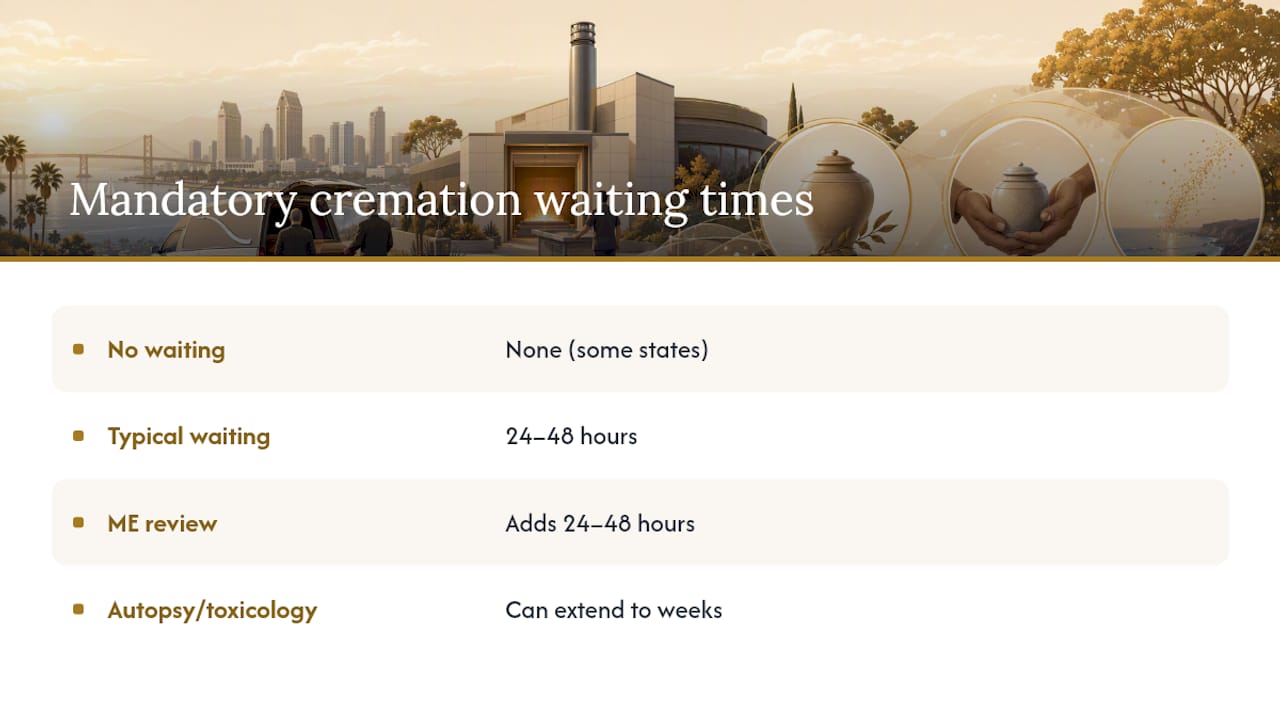
Many states require a waiting period, commonly 24 to 48 hours, between the time of death and cremation. The reasoning is straightforward: cremation destroys physical evidence permanently, so the law builds in a window for any medical or legal review to happen first. Some states don’t impose a waiting period at all, so this varies by jurisdiction.
Where things really stretch out is when a death falls under medical examiner or coroner jurisdiction. That typically happens with deaths that are sudden, unattended by a physician, accidental, or otherwise unexplained. A routine ME review might add another 24 to 48 hours. An autopsy or toxicology screening can extend that to a matter of weeks.
Families in this situation usually get a phone call from the funeral home once the medical examiner’s office has released the body, rather than a fixed date up front. Funeral homes generally keep remains refrigerated during the wait, and a good provider will give you a realistic estimate as soon as the ME’s office gives them one, rather than leaving you guessing.
How Long Does the Actual Cremation Take?
This is the part people usually picture wrong. The machine run itself, at temperatures between 1,400 and 1,800 degrees Fahrenheit, takes roughly 1.5 to 3 hours depending on body size and the equipment used. It is genuinely the shortest stage in the entire process.
After the cremation chamber finishes, the remains need to cool before processing, which typically adds another 1 to 2 hours. That cooling period isn’t optional. It’s why “how long does cremation take” and “how long until I get the ashes” are really two different questions with two very different answers.
Scheduling adds its own layer on top of the physical process. Crematories run on business hours and finite daily capacity, so a facility booked solid for a week can push your actual cremation date out even after every document is signed. This is one of the more common surprises for families expecting things to move the moment paperwork clears.
What Happens Between Cremation and Receiving Ashes?
Once cooling is complete, the remains are processed into a fine, consistent texture and transferred into a temporary container or the urn the family has chosen. This step itself takes very little time. What varies is how the ashes get back to you.
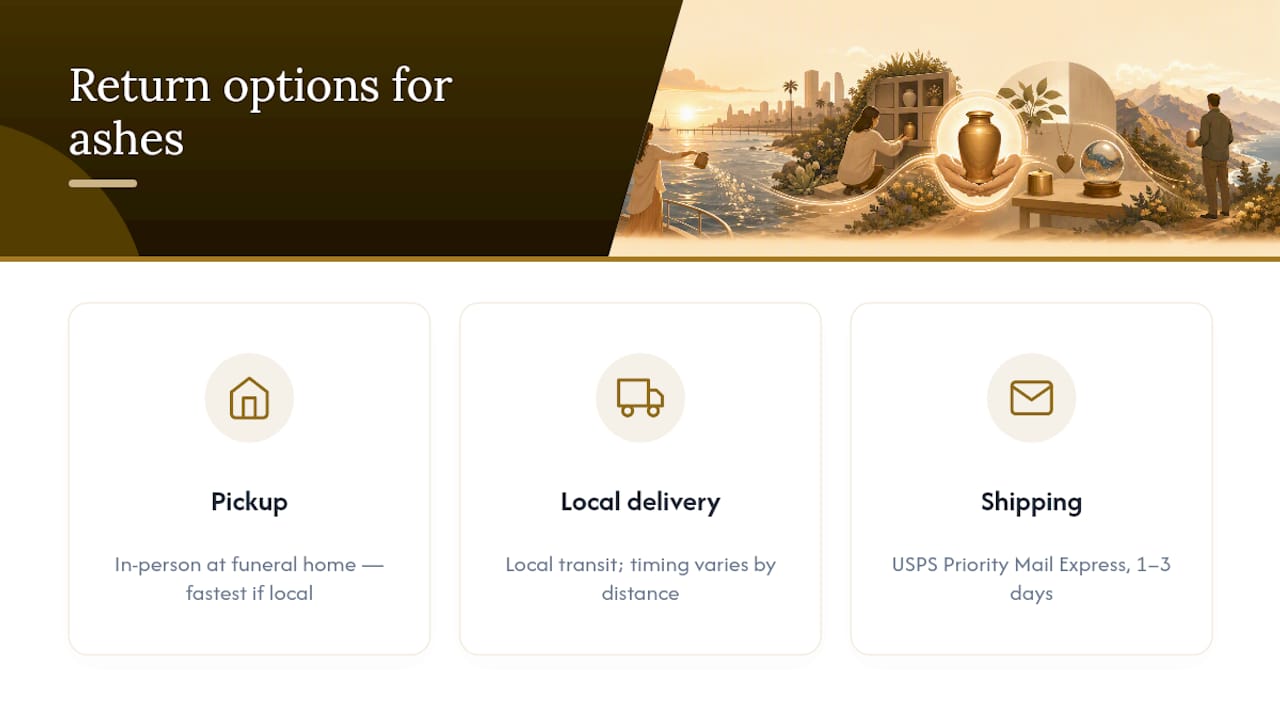
Families typically choose from three return options: in-person pickup at the funeral home, local delivery, or shipping through USPS Priority Mail Express, which is the carrier approved for transporting cremated remains and usually takes 1 to 3 days depending on distance. Pickup is fastest if you’re local. Shipping is a dependable fallback when family lives out of state.
If you’ve ordered a custom or engraved urn, add the vendor’s production time on top of the base timeline. Planning a memorial service around the return of ashes is common, and most families coordinate that date once they have a firm pickup or delivery window.
What Causes Delays, and What Can You Do About Them?
Nearly every delay in a cremation time frame traces back to paperwork or an outside authority, not the cremation process itself. The most common culprits:
- Unsigned authorization forms sitting with a family member who’s hard to reach
- A medical examiner investigation that hasn’t concluded
- Incomplete identification documents delaying intake
- A crematory backlog during high-demand weeks
- Inter-state transfer requirements when the death occurs away from home
Pro Tip: Sign the cremation authorization as soon as you’re able, even before you’ve decided on an urn or service date. That one signature is usually the single fastest way to keep the timeline moving, since everything else can be finalized in parallel.
Ask your funeral home these five questions directly: Has the death certificate been filed? Is a medical examiner involved? When can the crematory schedule the cremation? What return method do you recommend, and how long will it take? Is there anything you need from me today?
What Should Families Have Ready?
Gather these items early so nothing else stalls once the paperwork window opens:
- Government-issued ID for the deceased and next of kin
- Signed cremation authorization form
- Contact information for the attending physician or hospice
- Veteran discharge paperwork (DD214), if military honors apply
Most of these can be handled in under a day if you have them on hand. For guidance on how many certified death certificates you’ll actually need, or what belongs in a pre-arrangement document if you’re planning ahead, both are worth reading before you need them.
How Bravo Family Mortuary Handles Timing for San Diego Families
Bravo Family Mortuary lets families complete arrangements and sign authorization forms anytime, day or night, through our secure PartingPros portal. That matters because paperwork delay, not the cremation itself, is what stretches most timelines. Getting signatures in at 2 a.m. instead of waiting for a 9-to-5 office to open can shave real days off the calendar.
We offer direct cremation, cremation with memorial service, and aquamation, all with transparent, all-inclusive pricing published online. We serve Spanish-speaking families with care and attention, and we coordinate VA burial benefits paperwork for veterans’ families.
What Actually Matters Most in This Timeline
The conventional advice online treats the cremation itself as the thing to plan around, and that’s backwards. The machine run is a couple of hours out of a process that can take a week or two. What actually determines whether a family waits 5 days or 15 is how fast the death certificate clears, whether a medical examiner is involved, and how quickly someone signs the authorization form.
That’s the part most guides underplay. Families fixate on choosing an urn or scheduling a memorial service, when the real lever is administrative: get the paperwork moving on day one, and everything else falls into place around it. Where a medical examiner hold exists, there’s genuinely nothing to speed up, and no funeral home should promise otherwise. Where paperwork is the holdup, a provider that lets you sign and submit forms at midnight instead of waiting for business hours is doing something that measurably shortens your wait, not just something that sounds convenient.
If you’re planning ahead rather than arranging services this week, the single best thing you can do is complete as much paperwork as legally possible in advance. Pre-planning doesn’t eliminate the waiting period or a medical examiner’s authority, but it eliminates every delay that comes from decisions and documents you control.
— Steve Olsher
How We Can Help When You’re Ready
Bravo Family Mortuary offers direct cremation for families who want a simple, dignified path forward without the cost or complexity of a traditional funeral, along with cremation with memorial service and aquamation for families who want a gentler, water-based alternative. Every option comes with transparent, all-inclusive pricing published upfront on our pricing page, so you’re never guessing what a service costs or discovering fees later.

As an independent, family-owned mortuary, we answer to the families we serve, not to a corporate parent. You can start and complete arrangements entirely online through PartingPros at any time, in English or Spanish, without an in-person visit or a sales call. When you’re ready to see options or begin arrangements, explore our cremation services. We are here whenever you are ready.
Sources
- Cremation Timeline: How Long Every Step Takes | Local Cremation Guide
- What Is a Cremation Permit? Requirements and Process - LegalClarity
- Cremation Process - Cremation Association
- Funeral