How the Funeral Process Works: A Step-by-Step Guide

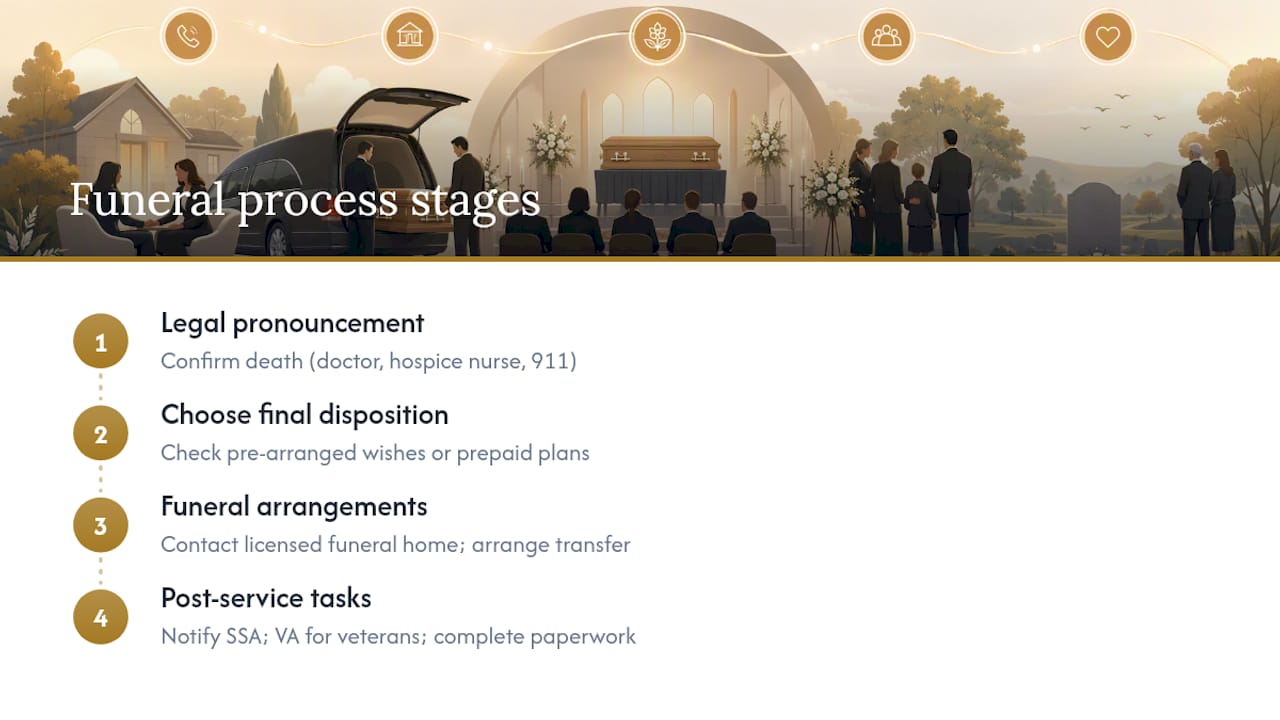
The funeral process in the United States moves through four core stages: legal pronouncement of death, choice of final disposition, formal arrangements with a licensed funeral provider, and post-service administrative tasks. When someone you love dies, the first three actions are: confirm legal pronouncement (a physician, hospice nurse, or 911 responder handles this), check for any pre-arranged wishes or pre-paid plans, and contact a funeral home to arrange safe transfer of the body. The National Funeral Directors Association (NFDA) reports that cremation has become the majority choice nationally, and direct cremation is typically the lowest-cost option. Under the FTC Funeral Rule, every licensed funeral home must provide an itemized General Price List (GPL) by phone or in person, so you can compare costs before committing to anything. The Social Security Administration (SSA) and, for veterans, the U.S. Department of Veterans Affairs are two federal agencies families typically contact within the first week.
Key Takeaways
The funeral process in the United States follows a clear legal and logistical sequence, and knowing your rights to itemized pricing protects your family at every step.
| Point | Details |
|---|---|
| Three immediate actions | Confirm legal pronouncement, check for pre-arranged wishes, then contact a funeral home for transfer. |
| Your right to a price list | The FTC Funeral Rule requires every funeral home to provide a General Price List by phone, free of charge, on request. |
| Order death certificates early | Request 8–12 certified copies at once through the funeral home or San Diego County vital records to avoid delays. |
| Cremation is the majority choice | The NFDA projected a 63.4% cremation rate by 2025; direct cremation is typically the lowest-cost disposition option. |
| Bravo Family Mortuary | Bilingual, family-owned, 24/7 online arrangements via PartingPros, transparent pricing, and VA paperwork coordination for San Diego families. |
Table of Contents
- What to do in the first hours after a death
- Essential documents and permits every family needs
- Disposition choices explained clearly
- How to choose a funeral home and what to ask
- A realistic timeline from pronouncement to final disposition
- How families pay for funeral services
- What the data shows about funeral trends today
- Religious and cultural considerations in U.S. funerals
- Personalizing a funeral or memorial service
- The emotional weight of the funeral process
- Legal matters beyond the funeral: wills, estates, and inheritance
- Why transparent, compassionate care changes everything
- Bravo Family Mortuary is here whenever you are ready
- Authoritative resources for families
- Sources
What to do in the first hours after a death
The hours right after a death feel disorienting. Having a short, ordered list of actions helps your family move forward with clarity rather than guesswork.
1. Confirm legal pronouncement. A death must be legally pronounced by a qualified person before a funeral home can take custody of the body. In a hospital or hospice setting, a nurse or physician handles this. At home, call hospice if the person was enrolled, or call 911 if no hospice is involved. Do not call the funeral home before pronouncement is complete.
2. You usually have a short window before transfer. Most U.S. counties allow a few hours for the family to gather at home before the funeral home arrives. You are not required to rush. If the death occurred in a hospital, the facility will hold the body safely while you make calls.
3. Check for pre-arranged wishes before making any new decisions. Look for a pre-need contract, a letter of instruction, a will, or any written notes about preferences. Many families discover a pre-paid plan or a specific request (cremation, a particular cemetery, a religious tradition) that changes the path forward. Reviewing what a funeral pre-arrangement document includes before you call a funeral home can save both time and money.
4. Notify immediate family and decide who leads. One person should be the primary decision-maker to avoid conflicting instructions to the funeral home. Assign supporting roles to other family members: someone to handle phone calls, someone to locate documents, someone to secure the home.
5. Gather key documents. You will need the deceased’s Social Security number, date and place of birth, parents’ names, and veteran discharge papers (DD-214) if applicable. These are required to file the death certificate.
Pro Tip: Order more certified death certificates than you think you need. Banks, insurers, the SSA, and the VA each require their own original certified copy. Most families need 8–12 copies. Ordering them all at once through the funeral home or county portal is faster and less expensive than reordering later.
Essential documents and permits every family needs
Understanding the paperwork side of a death removes one major source of anxiety. The documents fall into two categories: those that must exist before disposition can happen, and those needed afterward for financial and legal purposes.
The death certificate is the foundational legal document. It is prepared by the funeral home using information you provide, signed by the attending physician or coroner, and filed with the county. In California, the county registrar issues certified copies. For San Diego families, the San Diego County Office of Vital Records and Statistics explains the full ordering process, required information, fees, and the option to order through VitalChek online. A certified copy carries an official seal and is accepted by government agencies and financial institutions. An informational copy is not.
Disposition permits are required before burial or cremation can proceed. The funeral home obtains these from the county on your behalf. You do not need to manage this yourself.
Authorization for cremation or burial is a signed form from the legally authorized next of kin. The funeral home will walk you through who qualifies to sign under California law.
Other documents families typically need:
- Veteran’s DD-214 discharge papers (for VA burial benefits)
- Life insurance policy numbers and insurer contact information
- Pre-need funeral contract, if one exists
- Will or trust documents (for the estate attorney or probate court)
For federal notifications, the SSA should be contacted promptly to stop benefit payments and to apply for a one-time death benefit or survivor benefits. The VA handles burial benefits for eligible veterans separately.
The funeral home’s role in estate settlement extends beyond the service itself. The itemized invoice and certified death certificates become part of the estate record.
Certified copies matter: Each agency, bank, and insurer typically requires its own original certified copy. Ordering several at once through the county or your funeral home avoids delays weeks later when you are trying to close accounts or claim benefits.
Disposition choices explained clearly
The term “disposition” refers to what happens to the body after death. There are more options available today than most families realize, and the choice affects cost, timing, and ceremony planning significantly. Comparing cremation and burial options before you speak with a funeral home helps you ask better questions.
Direct cremation is the simplest and typically least expensive option. The body is transferred to the crematory, cremated without a prior viewing or formal service, and the cremated remains are returned to the family. A memorial can be held separately at any time and place the family chooses.
Cremation with memorial service combines cremation with a formal gathering, either before or after cremation. This gives families the flexibility of cremation’s lower cost while still holding a meaningful ceremony.
Traditional burial involves embalming (optional in most cases, but common for open-casket viewings), a viewing or visitation, a funeral service, and interment in a cemetery. It is typically the highest-cost option due to casket, cemetery plot, opening and closing fees, and grave marker.
Green or natural burial places the body in a biodegradable container without embalming chemicals, in a certified natural burial ground. The body returns to the earth naturally, which appeals to families with environmental values.
Aquamation (alkaline hydrolysis) uses water, heat, and an alkaline solution to gently break down the body, mimicking the natural decomposition process. It uses significantly less energy than flame cremation and produces no direct emissions. Bravo Family Mortuary offers aquamation as a distinct service for San Diego families.
Donation to science means the body is donated to a medical school or research institution. Costs to the family are typically minimal or none, and cremated remains are usually returned after the institution’s use. Families should arrange this in advance through a body donation program.
The NFDA projected a cremation rate of 63.4% by 2025, reflecting a clear national shift toward cremation-based options driven by cost, flexibility, and changing cultural preferences.
How to choose a funeral home and what to ask
Choosing a funeral home under time pressure is one of the most consequential financial decisions a family makes in grief. A few structured questions protect your budget and your dignity.
Start with the General Price List. Under the FTC Funeral Rule, every funeral home must provide an itemized GPL by phone or in person, on request, at no charge. You do not need to visit in person to get pricing. Call two or three providers, ask for the GPL, and compare these line items:
- Basic services fee (the non-declinable overhead charge)
- Transfer of remains (from place of death to funeral home)
- Embalming (ask whether it is required or optional)
- Cremation or burial fee
- Casket or urn (ask whether you may supply your own)
- Death certificate preparation fee
Sample cost ranges (labeled as examples, not guarantees):
See Bravo Family Mortuary’s transparent pricing page for San Diego-specific all-inclusive rates.
Red flags to watch for:
- Refusal to provide a GPL by phone
- Bundled packages with no itemization
- Pressure to decide within hours
- Claims that embalming is legally required (it rarely is)
- Fees for using a casket or urn purchased elsewhere
Pro Tip: Call at least two funeral homes before making any commitment. Ask each one: “Can you email or fax me your General Price List?” A provider who hesitates is telling you something important.
The FTC’s consumer guidance on shopping for funeral services outlines exactly which items are optional versus required, which is useful reading before you make any calls.
A realistic timeline from pronouncement to final disposition
Knowing what happens when removes the fear of the unknown. Here is a typical sequence for a San Diego family.
Hours 1–24:
- Legal pronouncement obtained (hospital, hospice, or 911)
- Family notified; primary decision-maker identified
- Funeral home contacted; body transferred
- Pre-arranged wishes reviewed; disposition choice confirmed
- Death certificate information gathered and provided to funeral home
Days 2–5: 6. Funeral home files death certificate with county; physician signature obtained 7. Certified copies ordered (through funeral home or San Diego County vital records) 8. Disposition permit obtained by funeral home 9. Cremation or burial scheduled; service date and location confirmed 10. Obituary written and submitted (optional but common) 11. Flowers, officiant, music, and venue arranged if a service is planned
Days 5–14: 12. Service or memorial held 13. Cremated remains returned to family, or burial completed 14. Certified death certificates received 15. SSA notified; survivor benefit application started if applicable 16. VA burial benefit claim filed for eligible veterans
Weeks 2–4 and beyond: 17. Life insurance claims submitted 18. Bank accounts and financial institutions notified 19. Probate process initiated if required by estate size 20. Utilities, subscriptions, and accounts closed or transferred
Timing can shift if an autopsy is required (ordered by the medical examiner, not the family), if the death occurred out of state, or if VA paperwork needs to be gathered. Plan for flexibility in the first week.
How families pay for funeral services
Funeral costs are real, and planning how to cover them is a practical act of care. There are several legitimate paths.
Common payment sources:
- Estate funds: The estate pays funeral costs as a priority expense before other debts are settled.
- Personal family funds: Many families pay directly and seek reimbursement from the estate later.
- Life insurance: A policy with a named beneficiary pays quickly, often within days of submitting the death certificate.
- Burial or final-expense insurance: Smaller policies designed specifically to cover funeral costs. Burial insurance is worth understanding before a death occurs, as premiums are lower when purchased in advance.
- Pre-need contracts: A pre-paid funeral plan locks in today’s prices and removes the decision burden from family members. Ask about escrow requirements and refund policies before signing.
- Crowdfunding: Platforms like GoFundMe are used by many families to share costs across a wider network.
Veteran burial benefits can cover a meaningful portion of costs for eligible veterans. The VA provides burial allowances, a burial flag, a Presidential Memorial Certificate, and, for eligible veterans, interment in a national cemetery at no cost. Bravo Family Mortuary coordinates VA paperwork for veteran families at no additional charge.
On pre-paid plans: Pre-paying can protect your family from future price increases and spare them from making decisions under grief. The practical cautions: confirm the funds are held in a state-regulated trust or insurance policy, ask what happens if the funeral home closes or you move, and get the refund policy in writing. For those aging without immediate family, end-of-life planning resources offer useful guidance on appointing an agent and documenting wishes.
Direct cremation remains the most accessible option for families managing tight budgets, with costs often only a fraction of a traditional funeral.
What the data shows about funeral trends today
The funeral industry has shifted considerably over the past decade, and understanding those shifts helps families make choices that fit their values and budgets.
The NFDA projected that cremation would account for 63.4% of dispositions by 2025, up from a minority share just two decades ago. Cost is the primary driver, but flexibility matters too. Families increasingly separate the disposition from the memorial, holding a celebration of life weeks or even months after the death when more people can attend.
Green burial and aquamation are growing in visibility, particularly among families with environmental priorities. Aquamation, in particular, is gaining acceptance in California as a licensed disposition method that produces no direct emissions and returns more bone material to the family than flame cremation.
Direct cremation has also normalized the idea of a “no-service” disposition followed by a personalized gathering. Many families find this approach reduces immediate financial pressure while still allowing a meaningful tribute on their own timeline.
Religious and cultural considerations in U.S. funerals
The United States is home to an enormous range of religious and cultural funeral traditions, and a good funeral home accommodates them rather than fitting families into a single template.
Catholic and Christian traditions often include a vigil or rosary the evening before the funeral Mass, followed by burial. Cremation is now permitted in the Catholic Church, though the Church asks that cremated remains be interred rather than scattered.
Jewish traditions emphasize burial as soon as possible, ideally within 24 hours. Embalming is generally not permitted under traditional Jewish law, and a simple shroud or plain wooden casket is preferred. A shiva period of mourning follows at home.
Muslim traditions also call for burial as quickly as possible, without embalming, and with the body washed and wrapped in a white shroud (kafan). Prayer services (Salat al-Janazah) precede burial.
Hispanic and Latino families often observe a velorio, a home or funeral home vigil that may last through the night, followed by a Catholic Mass and burial. Many families in San Diego maintain these traditions across generations, and a bilingual funeral home makes the process significantly less stressful.
Indigenous and other traditions vary widely. The key is to communicate your family’s specific needs to the funeral home early so that timing, preparation, and ceremony can be arranged accordingly.
No tradition is too specific to accommodate with advance communication. Ask the funeral home directly whether they have experience with your family’s practices.
Personalizing a funeral or memorial service
A funeral does not have to follow a standard script. Personalization has become one of the most meaningful parts of the modern memorial process.
Ceremony options range from a traditional religious service to a completely secular celebration of life. A celebration of life can be held at a park, a family home, a restaurant, a beach, or any place that held meaning for the person who died. There is no requirement that it happen within days of the death.
Memorial videos and tribute displays have become standard. A short video of photographs set to music, a memory table with personal objects, or a display of the person’s artwork or achievements all help guests feel connected to who the person actually was.
Music, readings, and speakers can be entirely chosen by the family. A funeral home can coordinate an officiant, or the family can lead the service themselves.

Keepsakes such as memorial cards, seed packets, custom urns, or jewelry made from cremated remains give family members something tangible to carry forward.
The practical note: personalization takes time to plan. If you choose direct cremation, you have the flexibility to hold the memorial weeks later, which often means better attendance and a more thoughtful tribute.
The emotional weight of the funeral process
Grief and logistics arrive at the same time, which is one of the hardest parts of losing someone. The administrative demands of a death do not pause for mourning.
Many families find that having a clear checklist and a calm, knowledgeable funeral director reduces the emotional load considerably. When you are not guessing what comes next, you have more space to actually grieve. This is one reason why transparent, organized funeral providers reduce stress in ways that go beyond price.
It is also normal for family members to disagree during planning. Decisions about disposition, ceremony, and cost can surface old tensions. Assigning one primary decision-maker early, as noted in the first-steps section, helps prevent those conflicts from derailing the process.
Grief support resources are available through hospice organizations, community grief groups, and mental health providers. The funeral home is not typically a grief counseling service, but many can refer families to local support. In San Diego, bilingual grief support is available through several community organizations for Spanish-speaking families who prefer to process in their first language.
Legal matters beyond the funeral: wills, estates, and inheritance
The death of a family member triggers a set of legal processes that run parallel to the funeral arrangements. Understanding the basics prevents costly delays.
The will (if one exists) names an executor and directs how assets are distributed. It does not take effect until filed with the probate court. The funeral home’s invoice and certified death certificates become part of the probate record.
Probate is the court-supervised process of settling an estate. In California, estates valued above $184,500 in assets typically require formal probate. Smaller estates may qualify for a simplified affidavit process. An estate attorney can advise on which path applies.
Beneficiary designations on life insurance policies, retirement accounts (IRAs, 401(k)s), and payable-on-death bank accounts pass outside of probate entirely. These assets go directly to the named beneficiary upon presentation of a certified death certificate, regardless of what the will says.
Joint tenancy property (a home held jointly with right of survivorship) also passes outside probate to the surviving owner.
Survivor benefits through the SSA may be available to a surviving spouse, minor children, or dependent parents. Contact the SSA promptly, as some benefits have time-sensitive application windows.
This is general information, not legal advice. For estate-specific questions, consult a licensed California estate attorney or contact the San Diego County Superior Court’s probate division.
Why transparent, compassionate care changes everything
Most families only go through this process once or twice in a lifetime, which means they have no frame of reference for what “normal” looks like. That information gap is where families get hurt financially and emotionally.
The funeral industry has a long history of opaque pricing. Families in grief are not in a position to negotiate or comparison-shop, and some providers take advantage of that. The FTC Funeral Rule exists precisely because Congress recognized that dynamic. But a rule only protects you if you know to invoke it.
What actually changes the experience is a provider who leads with transparency rather than waiting to be asked. A funeral home that posts its prices publicly, provides a GPL without hesitation, and explains every line item is not doing something unusual. It is doing what every provider should do. The fact that it stands out says something about the industry, not just the provider.
Bilingual service matters in a way that goes beyond convenience. When a family is processing grief in their second language, nuance gets lost. A Spanish-speaking funeral director who can explain the difference between a disposition permit and a death certificate, or walk through VA paperwork in Spanish, is providing a genuinely different level of care.
Family-owned funeral homes tend to operate differently from corporate chains because the person you speak with is accountable to the community, not to a quarterly earnings report. That accountability shows up in small ways: a returned call at 11 PM, a price that doesn’t change between the phone quote and the invoice, a staff member who remembers your family’s name.
Bravo Family Mortuary is here whenever you are ready
When a death happens, San Diego families deserve a funeral provider who answers the phone at any hour, explains every cost before asking for a commitment, and speaks your language.
Bravo Family Mortuary is a family-owned, 5-star rated funeral home serving all of San Diego County 24 hours a day, 7 days a week. Services include direct cremation and cremation with memorial service, aquamation, traditional burial, green burial, celebration of life, and military and veteran services. Arrangements can be completed entirely online through the PartingPros portal at any hour, without an in-person visit or sales pressure. The bilingual team serves Spanish-speaking families with the same care and detail as English-speaking ones. For veterans, Bravo coordinates VA burial benefits paperwork at no additional charge. All pricing is all-inclusive and posted transparently at Bravofamilymortuary. We are here whenever you are ready.
Authoritative resources for families
These official sources cover regulations, forms, benefit claims, and consumer rights. Each is free to access.
- Consumer: Your legal rights to itemized pricing and the right to buy only what you choose. Read this before calling any funeral home.
- FTC — Shopping for funeral services: A practical checklist of optional versus required items and how to compare providers.
- San Diego County Office of Vital Records and Statistics: How to order certified death certificates in San Diego, required information, fees, and the VitalChek online option.
- Social Security Administration (SSA): Report a death, stop benefit payments, and apply for survivor benefits. Contact SSA promptly after the funeral.
- U.S. Department of Veterans Affairs — Burials and Memorials: Burial allowances, national cemetery eligibility, burial flags, and required paperwork for veteran families.
- National Funeral Directors Association (NFDA): Industry data, consumer guides, and a funeral home locator.
- Consumer Reports — How to plan a funeral (Spanish): Spanish-language guidance on planning, comparing costs, and avoiding common mistakes.
This article is general information, not a substitute for advice from a qualified lawyer. Consult a qualified legal professional about your own circumstances before acting on anything here.
Sources
- National Funeral Directors Association (NFDA)
- Consumer
- San Diego County — Death certificates (Office of Vital Records and Statistics)
- U.S. Department of Veterans Affairs — Burials and memorials
- Social Security Administration (SSA)
Recommended
- Arrange a Funeral Entirely Online: Your Step-by-Step Guide | Bravo Family Mortuary
- Virtual Funeral Arrangement Process: A Family Guide | Bravo Family Mortuary
- Family Roles During Funeral Planning: A Clear Family Guide | Bravo Family Mortuary
- How Online Funeral Payments Work: A Family Guide | Bravo Family Mortuary