
Choosing Cremation vs Burial Quickly: A Clear Family Guide
Cremation and burial are the two legal methods of final disposition available to families in the United States, and choosing cremation vs burial quickly is possible when you understand four core factors: cost, timeline, religious tradition, and memorial preference. As of 2026, the national cremation rate has surpassed 60%, reflecting a broad shift in how American families approach end-of-life decisions. Neither option is more dignified than the other. Both honor your loved one. The goal of this guide is to give you the clearest possible picture so your family can decide with confidence, not confusion. Bravo Family Mortuary is here to support San Diego families through exactly this moment.
What are the main cost differences between cremation and burial?
Cost is often the first factor families consider, and the gap between cremation and burial is significant. A direct cremation costs a median of $1,995, while an immediate burial runs approximately $2,800 in funeral home charges alone. Those numbers reflect only what the funeral home charges. They do not include cemetery fees.

Traditional burial, once you add the cemetery, becomes a much larger expense. Cemetery costs add $2,000 to $5,000 or more to the total, covering the burial plot, grave opening and closing, a concrete vault, and a headstone. A full traditional burial commonly ranges from $9,000 to $15,000 or higher. That range matters when a family is making a fast decision under emotional pressure.
Here is a side-by-side look at typical cost categories:
| Cost element | Cremation | Burial |
|---|---|---|
| Funeral home base fee | Included in direct cremation | Included in burial package |
| Casket or container | Simple container ($100–$300) | Casket ($2,000–$10,000+) |
| Cemetery plot | Optional (for interment of ashes) | Required ($1,000–$4,000+) |
| Vault or liner | Not required | Often required by cemetery |
| Headstone or marker | Optional | Common ($500–$3,000+) |
| Total typical range | $1,995–$5,000 | $9,000–$15,000+ |
Common add-on charges that families miss include:
- Transportation fees for moving the body
- Refrigeration or storage if arrangements take time
- Weekend or after-hours surcharges
- Death certificate copies (you often need 8–10)
- Obituary filing fees
Families should always request an itemized price list from any funeral home before agreeing to anything. This General Price List is required by federal law and protects you from surprise charges.
Pro Tip: Ask specifically about weekend surcharges and transport fees. These two line items catch families off guard more than any other charges on a final bill.
How does timeline affect quick cremation decisions?
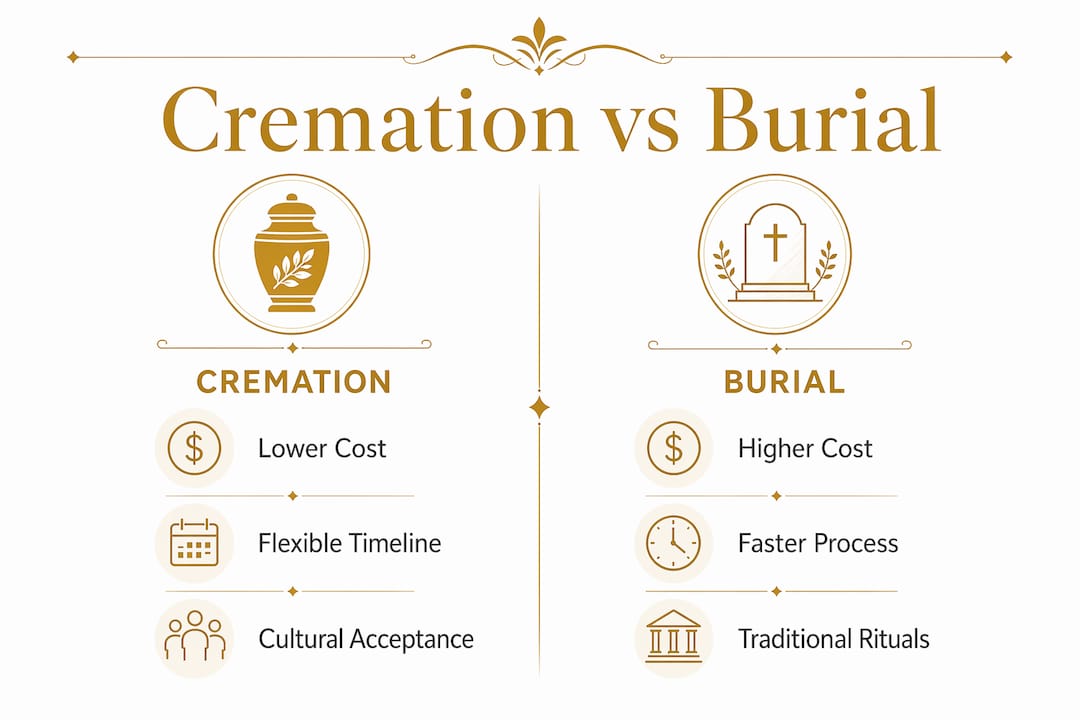
Timing is the second major factor in a burial vs cremation guide, and the two options operate on very different schedules. Burial typically occurs within 3–7 days of death. That window is tight, especially when family members are traveling from out of state.
Cremation allows memorial timing to be deferred by weeks or even months. This flexibility is one of the most practical advantages cremation offers. A family scattered across San Diego, Chicago, and Florida does not have to scramble to book flights within 48 hours.
Key timeline differences to know:
- Burial: Embalming or refrigeration required if service is delayed beyond 2–3 days; cemetery scheduling must align with funeral home and clergy availability.
- Cremation: The cremation process itself typically takes 5–10 days once permits are issued; the memorial service can happen anytime afterward.
- Legal permits: Both options require a death certificate and disposition permit. Cremation requires an additional cremation authorization form signed by the next of kin.
- Viewing options: A viewing before cremation is possible and does not require embalming if held within a short window.
Pro Tip: If your family is geographically spread out, cremation gives you the breathing room to plan a meaningful service when everyone can actually attend. That time matters for grief.
The scheduling flexibility of cremation is especially valuable when families have not yet had time to discuss wishes or coordinate travel. Choosing cremation does not mean forgoing a ceremony. It means you can hold that ceremony on your terms.
What religious and cultural factors guide this choice?
Faith tradition is a deeply personal factor, and for many families it is the deciding one. Understanding where major traditions stand can help you move forward without second-guessing.
Most Protestant denominations, Hinduism, and Buddhism accept or actively encourage cremation. These traditions view the body as a vessel, and cremation as a natural return. Hindu tradition, in particular, has practiced cremation for thousands of years as the preferred rite.
The Catholic Church permits cremation but expresses a preference for burial and requires that cremated remains be kept in a sacred place, such as a cemetery or columbarium. Scattering ashes or keeping them at home is not permitted under current Catholic guidelines.
Islam and Orthodox Judaism prohibit cremation entirely. Both traditions require burial as soon as possible after death, often within 24 hours. If your loved one practiced either faith, burial is the appropriate path.
A few practical points for families navigating this:
- If you are unsure of your loved one’s faith preferences, check for any written wishes, pre-planning documents, or conversations with clergy.
- A funeral director can help you contact a religious leader quickly if guidance is needed.
- Cultural values around physical gravesites vary widely. Some families find deep comfort in having a fixed location to visit. Others feel equally connected through cremated remains kept at home or scattered in a meaningful place.
- Honoring the deceased’s expressed wishes, when known, takes priority over family preference.
What memorial options come with cremation and burial?
The memorial experience your family wants long-term should shape your decision as much as the immediate logistics. Burial and cremation offer genuinely different paths for honoring your loved one.
Burial provides a fixed, permanent gravesite. Families can visit on anniversaries, holidays, and whenever grief calls them there. That physical location carries real meaning for many people, particularly older generations who grew up visiting family graves. The ongoing emotional commitment of maintaining a gravesite is real, though. Families who move away or live far from the cemetery may find that visits become rare over time.
Cremation opens a wider range of memorial options:
- Keepsake urns: Remains stay at home or are divided among family members in small keepsake vessels.
- Columbarium niches: A permanent, cemetery-based option that provides a fixed location for visitation without a full burial plot.
- Scattering: Ashes can be scattered at sea, in a park, or in a meaningful location. Note that legal permits may apply depending on location, including private property in some states.
- Interment of cremated remains: Ashes are buried in a cemetery plot, combining the flexibility of cremation with the permanence of a gravesite. This hybrid option suits families who want both.
- Memorial reefs or living urns: Remains are incorporated into a reef ball or used to grow a tree, offering an environmentally meaningful tribute.
Pro Tip: Think about who will be responsible for the remains in 10 or 20 years. If no one in the family is likely to stay local, a columbarium niche or scattering may serve your family better than a burial plot that goes unvisited.
Grief counseling can also help families process these decisions. Effective grief support often begins with having a clear sense of closure, and the memorial format you choose plays a real role in that process.
Pre-planning your own arrangements is another way to remove this burden from your family entirely. Bravo Family Mortuary offers funeral pre-planning in San Diego so your wishes are documented and your family is protected from having to guess.
Key Takeaways
Choosing between cremation and burial quickly comes down to four factors: cost, timeline, religious tradition, and long-term memorial preference, with cremation typically offering lower cost and greater scheduling flexibility.
| Point | Details |
|---|---|
| Cost gap is significant | Direct cremation averages $1,995; full traditional burial commonly reaches $9,000–$15,000+. |
| Timeline favors cremation | Burial requires action within 3–7 days; cremation allows memorial services weeks or months later. |
| Religion may decide for you | Islam and Orthodox Judaism require burial; most Protestant, Hindu, and Buddhist traditions accept cremation. |
| Memorial options differ | Burial offers a fixed gravesite; cremation offers urns, scattering, columbarium niches, and interment. |
| Ask for itemized pricing | Federal law requires funeral homes to provide a General Price List; always request it before agreeing to anything. |
What I’ve learned from watching families make this decision under pressure
By Steve Olsher
The hardest part of this decision is not the choice itself. It is making it while you are exhausted, grieving, and surrounded by family members who may all feel differently. I have seen families spend hours debating cremation versus burial when, in truth, both options would have honored their loved one beautifully.
What I have noticed is that the families who move through this most peacefully are the ones who anchor the decision in one clear priority. Not five priorities. One. Sometimes it is cost. Sometimes it is faith. Sometimes it is simply what the person who died would have wanted. When you find that anchor, the rest of the decision follows naturally.
The tension I see most often comes when no one documented the deceased’s wishes. That absence forces the family to make a values decision in a grief state, which is genuinely hard. If this experience teaches you anything, let it be this: write your own wishes down. Tell your family. Consider pre-planning your arrangements so the people you love never have to guess.
Neither cremation nor burial is the “right” answer in any universal sense. The right answer is the one your family can make with honesty, care, and a realistic look at your finances, your faith, and your long-term needs. Give yourself permission to choose without guilt.
— Steve Olsher
Bravo Family Mortuary is ready when your family needs guidance
Bravo Family Mortuary serves San Diego County families 24 hours a day, 7 days a week, with transparent pricing and no hidden fees. Whether your family is considering cremation or burial services, you can review all-inclusive pricing online and complete arrangements through the secure PartingPros portal without an in-person visit or any sales pressure.

Bravo is family-owned, 5-star rated, and bilingual, serving Spanish-speaking families across San Diego with the same care and respect. The team coordinates VA burial benefits for veteran families at no additional charge. You can also view transparent funeral pricing any time to compare options clearly before making any decisions. We are here whenever you are ready.
FAQ
What is the average cost of cremation vs burial in 2026?
Direct cremation has a median cost of $1,995, while a full traditional burial commonly ranges from $9,000 to $15,000 or more once cemetery fees are included. Cemetery costs alone can add $2,000 to $5,000+ to the burial total.
How quickly does cremation need to happen after death?
Cremation does not need to happen immediately. The process typically takes 5–10 days after permits are issued, and the memorial service can be held weeks or months later, giving families time to gather and plan.
Does religion affect whether I should choose cremation or burial?
Yes. Islam and Orthodox Judaism prohibit cremation and require burial as soon as possible. The Catholic Church permits cremation but prefers burial. Most Protestant, Hindu, and Buddhist traditions accept or encourage cremation.
Can cremated remains be buried in a cemetery?
Yes. Interment of cremated remains in a cemetery plot is a widely available option that combines the flexibility of cremation with a permanent, visitable location. Legal permits may be required depending on the state and location.
How do I avoid surprise charges from a funeral home?
Request the General Price List before agreeing to any services. Federal law requires funeral homes to provide this itemized list. Pay close attention to transport fees, storage charges, and weekend surcharges, which are the most common sources of unexpected costs.