
San Diego Burial Cost Breakdown: Expect a $6,415 Funeral Home Median

A full traditional burial in the United States typically runs $6,415 in funeral-home charges alone, plus $2,000 to $5,000 or more in separate cemetery fees, while direct cremation averages around $1,995. The single most useful thing you can do right now is ask any funeral home for their itemized General Price List, then get a separate written estimate from the cemetery. The breakdown below walks through exactly what each line means.
TL;DR:
- Funeral home charges for a full traditional burial median around $6,415, excluding cemetery costs like plots and headstones.
- Cemetery fees can add between $2,000 and $5,000 more to the total burial expense, depending on the region and services selected.
- Families should request itemized price lists from both funeral homes and cemeteries to compare costs and avoid surprise expenses.
- The most significant savings come from choosing direct cremation at approximately $1,995 or delaying facility costs by postponing a memorial service.
- Preplanning and comparing multiple estimates effectively help control costs, especially by excluding unnecessary services and third-party purchases.
Table of Contents
- What Is the Average Burial Cost Breakdown in the U.S.?
- What Charges Appear on a Funeral Home’s Price List?
- What Does the Cemetery Bill Separately From the Funeral Home?
- What Do Low, Mid, and High-Cost Burial Scenarios Look Like?
- How Does the FTC Funeral Rule Protect You?
- How Can You Lower Burial and Funeral Costs?
- Funeral Insurance vs. Prepaid Funeral Plans: What’s the Cost Difference?
- What Other Costs Come Up Beyond the Funeral Home and Cemetery?
- Do Digital Memorials Add to or Reduce Funeral Costs?
- An Editorial Take on Getting a Straight Answer About Burial Costs
- How Bravo Family Mortuary Makes This Breakdown Simple
- Sources
What Is the Average Burial Cost Breakdown in the U.S.?
Two separate bills make up any burial cost breakdown: the funeral home’s charges and the cemetery’s charges. Families often see only one number quoted and assume it covers everything. This is where budgets get blown.
Asurgo’s analysis of more than 1,000 price lists puts the median full traditional funeral, meaning funeral-home charges only, at about $6,415. That figure excludes the plot, vault, and headstone. Immediate burial, a simpler service with no viewing or embalming, medians around $2,800. Direct cremation runs lower still, at roughly $1,995.
The National Funeral Directors Association reports a broader national median for a funeral with burial and viewing near $8,300, and cremation with viewing near $6,280. These numbers include more of the funeral home’s optional services than a bare-bones package, which explains why they sit higher than Asurgo’s figures.
Quick benchmark: Direct cremation medians near $1,995. Immediate burial runs closer to $2,800. A full traditional funeral (funeral-home portion only) medians around $6,415, before cemetery costs are added. Your actual total depends heavily on which of these services you choose and where you live.
Regional cost swings are real. San Diego pricing tends to sit above the national median because of land values and labor costs, which is exactly why comparing at least two written estimates matters more here than in lower-cost states.
What Charges Appear on a Funeral Home’s Price List?
Every funeral home is required to hand you an itemized General Price List, and reading it line by line is the fastest way to understand where your money goes.
- Basic services fee. This is the one charge you cannot decline. It covers the funeral director’s time, staff, overhead, and the arrangement conference itself. Nationally, this fee is often one of the largest single line items on the GPL.
- Transfer of remains. Moving the deceased from the place of death to the funeral home. Distance and time of day affect this cost.
- Refrigeration or embalming. Embalming is rarely legally required, despite what some families are told. Refrigeration is a lower-cost alternative when a viewing is delayed.
- Facility use fees. Charged separately for a viewing, a funeral ceremony, or a memorial service, and priced by the hour or by the event.
- Transportation. Hearse and family car (limousine) rentals, billed per vehicle or per service.
- Merchandise. Caskets and urns, which carry the widest price range on any GPL, from a simple cloth-covered unit to a hardwood or metal casket costing several thousand dollars more.
- Cash advances. Items the funeral home pays on your behalf and passes through, such as flowers, obituary notices, or clergy honoraria.
The FTC’s Funeral Rule requires a written good-faith estimate for any cash advance item whose final price isn’t known at the time you make arrangements, and the funeral home must give you the actual final statement before you pay.
Pro Tip: If a price list bundles the basic services fee into a specific casket price instead of listing it separately, the funeral home still has to disclose that dollar amount to you on request. Ask for the breakdown before you sign anything.
What Does the Cemetery Bill Separately From the Funeral Home?
The cemetery sends its own bill, and it rarely shows up on the funeral home’s price list at all. Families are frequently surprised by this second invoice arriving weeks after they thought arrangements were settled.
- Plot or lot purchase. Ownership of the burial space itself, priced by section, view, and remaining inventory.
- Opening and closing fee. The labor and equipment to dig and refill the grave, often higher on weekends or holidays.
- Vault or grave liner. Many cemeteries require one to prevent ground settling; this is a cemetery rule, not a funeral home upsell.
- Headstone or marker. Can be purchased through the cemetery or an independent monument company, which often costs less.
- Perpetual care fee. A one-time charge that funds long-term grounds maintenance.
These charges can add $2,000 to $5,000 or more to a burial total depending on the region and cemetery, according to industry cost guides, on top of whatever the funeral home bills. Ask the cemetery directly for a written, itemized estimate before you finalize funeral-home arrangements, and compare it against the funeral home’s list side by side. If a line item shows up on both bills, that’s your signal to ask which provider is actually responsible for it.
What Do Low, Mid, and High-Cost Burial Scenarios Look Like?
Seeing three realistic scenarios side by side makes budgeting far less abstract than staring at a single national average.
- Low-cost, immediate burial or green burial. No embalming, a simple container or biodegradable casket, minimal facility time, and a basic vault where required. Funeral-home charges land near the $2,800 immediate burial median, with cemetery costs on top depending on the plot.
- Mid-range traditional burial. Basic services fee, embalming, a moderate casket, a brief viewing, and a standard cemetery plot with a concrete vault. Funeral-home charges commonly approach the $6,415 median, with cemetery fees adding a comparable amount.
- High-end burial. A premium hardwood or metal casket, extended facility time for a larger viewing and ceremony, additional transportation, and a premium cemetery location with a decorative marker. Totals here can run well above the national medians on both bills combined.
- Direct cremation. No viewing, no embalming, a simple cremation container. This is where the $1,995 median applies, and it’s the lowest-cost option available.
- Cremation with memorial service. Adds facility use, staffing, and possibly an urn, landing somewhere between direct cremation and a full traditional funeral, closer to the $6,280 median NFDA reports for cremation with viewing.
The biggest savings consistently come from skipping embalming when it isn’t needed, choosing a simpler casket or renting one for a viewing before cremation, and delaying a memorial gathering rather than paying for facility time immediately.
How Does the FTC Funeral Rule Protect You?
The Funeral Rule gives every family in the United States the legal right to an itemized General Price List on request, in person, and it requires funeral homes to keep three distinct price lists on hand: the GPL, a Casket Price List, and an Outer Burial Container Price List for vaults and liners.
Look for these specific disclosures when you review a quote:
- The basic services fee, clearly separated and labeled as non-declinable.
- Direct cremation described accurately, including whether a container is required and what it costs separately.
- Cash advance items marked as such, with a written good-faith estimate if the final price isn’t yet known.
- A final Statement of Funeral Goods and Services Selected before any payment is due.
The FTC’s consumer checklist confirms you have the right to select only the goods and services you actually want. If a provider refuses to hand over a GPL or hedges when you ask direct questions, that alone is reason to call another provider.
Pro Tip: Bring a short written list of questions with you, or send it by email first. A provider who answers pricing questions clearly and quickly, without pressure, is telling you a lot about how they’ll treat you through the rest of the process.
How Can You Lower Burial and Funeral Costs?
Cost control comes down to comparing before you commit and knowing which items you’re allowed to buy elsewhere.
- Request GPLs from at least two providers before choosing, and compare them line by line.
- Buy a casket or outer burial container from a third-party seller. Funeral homes are legally required to accept them without a markup penalty.
- Rent a casket for a viewing if cremation follows, which cuts one of the largest merchandise costs.
- Choose direct cremation or delay a memorial gathering to reduce immediate facility and staffing fees.
- Ask about VA burial benefits if the deceased was a veteran, and about local assistance programs if funds are tight.
Preplanning has real upside: it locks in decisions, spares your family from choosing under pressure, and can lock in some prices depending on the plan. It has a real downside too. Funds paid into some prepaid plans aren’t always fully refundable or transferable if you move, so read the contract terms closely before paying anything upfront.
Pro Tip: Life insurance can sometimes be assigned directly to a funeral home to cover costs immediately, which avoids waiting weeks for a claim to pay out to the family first.
Funeral Insurance vs. Prepaid Funeral Plans: What’s the Cost Difference?
These two products solve the same problem in different ways, and mixing them up can cost families real money.
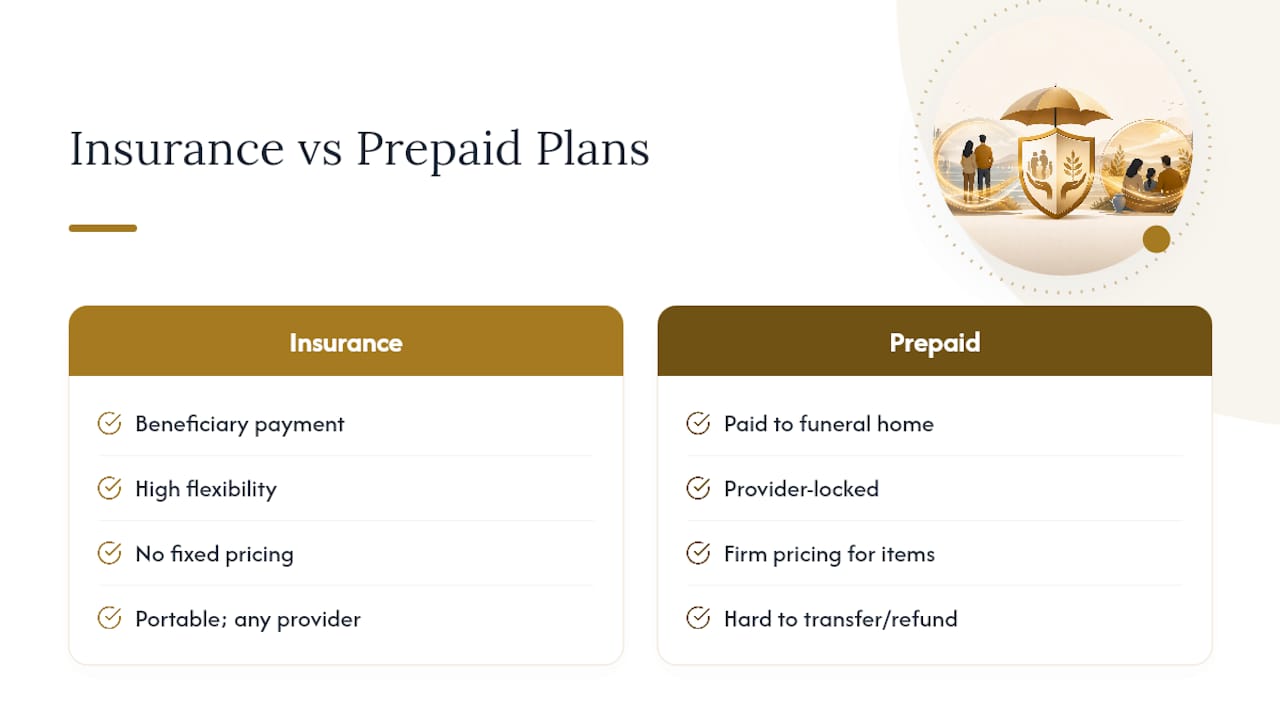
Funeral insurance, sometimes called final expense insurance, is a small life insurance policy. You pay a monthly premium, and upon death, the payout goes to whoever you name as beneficiary, who then uses it however they choose, including paying a funeral home. The advantage is flexibility: no funeral home is tied to the policy, and the money can cover any provider or any use.
A prepaid funeral plan works differently. You pay a specific funeral home directly, in advance, for specific goods and services locked into that contract. The advantage is price certainty for those exact items. The risk is that if the funeral home closes, changes ownership, or you move out of the area, transferring or refunding those funds can be complicated, and not all state laws protect prepaid funds the same way.
For most families, insurance offers more flexibility and less risk of losing money to a business that no longer exists when the time comes. A prepaid plan can still make sense if you’ve chosen a provider you trust for the long term and want firm pricing today. Either way, read the contract’s refund and transfer terms before signing, and ask whether funds are held in a state-regulated trust.
What Other Costs Come Up Beyond the Funeral Home and Cemetery?
Several smaller expenses add up outside the main GPL and cemetery estimate, and families are often blindsided by them because no single provider bundles them in.
Obituary notices published through a newspaper or online platform typically carry their own fee, separate from anything the funeral home charges for writing or displaying one. Flowers, whether ordered through the funeral home as a cash advance item or purchased directly from a florist, vary widely by arrangement size. Certified copies of the death certificate cost a per-copy fee through the county recorder, and most families need several copies for banks, insurers, and the Social Security Administration.
Transportation beyond the basic hearse, such as additional family cars or limousines for a larger group, is billed per vehicle. If a burial happens outside the immediate area, transporting remains across county or state lines can involve permits and additional paperwork the funeral home typically handles for a fee.
None of these costs are hidden if you ask upfront, but they rarely appear on the initial estimate a family sees. Asking your funeral director for a complete list of “everything not already on the GPL” before you finalize plans is the simplest way to avoid a surprise final bill.

Do Digital Memorials Add to or Reduce Funeral Costs?
Online memorial pages, livestreamed services, and digital guest books have become common additions rather than replacements for in-person services, and their cost impact runs in both directions.
On the savings side, a digital memorial lets out-of-town family attend without travel costs, and some families use a livestream in place of a second in-person gathering, cutting an entire facility-use fee. On the added-cost side, some funeral homes charge separately for livestreaming equipment, hosting, or a permanent online memorial page, so this isn’t automatically free just because it’s digital.
Families arranging services from a distance also benefit from being able to complete paperwork and selections online rather than through repeated in-person visits, which saves time without changing the core price of goods and services chosen.
An Editorial Take on Getting a Straight Answer About Burial Costs
The conventional advice on burial costs treats the national median as if it’s a price you can expect to pay. It isn’t. It’s a blended figure built from thousands of different combinations of embalming, caskets, facility time, and cemetery fees, and no single family’s bill looks exactly like it.
What the research actually supports is narrower and more useful: two separate bills exist, funeral-home and cemetery, and almost every dollar of confusion in this industry comes from families not realizing that. The FTC gave every American the legal right to an itemized GPL decades ago, yet most families still don’t ask for one until they’re already sitting across from a funeral director, mid-decision, with a grieving family behind them.
Prioritize the paperwork before the emotion takes over the negotiation. Ask for the GPL. Ask the cemetery for its own written estimate. Compare both before you agree to anything. That single habit does more to control cost than any tip about caskets or embalming ever will.
— Steve Olsher
How Bravo Family Mortuary Makes This Breakdown Simple
You shouldn’t have to decode a price list during one of the hardest weeks of your life. A family-owned funeral home serving San Diego County with transparent pricing shown upfront, no hidden fees, and no pressure to buy more than your family needs.

Whether you’re arranging direct cremation, aquamation, traditional burial, or green burial, Bravo Family Mortuary lists every cost clearly on its pricing page so you can compare it against any other provider’s General Price List using exactly what this article taught you to look for. Arrangements can be completed entirely online, any hour of the day or night, through a secure portal, and bilingual staff are available. Veteran families may receive assistance coordinating VA burial benefits paperwork. Explore funeral and cremation services or burial service options whenever you’re ready to see real numbers instead of estimates. We are here whenever you are ready.
This article is general information, not a substitute for advice from a qualified financial advisor. Consult a qualified financial professional about your own circumstances before acting on anything here.
Sources
- Funeral costs and pricing checklist | Federal Trade Commission
- Complying with the Funeral Rule | Federal Trade Commission
- Average Funeral Cost by State (Asurgo) — analysis of 1,000+ price lists (2026)
- National Funeral Directors Association (NFDA) — statistics and median cost reporting