
Arrange a Funeral Entirely Online: Your Step-by-Step Guide
Yes, you can arrange a funeral entirely online — from the first phone call or portal login to the return of your loved one’s ashes or the scheduling of a burial. You do not need to visit a funeral home in person, and you do not need to sign anything by hand. Here is how to start right now.
Immediate next steps:
- Gather the key documents you will need (listed in the next section).
- Confirm who is the authorized decision-maker, typically the next of kin.
- Open the PartingPros secure portal or call Bravo Family Mortuary at any hour — arrangements are available 24/7.
- Request the General Price List (GPL). Under the FTC Funeral Rule, every licensed funeral provider must give you one on request, and you are never required to buy a package.
- Decide on disposition: direct cremation, cremation with a memorial, aquamation, traditional burial, or green burial.
Bravo Family Mortuary is a licensed, family-owned funeral home serving all of San Diego County. We are here whenever you are ready.
Table of Contents
- Why do families choose to arrange funerals online?
- What documents and information should you gather first?
- How arranging a funeral entirely online actually works
- What do funeral costs look like, and what are your rights?
- How do you protect your personal information when arranging online?
- What legal forms does an online provider handle for you?
- How do you set up a virtual memorial or livestreamed service?
- What is the typical timeline when you arrange online?
- How do you choose a trustworthy online funeral provider?
- Why a local, family-owned provider makes a difference
- Key Takeaways
- What a funeral director wants you to know about arranging online
- Bravo Family Mortuary handles everything online, so you don’t have to
- Authoritative sources used in this guide
Why do families choose to arrange funerals online?
The shift toward digital funeral arrangements is not just about convenience. For many families, it is about reclaiming a sense of calm during one of the most disorienting weeks of their lives.
- Privacy. You can review options, compare prices, and make decisions without sitting across from a salesperson in a showroom.
- Time to decide. Online portals let you pause, consult relatives, and return when you are ready—no appointment pressure.
- Cost transparency. Seeing itemized pricing on a screen, side by side, makes it far easier to stay within budget. Industry reporting highlights that the median cost of a funeral with viewing and burial in the U.S. is around $8,300, while a funeral with viewing and cremation has a median cost of approximately $6,280, reflecting the different service components involved. Knowing those numbers before you speak with anyone changes the conversation.
- Remote participation. When family members are spread across states, a shared online portal means everyone can review the same GPL, discuss options by video call, and sign documents from wherever they are.
- Lower pressure. Moving arrangements online reduces the impulse to upgrade or add services you did not plan for, because you have time to think.
Bravo Family Mortuary’s PartingPros portal is available around the clock, with bilingual Spanish support and all-inclusive pricing posted before you commit to anything.
Statistic to know: Cremation rates in the United States have been rising steadily for years, and direct cremation — which can be arranged entirely online or by phone — is one of the most common choices families make today.
What documents and information should you gather first?
Completing an online arrangement in a single session is possible if you have the right information ready. Missing one item can delay the death certificate filing by days, so it pays to gather everything before you open the portal.
Essential documents:
- Legal pronouncement of death (from a physician, hospice nurse, or coroner)
- Photo ID for the authorized signer (the person completing the arrangement)
- Social Security number of the deceased
- Full legal name, date of birth, and place of birth
- Next-of-kin contact information for all immediate family members
- Veteran’s discharge papers (DD-214) if applicable
- Cemetery or crematory preferences, if already chosen
- Life insurance policy information, if you plan to assign benefits
What the portal will ask for:
- Time and place of death
- Clothing or jewelry preferences (for viewing or burial)
- Service preferences: direct cremation, cremation with memorial, burial, or green burial
- Obituary text, if you want one filed or published
- Preferred dates for any service or memorial
- Payment method (credit card, bank transfer, or insurance assignment)
Who can authorize arrangements? California law sets a clear priority order for who holds the right to control disposition. A surviving spouse or registered domestic partner comes first, followed by adult children, then parents, then adult siblings, and so on down the line. California Health and Safety Code Section 7100 governs this in full detail. If the person with priority cannot be reached within seven days, that right passes to the next in line.
If authority is unclear: Do not wait and hope it resolves itself. Contact the funeral home directly. A licensed provider can walk you through the legal options, including petitioning the court if family members disagree — a process outlined in California Health and Safety Code Section 7105.
State rules vary. If the death occurred outside California, the rules of that state apply for the initial paperwork, though a California-licensed provider can still coordinate the transfer.
How arranging a funeral entirely online actually works
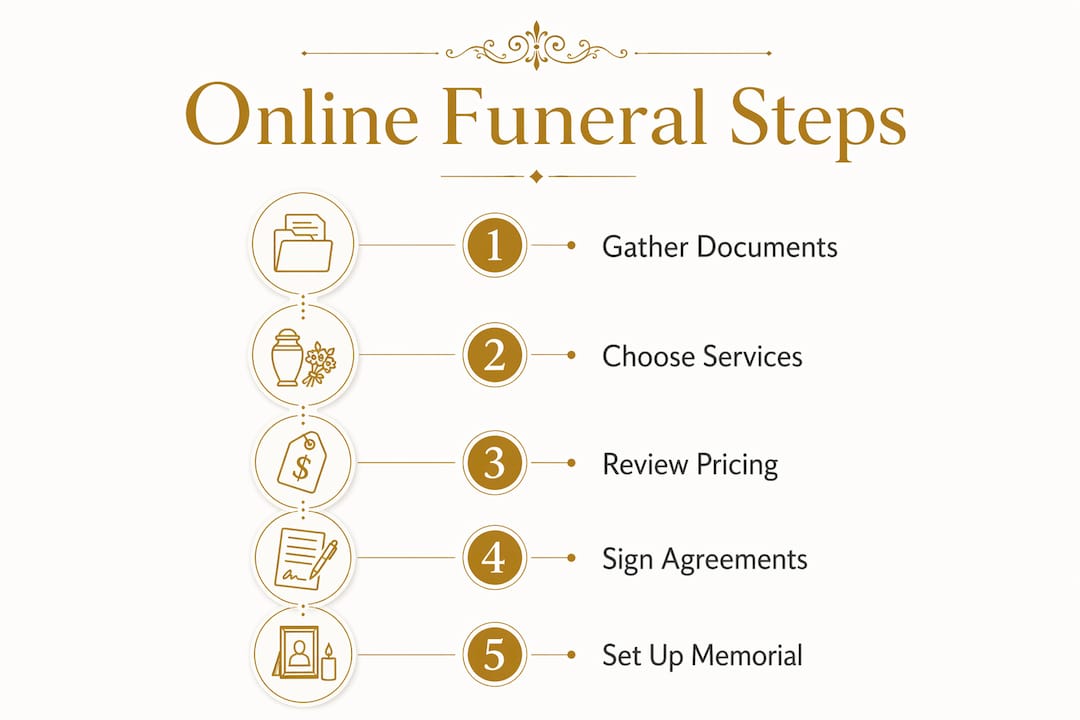
The process has eight clear steps. Timelines below are typical for San Diego County; your county’s registrar and the medical examiner’s office can affect the pace.
- Initial contact and identity verification. Call or log into the portal. The provider confirms your identity and your relationship to the deceased. This usually takes less than an hour.
- Authorization forms and digital signatures. You sign the cremation authorization or burial authorization electronically. Most providers accept scanned signatures or e-signatures through the portal; physical pickup is rarely required.
- Choose disposition and service options. Select from direct cremation, cremation with a memorial, aquamation, traditional burial, or green burial. Review the GPL line by line before confirming.
- Transfer and care of the deceased. The provider dispatches a licensed transfer team. Transfer from a hospital, hospice, or residence typically happens the same day or within 48 hours.
- Permits and death certificate ordering. The funeral home files for the disposition permit and orders certified copies of the death certificate on your behalf. Order more copies than you think you need — banks, insurers, and the VA each require their own original.
- Payment and contract signing. Review the itemized contract online. Pay by credit card or bank transfer. Save a PDF of every document, including the GPL and payment confirmation.
- Cremation, burial, or transfer. For direct cremation, the process itself typically takes 3–10 days from the time paperwork clears, depending on medical examiner involvement and county processing times.
- Return of remains or memorial scheduling. Ashes are returned by courier or in-person pickup, usually within a few days of cremation. Memorial or celebration-of-life scheduling can happen weeks or months later, entirely on your timeline.
Pro Tip: Create a dated digital folder the moment you begin. Drop every signed PDF, the GPL, payment receipts, and permit confirmations into it. If a question arises later, you will have a complete paper trail without searching your email.
What do funeral costs look like, and what are your rights?
The FTC Funeral Rule gives you three core rights: the right to receive an itemized GPL on request, the right to buy only the specific goods and services you want, and the right to decline any package. No licensed funeral provider can legally require you to purchase a bundle.
Typical line items to expect:
- Professional services fee (non-declinable, covers overhead and licensing)
- Transfer of remains
- Refrigeration or embalming (embalming is rarely legally required)
- Basic container or urn
- Crematory or facility fee
- Certified death certificates (per copy)
- Cemetery or interment costs (if applicable)
- Obituary filing or memorial page fees (optional)
| Service | Typical price range (U.S.) |
|---|---|
| Funeral with viewing and burial | ~$8,300 (median) |
| Funeral with viewing and cremation | ~$6,280 (median) |
Median figures sourced from industry reporting. San Diego County prices may differ; request Bravo Family Mortuary’s current pricing for exact figures.
Pro Tip: Request itemized quotes in writing before authorizing anything. Confirm that the GPL you received by email or portal matches the quote you were given verbally. If numbers differ, ask for a written explanation before signing.
You are also entitled to bring your own urn or container. A provider cannot charge a handling fee for using a container you supply, as long as it meets the crematory’s specifications.
For a deeper look at reading a GPL line by line, Bravo Family Mortuary’s guide to transparent funeral pricing walks through each item in plain language.
How do you protect your personal information when arranging online?
Funeral arrangements require sensitive data: Social Security numbers, death certificates, payment details, and family contact information. Verifying the security of any online portal before you enter that information is not paranoia. It is good practice.
Security checks to run before you start:
- Confirm the site uses HTTPS (look for the padlock icon in your browser’s address bar).
- Read the privacy policy. It should state clearly what data is collected, how it is stored, and whether it is shared with third parties.
- Check whether the portal uses two-factor authentication or secure email confirmation for document uploads.
- Verify that the provider asks only for information genuinely needed to complete the arrangement — not more.
Payment safeguards:
- Pay by credit card when possible. Credit cards offer fraud protection and chargeback rights that wire transfers and prepaid cards do not.
- Save every receipt and note the merchant descriptor that appears on your statement.
- Confirm the refund and cancellation policy in writing before payment.
Red flags that should give you pause:
- Vague or missing pricing — no GPL available online or on request
- Requests to wire money or pay via gift cards or cryptocurrency
- Pressure to sign documents immediately, before you have read them
- Inconsistent contact information across the website and portal
- No physical address, no license number, and no verifiable local presence
Bravo Family Mortuary’s PartingPros portal is a secure, encrypted arrangement platform. The privacy policy is publicly available, and no payment is collected before you have reviewed and signed the itemized contract.
What legal forms does an online provider handle for you?
A licensed funeral home handles most of the legal paperwork on your behalf. Understanding what each form is helps you know what to expect and when.
Common legal forms in a California funeral arrangement:
- Death certificate: The funeral home prepares and files the death certificate with the local registrar. You order certified copies through the provider; each institution (bank, insurer, VA) typically requires its own original.
- Cremation authorization: Signed by the authorized next of kin. Required before any cremation can proceed. Digital signatures are accepted in most California counties.
- Disposition permit: Issued by the county registrar after the death certificate is filed. The funeral home obtains this on your behalf.
- Burial permit: Required for ground burial; also obtained by the funeral home.
- VA paperwork: For veteran families, the provider coordinates burial benefits applications and flag requests at no additional charge.
How signatures work online: Most providers accept e-signatures through the portal or scanned copies uploaded securely. In rare cases, a physical signature may be required by a specific county registrar; your provider will tell you if that applies.
Special cases that extend timelines: If the death was unattended, unexpected, or occurred under circumstances requiring investigation, the county medical examiner or coroner must review the case before the funeral home can proceed. This can add days or weeks to the timeline. The funeral home cannot begin cremation or burial until the medical examiner releases the remains.
California allows families to arrange final disposition without a licensed funeral director in certain scenarios, but the family must personally file the death certificate and secure all permits. As Nolo explains, those filing responsibilities are complex enough that most families find professional coordination far less burdensome.
For a fuller picture of remote funeral planning and how providers coordinate with registrars and healthcare facilities, Bravo Family Mortuary’s guide covers the process step by step.
How do you set up a virtual memorial or livestreamed service?
A virtual service is not a lesser version of an in-person gathering. For families spread across the country, it is often the only way everyone can be present. The technology is straightforward; the planning is what makes it meaningful.
Common platform options:
- Integrated portal livestream: Some arrangement platforms include a built-in livestream link that guests access with a private code.
- Zoom: Reliable for smaller gatherings; allows breakout rooms for family conversations after the service.
- YouTube private livestream: Good for larger audiences; the link can be shared by email and the recording stays accessible afterward.
- Dedicated memorial platforms: Services like Memory Keep let families create a permanent memorial page, collect tributes, and share photos and videos in one place.
Checklist for a successful virtual service:
- Test your internet connection and device camera at least 24 hours before the service.
- Designate one person as the technical moderator — someone who is not also delivering a eulogy.
- Do a full rehearsal with at least one remote participant the day before.
- Set up a recorded backup so the service is preserved even if a viewer’s connection drops.
- Send guests a clear start time, time zone, and the link at least 48 hours in advance.
- Prepare a simple order of service document guests can follow along with.
What families can arrange entirely online:
- Prerecorded video tributes from relatives who cannot speak live
- Remote speakers joining by video during the service
- A photo slideshow set to music, shared via screen share
- A donation link in memory of the deceased, embedded in the memorial page
- Online condolence messages collected through a memorial page or shared document
Bravo Family Mortuary can coordinate the livestream setup and provide a post-service recording. A celebration of life can be scheduled weeks or months after the cremation or burial, giving your family time to plan something meaningful.

What is the typical timeline when you arrange online?
Setting realistic expectations prevents unnecessary anxiety. Here is what most families experience, in order:
- Transfer of remains: Same day to 48 hours after the funeral home is contacted.
- Authorization and GPL review: Completed the same day in most cases, once the authorized signer is available.
- Death certificate filing: Filed within a few days of transfer; issuance by the county registrar varies from a few days to several weeks depending on the county and whether the medical examiner is involved.
- Cremation process: Typically 3–10 days from the time all paperwork clears and the disposition permit is issued.
- Return of ashes: Usually within a few days of cremation completion, by courier or pickup.
- Memorial or celebration of life: Entirely on your schedule, from days to months after disposition.
What commonly causes delays:
- Medical examiner or coroner hold (unattended or investigated deaths)
- Missing paperwork from out-of-state next of kin
- Holidays, when county registrar offices may be closed
- Incomplete information on the death certificate application
Practical tip: Order at least six to ten certified death certificates. Banks, mortgage lenders, the Social Security Administration, the VA, and life insurance companies each require their own. Ordering them all at once through the funeral home is faster and less expensive than ordering additional copies later.
How do you choose a trustworthy online funeral provider?
Not every provider that accepts online arrangements is equally equipped to handle them well. These questions help you verify competence before you commit.
Questions to ask any provider:
- Are you licensed in California, and can you provide your license number?
- Do you have a physical address in San Diego County?
- Is your GPL available online, and will you email it to me before I sign anything?
- How do you verify identity and maintain chain of custody for remains?
- What is your typical turnaround time from transfer to return of ashes?
- Do you coordinate VA burial benefits paperwork, and is there an additional charge?
Red flags to watch for:
- No GPL available, or pricing only disclosed after you provide payment information
- Vague timelines with no written commitment
- Requests for large non-refundable deposits to accounts you cannot verify
- No verifiable license number or physical location
- Patterns of complaints about poor communication in online reviews
A simple decision rule: Prefer a licensed, locally based, family-owned provider that offers transparent itemized pricing, handles VA paperwork, and is reachable 24/7. Local coordination matters because the provider must physically interact with county registrars, the medical examiner’s office, and transfer teams. A provider based in another state managing your arrangement remotely adds a layer of risk and delay that a local provider eliminates.
Reputable direct cremation providers explain their identification and chain-of-custody procedures clearly and provide itemized pricing before you sign. Ask specifically how they ensure the ashes returned are those of your loved one.
For a full question checklist, Bravo Family Mortuary’s guide to questions to ask a funeral home online covers every item worth raising before you authorize anything.
Why a local, family-owned provider makes a difference
Bravo Family Mortuary is a licensed, family-owned funeral home at 4427 Rainier Ave in San Diego, serving all of San Diego County 24 hours a day, seven days a week. The PartingPros portal lets families complete every step of the arrangement online, at any hour, without an in-person visit.
What Bravo Family Mortuary offers:
- Direct cremation, aquamation (water cremation), traditional burial, green burial, cremation with memorial, celebration of life, and military and veteran services
- Transparent, all-inclusive pricing with no hidden fees
- VA burial benefits paperwork coordination at no additional charge
- Bilingual Spanish and English support
- 47-plus five-star Yelp reviews from San Diego families
How a typical online arrangement works through PartingPros:
A family logs into the portal, verifies identity, and reviews the GPL before selecting direct cremation. They sign the cremation authorization electronically, confirm payment, and receive a confirmation email with every document attached. Bravo Family Mortuary handles the transfer, files the death certificate, obtains the disposition permit, and returns the ashes by courier. The family schedules a memorial at their own pace.
Trust signals that matter:
- FTC Funeral Rule compliance: GPL provided before any payment
- California state licensing
- Local physical address and verifiable license number
- VA paperwork coordination included
- Transparent pricing available at bravofamilymortuary.com/pricing
“The right to control the disposition of the remains of a deceased person… vests in [the next of kin] in the order named.” — California Health and Safety Code Section 7100. Knowing that right belongs to you is the first step toward making decisions with confidence.
Key Takeaways
Arranging a funeral entirely online is legal, secure, and fully manageable when you work with a licensed local provider that offers transparent pricing and 24/7 support.
| Point | Details |
|---|---|
| Online arrangements are fully legal | You can complete every step, from authorization to payment, through a secure portal without visiting a funeral home. |
| Request the GPL first | The FTC Funeral Rule guarantees your right to an itemized General Price List before you commit to any service. |
| Gather documents before you start | Social Security number, photo ID, DD-214 (if veteran), and next-of-kin contacts prevent delays in filing. |
| Typical cremation timeline is 3–10 days | From paperwork clearance to return of ashes; medical examiner involvement or missing documents can extend this. |
| Bravo Family Mortuary | A licensed, family-owned San Diego provider with 24/7 online arrangements, bilingual support, and transparent all-inclusive pricing via PartingPros. |
What a funeral director wants you to know about arranging online
There is a misconception that choosing to arrange a funeral online means choosing something less personal, less dignified, or somehow less caring. That has not been our experience at Bravo Family Mortuary. Families who arrange through the PartingPros portal often tell us they felt more in control, not less, because they could read every line of the contract at their own pace, ask questions without feeling rushed, and include relatives from across the country in the decision.
Dignity does not require a showroom. It requires honesty, clear communication, and a provider who treats your loved one with the same care whether you are sitting across a desk or logging in from your kitchen table at midnight. Online arrangements make it possible for more families to access that care, on their own terms and their own timeline.
We are here whenever you are ready.
Bravo Family Mortuary handles everything online, so you don’t have to
When you are ready to move forward, Bravo Family Mortuary offers a clear, no-pressure path. San Diego families can access cremation services, traditional and green burial, aquamation, military and veteran services, and pre-planning, all through a single secure portal with all-inclusive pricing posted before you commit.
Starting is simple. Open the PartingPros portal at any hour, request the GPL, and review itemized pricing before signing anything. If you prefer to speak with someone first, call us directly. Bilingual Spanish support is available around the clock. For veteran families, VA burial benefits paperwork is coordinated at no additional charge. Every step, from the first form to the return of your loved one’s remains, can be completed from home.
View the full list of services and pricing or begin your arrangement online now. We are here whenever you are ready.
Authoritative sources used in this guide
These primary sources back the facts in this guide. When in doubt, verify directly with the issuing authority.
- FTC Consumer Advice: Planning Your Own Funeral — Verify your rights under the FTC Funeral Rule, including the GPL requirement and your right to itemized pricing.
- FTC Consumer Advice: Types of Funerals — Understand the differences between direct cremation, direct burial, traditional burial, and what each typically includes.
- California Health and Safety Code Section 7100 (Justia) — The legal priority order for who holds the right to authorize disposition in California.
- California Health and Safety Code Section 7105 (Justia) — What happens when the authorized person fails to act within the required timeframe.
- Nolo: California Home Funeral Laws — State-specific guidance on arranging disposition without a licensed funeral director, including filing responsibilities.
- Memory Keep: Benefits of an Online Memorial — How online memorial pages support remote grieving and preserve a record of the service.
- Funeral Channel: How Direct Cremation Works — Step-by-step explanation of direct cremation, including chain-of-custody and typical timelines.
A note on state and county variation: Laws governing death certificates, permits, and disposition timelines differ by state and county. The information in this guide reflects California law and general U.S. federal consumer protections. Consult your local county registrar, coroner’s office, or a licensed funeral director for rules specific to your situation.